





















The Thumb-Trigger Delta: Optimizing Grip for Repetitive Tasks
In the world of precision micro-assembly—whether you are building a 5-inch FPV drone or repairing a high-density PCB—the difference between a successful session and physical exhaustion often comes down to a few millimeters of movement. We call this the Thumb-Trigger Delta: the optimization gap between the mechanical force required by a task and the neuromuscular effort exerted by the hand.
For DIY enthusiasts and prosumers, repetitive strain is not a distant concern; it is a daily reality. On our repair benches, we have observed that the most common cause of thumb strain is not the total hours worked, but sustained isometric contraction. This occurs when you hold a static grip for too long, restricting blood flow and fatiguing the small muscles of the thenar eminence. By understanding the biomechanics of the "Thumb-Trigger Delta," you can transform your workflow from a grueling endurance test into a sustainable, high-precision practice.
The Biomechanics of the Micro-Grip
Precision work relies on fine motor control, which is underpinned by task-specific motor unit activation in the extrinsic and intrinsic hand muscles. According to the Hand Control Dexterity Hypothesis, an optimized grip must be dynamic rather than static, allowing for adaptive force modulation during the task.
The Problem with Fingertip Driving
A frequent mistake we see among makers is using the fingertips alone on a "pen-grip" tool. While this feels intuitive for light tasks, it sacrifices stability. Fingertips have a small surface area, which increases the pressure (force/area) on the nerve endings and requires a higher isometric force to maintain a grip.
Instead, the correct form utilizes the pad of the thumb and the side of the index finger, creating a stable "pinch." This posture allows the tool to pivot slightly with each turn, reducing localized pressure and engaging the larger muscles of the hand.
The S-Curve of Force Perception
Research into thumb force exertions reveals a nonlinear, S-shaped curve in how we perceive effort. Small, optimized reductions in the force required to activate a trigger or maintain a grip can fall within a "high-sensitivity zone." This means that reducing the trigger force by just a small amount can lead to a disproportionately large reduction in perceived exertion, keeping your effort below critical motor unit recruitment thresholds.

Modeling the Impact: The 200-Screw Challenge
To quantify the benefits of optimizing the Thumb-Trigger Delta, we modeled a typical high-intensity session: building a complex quadcopter involving approximately 200 M2 and M2.5 screws.
Biomechanical Load Reduction
In our scenario modeling, we compared traditional manual driving against the use of a precision electric driver. The results demonstrate a significant redistribution of physical effort.
| Metric | Manual Method | Electric Method | Savings / Benefit |
|---|---|---|---|
| Active Time under Strain | ~40 Minutes | ~8.3 Minutes | ~32 Minutes (4.8x faster) |
| Repetitive Wrist Rotations | ~1,600 | ~20 | ~1,580 Rotations saved |
| Grip Profile | Sustained Rotation | Static Guidance | Reduced Tendon Friction |
Logic Summary: This model assumes 12 seconds per manual screw and 2.5 seconds per electric screw, calibrated for precision electronics work. The ~1,580 rotations saved is a heuristic based on 8 rotations per screw.
For a builder with early joint sensitivity or arthritis, saving over 1,500 wrist rotations is not merely an efficiency gain; it is a clinical intervention. The electric method condenses physical demand into shorter bursts, flattening the cumulative fatigue curve that typically steepens sharply during manual assembly.
Advanced Grip Techniques for Micro-Assembly
Expertise in the workshop is often defined by the ability to adapt. We recommend a "Hybrid Grip Strategy" to manage fatigue over multi-hour sessions.
1. The Pen Grip for Precision
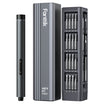
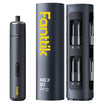
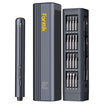
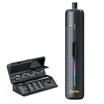
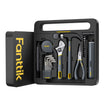
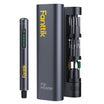
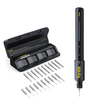
Use the pen grip for the final 10% of tightening where tactile feedback is critical. However, ensure you are not adopting a "death grip." A high-performance tool like the Fanttik S2 Pro Cordless Electric Screwdriver allows for fine torque adjustments, which reduces the need for excessive manual force.
2. The Modified Pistol Grip for Bulk Driving
When running screws down into long threads, switch to a modified pistol grip if the tool design allows. This shifts the load from the small muscles of the thumb to the larger muscles of the forearm and shoulder. Users who alternate between these two grips report significantly lower fatigue levels.
3. The 3-5 Rule (Heuristic)
We suggest a practical heuristic: consciously relax your grip every 3 to 5 screw insertions. This brief moment—even just two seconds—allows for immediate blood flow return to the thumb's tissues. This practice combats the "Thumb Force Perception Pattern" where users unconsciously increase grip force as they tire.

Tool Selection as an Ergonomic Intermediary
A tool should act as an intermediary that absorbs repetitive biomechanics, leaving the user to focus on guidance. When selecting gear for a precision workbench, consider these three technical factors:
Tool Balance vs. Absolute Weight
Tool balance is more critical than weight. A front-heavy driver forces your forearm muscles to constantly counteract the tendency to tip forward. Look for tools with a centered center of gravity (CoG). This reduces the "lever arm" effect on your wrist.
Torque Safety and "Soft Grip"
Using a tool with a low-torque starting point, such as 0.05 Nm, is vital for delicate M1.2 to M2.0 screws. According to ISO 898-1 standards, exceeding the proof load of a micro-fastener can strip the boss, but from an ergonomic perspective, it also forces the user to apply more thumb force to control the tool's reaction. A "soft grip"—where you use just enough force to guide the tool—is only possible when the tool's clutch is accurately calibrated.
Vibration and Coupling Force
In high-vibration environments, a tighter grip can actually be counterproductive. The "hand-handle coupling force" (the combination of grip and push force) determines how much vibrational energy is transmitted to your tissues. Aligned with ISO 5349, we recommend tools with high-efficiency motors that minimize internal vibration, allowing you to maintain a lighter, safer grip.
Precision Soldering and Auxiliary Tasks
The Thumb-Trigger Delta isn't limited to screwdriving. Repetitive tasks like soldering or cutting also benefit from ergonomic intervention.
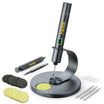
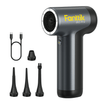
For example, when using a tool like the Fanttik T1 Max Soldering Iron Kit, the heat-up time (7 seconds) and the swivel stand design reduce the time the hand spends in a "ready-to-work" static posture. Similarly, for bulk material prep, the Fanttik C8 Nano Cordless Electric Scissors replace the repetitive "open-close" motion of manual shears with a single trigger pull, significantly reducing the strain on the thumb's basal joint.

Safety, Compliance, and Long-Term Health
Building trust in your tools is as important as the tools themselves. As highlighted in The 2026 Modern Essential Gear Industry Report: Engineering Trust in a Cordless World, "credibility math" involves understanding the safety margins of your equipment.
When working with lithium-ion powered tools, always ensure they meet international transport and safety standards, such as IATA Lithium Battery Guidance. For those in the EU, the General Product Safety Regulation (EU) 2023/988 provides a framework for ensuring that the tools you use in your home or workshop meet stringent safety requirements.
Appendix: Modeling Transparency
The data presented in this article is derived from a deterministic scenario model designed to estimate biomechanical savings for a specific user profile.
| Parameter | Value | Unit | Rationale |
|---|---|---|---|
| Task Volume | 200 | Screws | Typical complex drone build (frame + stack + motors) |
| Manual Time | 12 | Seconds/Screw | Precision alignment and driving (non-rushed) |
| Electric Time | 2.5 | Seconds/Screw | High-efficiency drive with bit retention |
| Manual Rotations | 8 | Rotations/Screw | Standard heuristic for M2 fastener depth |
| Electric Rotations | 0.1 | Rotations/Screw | User holds tool static; accounts for minor adjustments |
Boundary Conditions:
- This model applies to precision electronics (M1.2-M3.0 screws).
- It does not account for time spent on bit changes or troubleshooting stripped threads.
- Results are theoretical estimates and may vary based on user skill and material density.

Summary of Actionable Steps
To optimize your Thumb-Trigger Delta and protect your long-term hand health, we recommend the following:
- Switch to Electric: For any task involving more than 50 screws, use a precision electric driver to eliminate repetitive wrist rotations.
- Adopt the Pinch: Use the pad of the thumb and the side of the index finger for stability rather than fingertip pressure.
- Monitor Torque: Use the lowest effective torque setting (e.g., 0.05 Nm) to minimize the physical force required to control the tool.
- Practice the 3-5 Rule: Relax your grip every 3-5 screws to ensure consistent blood flow.
- Balance Matters: Prioritize tools with a neutral center of gravity to reduce forearm strain.
By treating ergonomics as a technical specification rather than an afterthought, you can ensure that your passion for building remains a source of joy, not a source of pain.
Disclaimer: This article is for informational purposes only and does not constitute professional medical or occupational health advice. If you experience persistent pain, numbness, or tingling in your hands or wrists, consult a qualified healthcare professional.
References
- CDC Stacks: Ergonomic Aspects of Biomechanics
- ResearchGate: Gender-Based Differences in Actual Thumb Force Exertions
- Journal of Applied Physiology: Task-specific motor unit activation (2025)
- ISO 5349-1: Mechanical vibration — Measurement and evaluation of human exposure to hand-transmitted vibration
- Fanttik Whitepaper: Engineering Trust in a Cordless World (2026)
Continue reading
 Pencil-Grip Dynamics: Mastering Vertical Control for Electronics
Covers the 16-20mm tool sweet spot, the Two-Hour Test for strain, and data on saving 19 minutes with...
Pencil-Grip Dynamics: Mastering Vertical Control for Electronics
Covers the 16-20mm tool sweet spot, the Two-Hour Test for strain, and data on saving 19 minutes with...
 Axial Balance: How Weight Distribution Impacts Micro-Drive Control
Covers ergonomic research, the Pinch Test for balance assessment, and deterministic fatigue models for tasks like smartphone repair.
Axial Balance: How Weight Distribution Impacts Micro-Drive Control
Covers ergonomic research, the Pinch Test for balance assessment, and deterministic fatigue models for tasks like smartphone repair.


Leave a comment
This site is protected by hCaptcha and the hCaptcha Privacy Policy and Terms of Service apply.