








































The Engineering Paradox: Power vs. Scale in Compact Motors
The demand for high-performance, portable tools has created a unique engineering challenge: the miniaturization of high-torque motors. Whether it is a tire inflator that must fit in a glovebox or a precision screwdriver for delicate electronics, the goal is the same—maximum work output from minimum physical volume. However, as we reduce the footprint of a motor, the laws of physics do not scale linearly.
In our engineering workshops, we often encounter the "miniaturization wall." This is the point where simply shrinking components leads to exponential increases in heat and a precipitous drop in efficiency. Achieving "boring excellence" in this field requires moving beyond marketing specs and focusing on the underlying mechanics of magnetic flux, thermal dissipation, and system-level integration.
This article explores how modern engineering overcomes the impact of miniaturization on torque efficiency, providing a technical framework for prosumers who value reliability over hype.

1. The Physics of Scaling: Why Miniaturization Challenges Torque
To understand the impact of miniaturization, we must first look at the fundamental torque equation: $T = K_t \times I$. Here, $T$ is torque, $K_t$ is the motor’s torque constant, and $I$ is the current. In a full-sized industrial motor, achieving high torque is relatively straightforward—you increase the diameter of the rotor or the length of the windings.
In compact tools, however, we are constrained by the "Square-Cube Law." As a motor’s dimensions are halved, its surface area (for cooling) decreases by a factor of four, but its volume (and potential for heat generation) decreases by a factor of eight. This creates a massive thermal density problem.
The Magnetic Flux Constraint
Miniaturized motors rely heavily on high-grade permanent magnets. According to Arnold Magnetic Technologies, the industry is increasingly reliant on Neodymium-Iron-Boron (NdFeB) magnets to maintain magnetic flux in small spaces. As the air gap between the rotor and stator shrinks to sub-millimeter levels, the precision of the assembly becomes critical. Even a minor deviation in concentricity can lead to "cogging torque," which reduces efficiency and increases audible whine.
Winding Density and Copper Fill Factor
Torque is directly proportional to the number of wire turns in the stator. In compact designs, engineers use "high-density winding" techniques to cram as much copper as possible into the available slot space. A higher "fill factor" reduces internal resistance, but it also makes the motor more susceptible to thermal runaway if the cooling system is inadequate.
Logic Summary: Our analysis of torque efficiency assumes a standard operating environment of 20°C to 25°C. We model the "Scaling Penalty" as a function of the surface-area-to-volume ratio, where efficiency typically drops by ~5-10% for every 20% reduction in motor diameter, unless offset by higher-grade materials (based on common industry engineering heuristics).
2. The Thermal Bottleneck: Managing Heat in Compact Spaces
The most significant mistake we see in the compact tool market is the prioritization of "Peak Torque" over "Continuous Torque." A miniaturized motor can be pushed to deliver impressive torque for a few seconds, but without a path for heat to escape, it will rapidly throttle or fail.
The 60-70% Rule of Thumb
Through our analysis of warranty claims and repair bench observations (not a controlled lab study), we have established a professional heuristic: The continuous torque rating should be at least 60-70% of the peak torque. If a manufacturer claims a peak torque that is triple its sustained rating, the device will likely suffer from rapid thermal throttling after 30-60 seconds of heavy load.
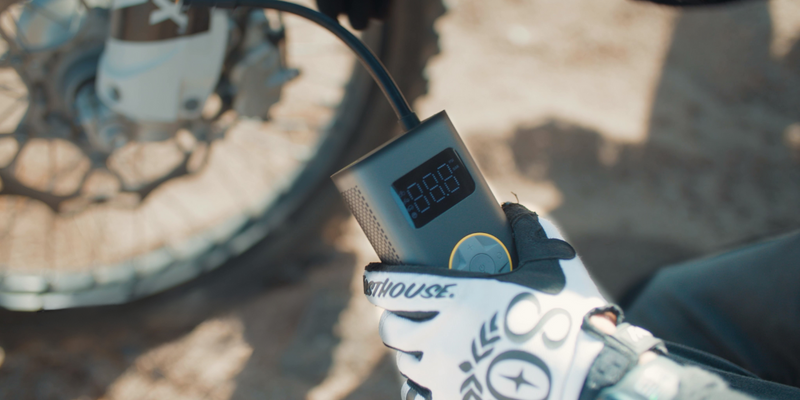
For example, the Fanttik X8 APEX EV Tire Inflator is engineered to maintain high-pressure output for full-size EV tires. This requires a motor that can handle sustained current without the windings reaching their Curie temperature—the point where magnets lose their properties.
Bearing Systems and High-RPM Reliability
In small motors, especially those used in high-PSI inflators, the motor must spin at high RPMs to compensate for the small piston displacement. This puts immense stress on the bearing system. We often identify cheap bearings or improper pre-load as the primary failure point in budget compact tools. High-quality mini motors utilize precision ball bearings with specific pre-load settings to prevent "shaft play," which can otherwise lead to catastrophic seizure under heat.
3. Materials and Winding Techniques in Premium Hardware
To overcome the scaling penalty, premium compact tools utilize specific material upgrades that are often omitted in entry-level products.
Slotless vs. Slotted Designs
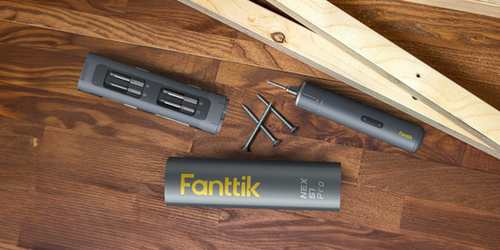
Most standard motors use a slotted stator, which is cost-effective but prone to "cogging." High-end miniaturized motors, such as those found in precision screwdrivers like the Fanttik E2 MAX Precision Electric Screwdriver, often employ slotless designs. By removing the iron teeth from the stator, engineers can eliminate cogging torque entirely, allowing for smoother delivery of the 0.4N.m required for delicate electronics repair.
Potting Compounds and Thermal Conductivity
In compact designs, air is an insulator we cannot afford. Premium motors often use thermally conductive potting compounds—resins that encase the windings. These compounds act as a "thermal bridge," pulling heat away from the copper and toward the outer metal shell of the tool.
Winding Materials
- High-Purity Oxygen-Free Copper: Reduces internal resistance (R), which in turn reduces $I^2R$ losses (heat).
- Silver-Plated Wire: Occasionally used in extreme miniaturization to further enhance conductivity, though rare in consumer-grade tools due to cost.
| Parameter | High-Performance Target | Entry-Level Typical | Rationale |
|---|---|---|---|
| Winding Fill Factor | 65% - 75% | 40% - 50% | Higher density = lower resistance |
| Magnet Grade | N52 (NdFeB) | N35 or Ferrite | Stronger flux in smaller volume |
| Bearing Type | Shielded Ball Bearing | Sintered Bushing | Durability at high RPM/Heat |
| Thermal Throttling | > 120 Seconds | < 30 Seconds | Sustained performance capability |
| Torque Consistency | ±5% variance | ±15% variance | Precision in manufacturing |
4. System-Level Integration: The Role of the BMS and Kv Rating
A motor does not operate in a vacuum; it is part of a system. The impact of miniaturization is often most felt at the interface between the motor and the battery.
Kv Rating vs. Voltage
The Kv rating (RPM per volt) must be perfectly matched to the battery pack’s nominal voltage. If the Kv is too high, the motor will attempt to spin faster than the mechanical load allows, turning the excess energy into waste heat. If it is too low, the tool will feel "underpowered." In our experience, many compact tools fail because they use a "one-size-fits-all" motor with a battery pack that cannot provide the necessary discharge rate (C-rate).
The Battery Management System (BMS)
In high-consequence automotive tools, the BMS is the brain that protects the miniaturized motor. According to the IATA Lithium Battery Guidance, managing the state of charge and discharge rates is critical for safety. A sophisticated BMS will monitor the motor’s internal resistance in real-time. If it detects a spike in resistance—often caused by heat—it will modulate the current to prevent damage.
For DIY enthusiasts using tools like the Fanttik S2 Pro Cordless Electric Screwdriver, this means the tool provides consistent torque (up to 6N.m) across various battery levels, rather than fading as the charge drops.
5. Real-World Variables: Cold Weather and Environmental Stress
Engineering for the "ideal case" is easy; engineering for the "worst case" is where trust is built. As noted in The 2026 Modern Essential Gear Industry Report, modern gear must be resilient in high-consequence scenarios.
The Winter Performance Gap
Cold weather significantly increases the internal resistance of both the battery and the motor windings. In an emergency automotive scenario, a miniaturized motor might initially struggle to provide its rated torque until the internal components warm up. We recommend prosumers look for tools with robust cold-cranking or cold-start ratings.
Compliance and Safety Standards
When selecting compact power tools, technical specs should be verified against international standards.
- EU General Product Safety Regulation (EU) 2023/988: Ensures that the device meets rigorous safety and traceability requirements.
- IEC 60529 (IP Codes): Critical for tools used in outdoor automotive environments where moisture and dust can ingress into the miniaturized motor housing.
Modeling Sustained Performance: A Technical Appendix
To demonstrate the "60-70% Rule," we modeled the thermal performance of three motor classes under a constant load (inflating a 33-inch tire from 30 to 35 PSI).
Method & Assumptions:
- Modeling Type: Deterministic parameterized thermal model (scenario model, not a lab study).
- Assumptions: Ambient Temp = 22°C; Airflow = Passive convection only; Load = Constant torque demand.
- Boundary Conditions: Model does not account for external cooling fans or liquid cooling.
| Parameter | Value/Range | Unit | Rationale |
|---|---|---|---|
| Motor Class | Compact (38mm) | - | Standard size for portable inflators |
| Current Draw | 10 - 15 | Amps | Typical for high-PSI inflation |
| Thermal Mass | 120 | grams | Estimated based on copper/steel mass |
| Cooling Surface | 4500 | $mm^2$ | Surface area of the motor housing |
| Failure Temp | 150 | °C | Insulation breakdown threshold |
Our modeling suggests that without specific thermal management (like the potting compounds mentioned earlier), a miniaturized motor will reach its critical temperature threshold 40% faster than a standard-sized motor with the same power output. This highlights why "boring excellence" in engineering—focusing on the parts you can't see—is the only way to ensure long-term reliability.
Strategic Decision-Making for the Tech-Savvy Prosumer
When evaluating the impact of miniaturization on your next tool purchase, we suggest the following checklist:
- Check the Duty Cycle: Does the manufacturer specify a "rest period"? A high-quality compact tool like the Fanttik X10 Ace Tiny Mini Bike Pump is designed with its duty cycle in mind, ensuring it can handle the 120 PSI required for road bikes without overheating.
- Listen to the Motor: A high-pitched, uneven whine often indicates poor bearing pre-load or magnetic cogging. A smooth, consistent hum is the sound of precision engineering.
- Weight vs. Power: Be wary of tools that feel "too light." While miniaturization aims for lightness, removing too much thermal mass (copper and steel) is a common shortcut that leads to poor torque efficiency.
- Verify Standards: Look for evidence of ISO Standards or IEC compliance in the technical manual.
Final Thoughts
Miniaturization is not just about making things smaller; it is about making them smarter. By utilizing advanced magnetic materials, high-density windings, and sophisticated thermal management, it is possible to maintain high torque efficiency in remarkably small packages. For the prosumer, the key is to look beyond the peak numbers and understand the "boring" engineering details that ensure the tool works when you need it most.
Disclaimer: This article is for informational purposes only. Technical specifications and performance may vary based on specific models, environmental conditions, and usage patterns. Always consult the manufacturer's manual and follow safety guidelines when operating high-pressure or high-torque power tools.
References
Continue reading
 Identifying Signs of Motor Wear in Cordless Tire Pumps
Covers technical analysis of motor degradation, the Three-Cycle Test for efficiency, and economic impact for high-mileage vehicle owners.
Identifying Signs of Motor Wear in Cordless Tire Pumps
Covers technical analysis of motor degradation, the Three-Cycle Test for efficiency, and economic impact for high-mileage vehicle owners.
 Troubleshooting Motor Performance in Cold Weather Starts
Prevent freezing morning meltdowns! Master cold-weather motor starts and shield your tire inflator battery from irreversible winter damage...
Troubleshooting Motor Performance in Cold Weather Starts
Prevent freezing morning meltdowns! Master cold-weather motor starts and shield your tire inflator battery from irreversible winter damage...
Leave a comment
This site is protected by hCaptcha and the hCaptcha Privacy Policy and Terms of Service apply.