


























The Hidden Cost of Accessory Disorganization
In the context of urban making—where a workshop might consist of a single shelf or a fold-out desk—the "search tax" is the most significant drain on productivity. For a precision electronics repair or a furniture assembly project, the loss of a single 4mm hex bit or a specialized Torx driver does not just delay the task; it often stalls it entirely. Practitioners consistently report that the single biggest mistake in bit organization is mixing driver types (e.g., Phillips, Torx, hex) in a single compartment. This lack of categorization typically adds 15 to 30 seconds of fumbling per bit change. Over a complex project involving 60 or more fasteners, this inefficiency accumulates into significant wasted time and cognitive fatigue.
According to data from ABAX regarding tool loss in construction, workers can spend up to 38 hours annually simply searching for misplaced equipment. While an apartment-based DIYer may operate on a smaller scale, the density of precision accessories makes them even more prone to vanishing into the "workshop abyss." Engineering a system that prioritizes easy access and visual inventory management is not just an aesthetic choice; it is a foundational requirement for maintaining a functional DIY capability in limited living spaces.

Architectural Heuristics for Bit Management
Effective organization begins with a clear hierarchy. For precision accessories, we recommend a three-tier sorting strategy based on frequency of use and mechanical commonality.
1. The Primary Sort: Drive Type and Size
The most effective heuristic is to organize bits first by their drive geometry (Phillips, Slotted, Hex, Torx, Pozidriv) and then by their size. Mixing different geometries in a single tray leads to "profile fumbling," where a user repeatedly picks up a Pozidriv bit when they actually need a Phillips #2. By grouping by type, the hand develops a spatial memory of where specific bit families reside.
2. The Secondary Sort: Length and Reach
Once categorized by type, bits should be arranged by length. In cramped interior spaces, the choice between a standard 25mm bit and an extended 50mm bit is often the difference between success and a stripped screw head. For guidance on navigating these tight areas, see our guide on Mastering One-Handed Operation in Cramped Interior Spaces.
3. Tray Depth and Piling Prevention
A common oversight in small-scale workshops is using containers that are too deep. If you are using drawer inserts or compartment boxes, use shallow trays no deeper than 1.5 inches. This depth prevents "piling," where smaller bits migrate to the bottom of a stack, requiring the user to dump the entire contents to find a specific size.
Methodology Note: These heuristics are derived from time-motion study principles applied to DIY workflows. The 1.5-inch depth limit is a practical baseline designed to ensure that every bit remains in a single, visible layer (based on standard bit diameters of 1/4" or 4mm).
Hardware Selection: Trays, Strips, and Enclosures
The physical medium of your storage system must align with your environment and the sensitivity of your tools.
Magnetic Strips: The 5-lb Rule
Magnetic strips offer the fastest access speed for frequently used bits. However, a common mistake is underestimating the weight of longer driver bits or small pliers, which can cause sagging or falling. The rule of thumb for general workshop use is to select a magnetic strip with a holding force of at least 5 lbs per square foot.
A Critical Warning on Magnetism: While magnetic holders are convenient, they carry a hidden long-term cost. Research suggests that strong permanent magnets can irreversibly demagnetize certain bits or, conversely, impart a magnetic charge that attracts metallic dust and debris. This contamination poses a significant risk when working with sensitive electronics or high-vibration machinery. In such cases, a positive-locking enclosed case is often a safer alternative.
Enclosed Systems for High-Vibration and Mobile Use
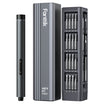
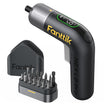
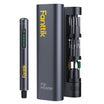
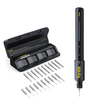
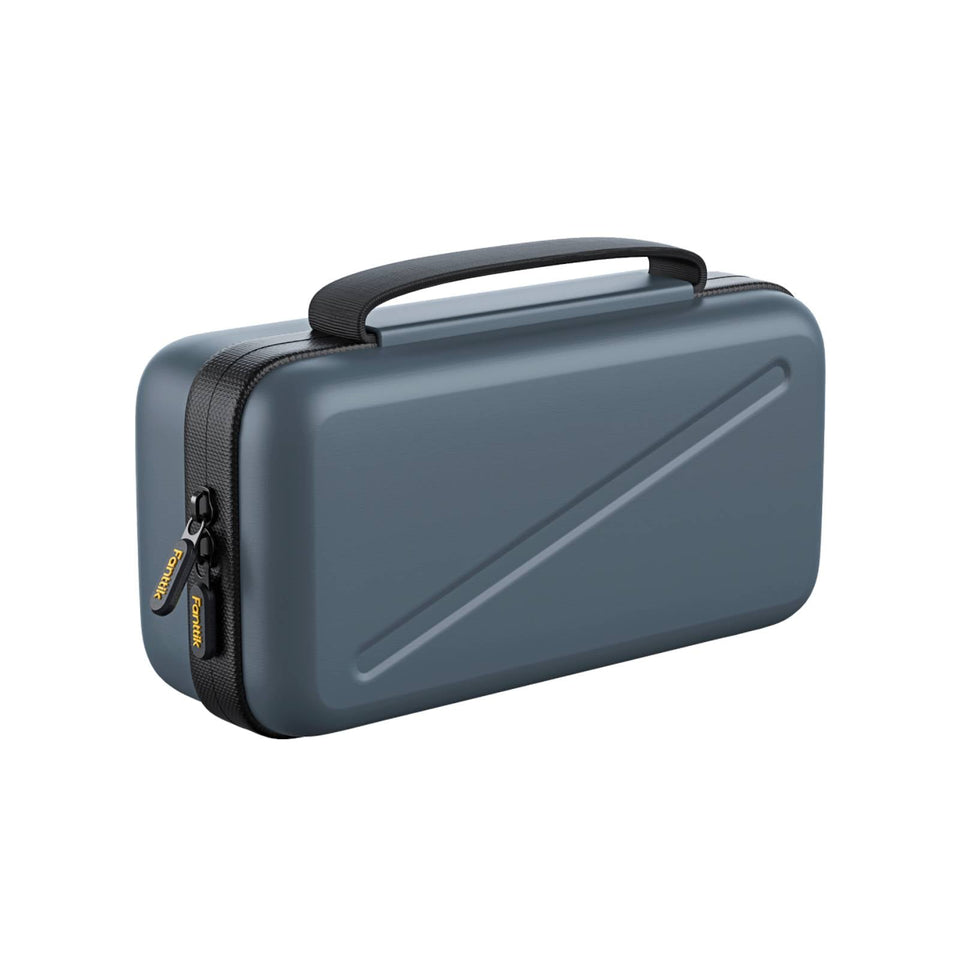
For makers who move their kits between a home desk and a vehicle, or for those working in high-vibration environments, open magnetic racks are often insufficient. In these scenarios, bits can become loose and turn into safety hazards. Enclosed, indexed cases—such as those provided with the Fanttik S1 Pro Cordless Electric Screwdriver—ensure that bits remain seated regardless of movement.
Pouches vs. Modular Walls
While wall-mounted modular systems are often seen as the "gold standard" for workshops, they are frequently impractical for apartment dwellers. For space-constrained users, a well-organized labeled pouch system can offer superior portability and flexibility without sacrificing access speed. This approach is particularly effective when Selecting Tool Footprints for Efficient Apartment Storage.
Quantitative Efficiency: The Urban Hobbyist Model
To demonstrate the impact of organized bit management, we modeled a typical project for an urban electronics hobbyist. This scenario involves a 60-screw assembly task (e.g., disassembling a modern laptop or assembling a complex 3D-printed kit).
Modeling Analysis: Organized Access vs. Disorganized Searching
| Parameter | Disorganized (Manual) | Optimized (Electric + Organized) | Unit | Rationale |
|---|---|---|---|---|
| Search Time per Bit Change | 15–30 | 2 | seconds | Practitioner observation of "fumbling" tax |
| Driving Time per Screw | 15 | 3 | seconds | Manual vs. Electric (3.7V/200 RPM) |
| Total Time for 60 Screws | ~22 | ~5 | minutes | Calculated total workflow |
| Wrist Rotations Required | 720 | 30 | rotations | 12 rotations/screw (manual) vs. positioning (electric) |
| Estimated Time Saved | -- | 17 | minutes | Net gain per session |
Methodology & Assumptions: This is a scenario model, not a controlled lab study. It assumes a standard session of 60 fasteners. Manual driving time includes a 7-second search penalty for disorganized bits. Electric driving time is based on the performance of a precision driver like the Fanttik L2 Pro Cordless Electric Screwdriver, which operates at consistent RPMs to reduce fatigue.
Ergonomic and Safety Gains
The model reveals that organizing your bits and transitioning to a powered driver saves roughly 690 wrist rotations per session. This 95% reduction in repetitive motion is vital for preventing strain during long DIY sessions. Furthermore, using a driver with precise torque settings—aligned with ISO 898 Mechanical properties of fasteners—ensures that you do not strip delicate M1.2 to M2.0 screws typically found in electronics. For more on this, explore Extending Precision Tool Life Through Proper Indoor Storage.
Material Integrity and Long-Term Preservation
Urban environments, particularly basements or poorly ventilated apartments, can be surprisingly humid. Precision bits, often made of S2 tool steel or chrome-vanadium, are susceptible to oxidation.
The Gasket-Seal Requirement
In humid environments, clear plastic compartment boxes are preferred over open magnetic systems to prevent rust. However, a common mistake is relying on simple snap-lid containers. For effective protection, containers must have tight-sealing gaskets. This creates a micro-environment that shields the bits from ambient moisture. If you already suspect corrosion, refer to our guide on Preventing Precision Bit Corrosion in Humid Storage Areas.
Opaque vs. Transparent Storage
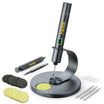
While transparent containers allow for instant visual identification, some professional practitioners argue that opaque, sealed containers are superior for long-term bit integrity. This is especially true for coated or carbide bits that may be sensitive to UV degradation or environmental contamination. A balanced approach is to use transparent lids for "daily drivers" and opaque, gasketed bins for specialized accessories like those found in the Fanttik F2 Master Cordless Rotary Tool Kit.
Implementing a Sustainable Labeling System
Written labels on small bit holders often wear off due to skin oils and friction. A more sustainable and efficient method is a simple color-coding dot system on the ends of the bits or the base of the holders.
- Green: Wood-specific bits (e.g., Brad-point or specific drill bits).
- Blue: Metal-cutting or high-torque bits.
- Red: Delicate electronics or precision-only accessories.
This visual shorthand allows for "pre-attentive processing," where the brain identifies the correct tool family before the hand even reaches for it. This technique is particularly useful when managing a high density of small parts, such as those used with the Fanttik K2 Nano 3.7V Precision Power Drill.
Optimizing the Modern DIY Workflow
True workshop efficiency is a function of "credibility math"—engineering your environment to produce predictable results. As highlighted in the industry white paper The 2026 Modern Essential Gear Industry Report: Engineering Trust in a Cordless World, trust in your tools is built through reliability and transparency. By applying methodical organization to your precision accessories, you reduce the "friction" of DIY work, allowing you to focus on the craft rather than the hunt for a missing 4mm bit.
For the urban maker, space is a luxury, but precision is a choice. Whether you are using a compact electric driver for a quick repair or a rotary tool for a detailed craft project, your storage system should be as well-engineered as the tools it holds. Start by eliminating the "fumbling tax" today: sort by type, limit your tray depth, and protect your investments from the environment.
Disclaimer: This article is for informational purposes only. When performing repairs on electronics or high-voltage systems, always consult the manufacturer's service manual and adhere to local safety regulations. Proper use of torque-limited drivers is recommended to prevent damage to delicate components.
References & Authoritative Sources
Continue reading
 Troubleshooting Precision Tool Lag in Humid Urban Flats
A guide to diagnosing and preventing tool motor lag caused by humidity and poor ventilation in urban living...
Troubleshooting Precision Tool Lag in Humid Urban Flats
A guide to diagnosing and preventing tool motor lag caused by humidity and poor ventilation in urban living...
 Understanding Safety Certifications for Indoor Precision Tools
Covers key standards like UN 38.3, expert runtime heuristics, and scenario modeling for safe crafting in confined urban...
Understanding Safety Certifications for Indoor Precision Tools
Covers key standards like UN 38.3, expert runtime heuristics, and scenario modeling for safe crafting in confined urban...
Leave a comment
This site is protected by hCaptcha and the hCaptcha Privacy Policy and Terms of Service apply.