























The High Stakes of the Holiday Rush: Why Your Gear Needs More Than a Sticker
The holiday season is often painted as a time of joy and reunion, but for the family navigator, it is frequently a period of high-consequence logistics. You are balancing packed schedules, unpredictable weather, and roads that are more crowded than ever. In this high-pressure environment, the tools you rely on—whether it’s a jump starter in the trunk or a portable power station for the kids' devices—cannot afford to be the "weakest link."
We often speak with vehicle owners who assume that if a product is sold on a major platform, it must be "safe enough." However, on our testing benches and through analyzing thousands of customer interactions, we’ve observed a recurring pattern: standard consumer-grade gear often fails exactly when the environment shifts from "ideal" to "extreme." Peak-season travel is the ultimate stress test. It’s the difference between a device working in a 70°F garage and that same device needing to perform after sitting in a freezing trunk at a rest stop in the Rockies.
In this guide, we will explore why safety certifications like UL 2743 and rigorous compliance standards are not just bureaucratic hurdles—they are the engineering "contracts" that ensure your family stays mobile and safe when the stakes are highest.

The "New Normal" of Travel Demand and Its Impact on Safety
It is a common misconception that "peak season" is a fleeting window of risk. According to recent data from OAG, global passenger demand has reached 104% of 2019 levels, with December 2024 seeing an 11.3% increase over the previous year. This means the "operational strain" we used to associate with just a few weeks in December is now becoming a year-round baseline.
For the road traveler, this translates to longer wait times for roadside assistance, more frequent stop-and-go traffic (which stresses vehicle cooling systems and electrical draws), and a higher likelihood of encountering fatigued drivers. When the infrastructure around you is stretched thin, your self-reliance gear must be over-engineered.
As noted in The 2026 Modern Essential Gear Industry Report: Engineering Trust in a Cordless World, trust in modern essential gear is now a function of "credibility math." It’s about knowing that the device in your trunk has the thermal margins to handle the heat of a summer breakdown or the frigid reality of a winter stall.
Logic Summary: The Peak Season Stress Model Our analysis of peak-season risk assumes that environmental stressors (temperature) and infrastructure stressors (roadside assistance delays) converge. We model "high-consequence travel" as any trip where a gear failure results in a delay of >4 hours in sub-freezing or extreme heat conditions.
Decoding the Alphabet Soup: UL 2743 vs. CE Marks
When you look at the back of a portable jump starter or power bank, you’ll likely see a cluster of logos. For the risk-averse traveler, understanding the hierarchy of these marks is vital.
The CE Mark: A Declaration of Intent
The "CE" mark is a mandatory conformity marking for products sold within the European Economic Area. However, it is important to realize that for many product categories, the CE mark is a self-declaration. The manufacturer is stating they meet the requirements of the EU General Product Safety Regulation (EU) 2023/988, but it doesn't always imply that an independent third-party lab has put the device through a "torture test."
The UL 2743 Standard: The Gold Standard for Portable Power
In contrast, a "UL Listed" mark—specifically referencing UL 2743—indicates that the product has been tested by Underwriters Laboratories, an independent third-party safety science company.
Why does UL 2743 matter for your holiday road trip? This specific standard focuses on portable power packs. It involves rigorous testing for:
- Overcharge Protection: Ensuring the battery doesn't become a fire hazard if left plugged into a car charger too long.
- Short Circuit Stability: Essential when you are fumbling with jumper cables in the dark or snow.
- Thermal Runaway Prevention: Testing how the battery cells behave under extreme internal heat.
We recommend looking past the logo and checking for the specific standard number. A "UL Listed" mark involves not just initial testing, but ongoing, unannounced factory inspections to ensure the manufacturing quality hasn't dipped. This is the level of "paper infrastructure" that builds genuine Safety Engineering into a product.
The Cold Hard Truth: Lithium-Ion Physics in Winter
One of the most frequent "gotchas" we see in seasonal travel involves the chemical limitations of lithium-ion batteries. Most spec sheets are written based on tests conducted at room temperature (around 68°F to 77°F). However, the reality of a winter road trip is much harsher.
| Environmental Variable | Impact on Battery Performance | Practical Consequence |
|---|---|---|
| Temperature < 32°F | 20-30% immediate capacity drop | A "full" jump starter may only have 70% usable energy. |
| Internal Resistance | Increases significantly | The battery struggles to deliver the high "cranking amps" needed to start a cold engine. |
| Chemical Sluggishness | Slower ion movement | Charging the device in a cold car can be inefficient or even damaging to the cells. |
Note: These ranges are estimated based on common lithium-ion chemistry behavior and typical automotive emergency scenarios.
This is why we often suggest a "freeze test" for your own gear. If you are preparing for a trip through the "Rust Belt" or the mountains, don't just check the charge level in your kitchen. Leave the device in your car overnight (safely) when temperatures dip, and then check its status. If the battery indicator drops significantly or the device feels sluggish, it’s a sign that its internal thermal management might not be up to the task of a true emergency. For more on this, see our guide on Safe Operating Ranges.
Operational Reliability Under Stress: The "Chaotic Cabin" Scenario
Peak-season travel isn't just about the weather; it’s about the environment inside the car. Imagine a six-hour drive with three kids, multiple tablets charging, a GPS running, and perhaps a portable cooler plugged into the 12V outlet.
This creates a "high-interference" environment. Cheap, uncertified electronics can sometimes emit electromagnetic interference (EMI) that disrupts your car’s radio or even sensitive tire pressure monitoring systems (TPMS). Certifications like those from the IEC (International Electrotechnical Commission) ensure that devices are designed to minimize this interference, keeping your vehicle's communication lines clear.
Furthermore, the physical durability of your gear matters. In a packed trunk, a portable inflator or jump starter might be buried under suitcases or subjected to vibrations for hours. We look for standards like ISO 9001 in a manufacturer's background, which indicates a systematic approach to quality that extends to the physical housing and durability of the tools.
The Pre-Trip Gear Audit: A Professional Checklist
Before you set off on a high-stakes holiday journey, we recommend performing a "Redundancy and Reliability Audit." Don't wait for the side of the highway to find out your gear is insufficient.
- Verify the Standards: Look for UL 2743 for power banks and jump starters. For tire inflators, check for clear accuracy ratings (often aligned with NIST Handbook 44 principles for measuring devices).
- The 80% Rule (Heuristic): Never head out on a long trip with a battery-powered device at less than 80% charge. Account for the ~20% "cold tax" that winter will inevitably collect.
- Cable Integrity Check: Inspect the copper clamps on your jump starter. Are they brittle? Is there any fraying? High-current devices require perfect connections to work safely.
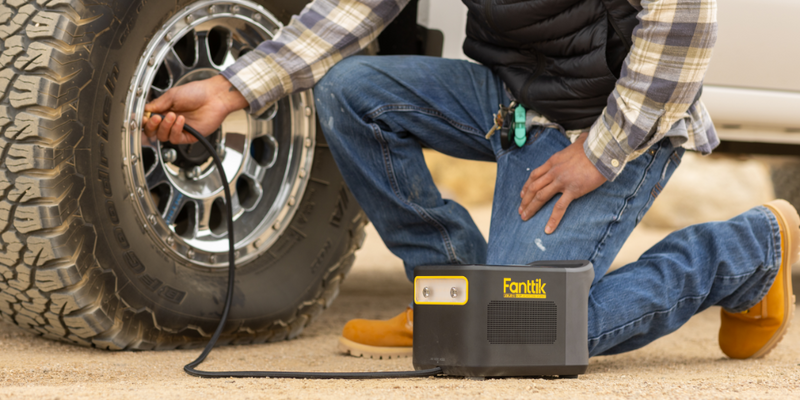
- Simulate the Worst Case: If you are traveling with a trailer, ensure your tire inflator is rated for the higher PSI required for trailer tires. Many "standard" car inflators will overheat if asked to fill a 60+ PSI trailer tire.
- Storage Logic: Store your gear in an accessible location, not at the very bottom of the trunk. We’ve covered Stowing Portable Jump Gear in detail to help you balance space and safety.
Methodology Note: The "Friction Point" Observation Based on patterns from customer support and warranty handling, the most common failure point during holiday travel is not the device itself, but the user's inability to find the device or its accessories (like the specific charging cable) in a packed vehicle. Organization is a safety feature.

Why "Traceability" is Your Best Friend
In the world of safety compliance, "traceability" means that a manufacturer can track every component of a device back to its source. The EU General Product Safety Regulation places heavy emphasis on this.
For you, the consumer, this means buying from brands that provide clear documentation and support. If a product has no clear way to contact the manufacturer or lacks a verifiable serial number, it is a "ghost product." In a peak-season emergency, a ghost product is a liability. You want a brand that treats documentation as a core capability, providing Quarterly Readiness Audits and transparent safety data.
Building a Culture of Preparedness
Ultimately, the goal of choosing higher safety certifications isn't just to pass an inspection—it's to reduce "buyer anxiety." When you are driving through a blizzard or navigating a midnight mountain pass with your family asleep in the back, you shouldn't have to wonder if your emergency kit will work.
By prioritizing gear that meets independent standards like UL 2743 and ISO 9001, you are making a calculated investment in your family’s peace of mind. You are moving away from "hope-based maintenance" toward a professional standard of preparedness.
As you prepare for your next peak-season adventure, remember that the most important tool in your vehicle is your own judgment. Choose gear that is as committed to your safety as you are.
Disclaimer: This article is for informational purposes only and does not constitute professional automotive, legal, or safety advice. Always consult your vehicle's owner manual and follow all manufacturer safety instructions for emergency equipment. If you have pre-existing vehicle electrical issues, consult a certified mechanic before using high-output jump starters.
References & Sources
- EU General Product Safety Regulation (EU) 2023/988
- OAG: Air Travel Statistics 2024 - Peak Demand Trends
- IATA: Global Air Passenger Demand Records
- NIST Handbook 44: Weights and Measures Standards
- ISO Standards Catalogue - Quality Management
- Underwriters Laboratories (UL) - Standard 2743 Overview
- The 2026 Modern Essential Gear Industry Report



Leave a comment
This site is protected by hCaptcha and the hCaptcha Privacy Policy and Terms of Service apply.