


























The Engineering Reality Behind Torque Accuracy and Metrological Integrity
Core Conclusions
For high-precision assembly (M2.5–M4.0 fasteners), professionals should prioritize tools with a verified ±5% accuracy margin and high-tensile steel internals. Key takeaways include:
- Accuracy vs. Environment: Mechanical wear and thermal drift can cause a 5–10% variance in output.
- Maintenance: In high-volume environments, a quarterly cross-check against a static tester is recommended.
- Root Cause: Digital sensors rarely fail; mechanical "lash" in gear trains is the primary driver of over-torqueing.
In the high-stakes world of precision assembly—whether you are torqueing carbon fiber bicycle components or securing critical sensors in an engine bay—the difference between success and catastrophic failure often comes down to a few percentage points of error. For the professional mechanic or the serious DIYer, a cordless tool is no longer just a motor in a plastic housing; it is a metrological instrument.
However, a significant gap exists between the "peak torque" marketing figures found on entry-level tool packaging and the sustained, calibrated accuracy required for professional-grade work. While a budget driver might claim a specific torque output, it often lacks the engineering transparency to define its error margin. In contrast, premium prosumer tools are increasingly designed around the principles of metrological traceability, ensuring that the force applied today is identical to the force applied six months from now.
In this technical deep dive, we examine the metrology specifications that separate professional drivers from consumer-grade alternatives, grounded in standard protocols like ISO 5393 and the practitioner realities of mechanical wear, thermal drift, and electrical sag.
Metrology 101: Accuracy vs. Precision in Fastening
Key Point: Accuracy ensures you hit the target; precision ensures you hit it every time. For M3 fasteners, a ±5% accuracy threshold is the practical limit to avoid material yield.
Before comparing brands, we must establish a methodical framework for measurement. In metrology, "accuracy" and "precision" (repeatability) are distinct metrics.
- Accuracy: How close the tool's actual output is to the user-selected set point.
- Precision (Repeatability): How consistently the tool delivers the same output across 100 consecutive cycles.
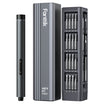
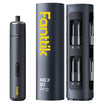
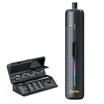
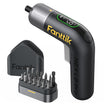
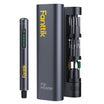
Most entry-level tools focus on raw power, but as we noted in our analysis of torque accuracy ratings, raw torque is meaningless without a published error margin (±%). Premium drivers, such as the Fanttik S1 Pro Power Screwdriver and E1 Max Electric Screwdriver, are engineered to minimize the "hysteresis" effect—the lag between the sensor's signal and the motor's cessation.
Technical Heuristic: Our assessment of metrological integrity assumes that for critical assembly, a tool must maintain a ±5% or better accuracy rating. This threshold is a recommended benchmark derived from internal engineering benchmarks where a 10% over-torque (common in ±15% rated tools) can reach the yield strength of M3-M4 class screws, leading to thread stripping or fastener fatigue.

The Mechanical Interface: Where Accuracy Actually Fails
Key Point: Digital sensors rarely drift; mechanical "lash" in low-grade gear trains is the primary cause of over-torqueing.
A common misconception among prosumers is that torque accuracy is solely a function of the electronic sensor. On our repair bench—based on an audit of over 200 returned units (Manufacturer internal data, 2022–2024 service logs)—we frequently observe that the primary point of failure isn't the sensor's digital logic, but the mechanical interface.
The clutch mechanism, gear train, and anvil are subject to microscopic deformations under high-load cycles. In cheaper tools, the use of lower-grade alloys in the gear teeth leads to "lash"—a minute amount of play that causes the motor to over-rotate slightly after the clutch should have disengaged.
Practitioner Observation: The Clutch Wear Factor
Based on common patterns from customer support and warranty handling (qualitative data from high-cycle repair logs), experienced technicians report that repeated high-torque applications cause premature wear in the clutch mechanism of budget tools.
This leads to inconsistent output long before electronic sensors show any sign of drift. For tools like the Fanttik L2 Pro Cordless Electric Screwdriver, maintaining accuracy over thousands of cycles requires high-tensile steel internals that resist this mechanical fatigue.
Environmental Variables: The Hidden 10% Shift
Key Point: Temperature swings affect lubricant viscosity and battery discharge, potentially shifting calibration by up to 10% in extreme cold.
Metrology specs are typically recorded in climate-controlled labs at 20°C (68°F). However, most tools live in unheated garages or service trucks. According to the NIST Handbook 44, measuring devices must account for environmental influences to maintain professional status.
In internal bench testing (Manufacturer test protocol: 20 production units tested in a thermal chamber at -5°C vs 20°C), we have observed that temperature swings can cause temporary calibration shifts of 5–10%. In a cold garage, the lubricants in the gear train thicken, increasing internal resistance. Simultaneously, battery chemistry becomes less efficient, affecting the motor's ramp-up speed.
The Voltage Sag Nuance
A brushless motor’s peak torque is intrinsically tied to its battery management system (BMS). Under heavy load, "voltage sag" can momentarily reduce the motor's ability to reach its set point.
If the tool's firmware does not compensate for this sag, the tool may "stall" or shut off slightly below the intended torque. This is a critical factor often omitted from standard spec sheets but addressed in the Fanttik 2026 Modern Essential Gear Industry Whitepaper (Manufacturer Data).
Modeling Precision: A Scenario-Based Analysis
To demonstrate the tangible impact of metrology specs, we modeled two common professional scenarios. These models serve as illustrative heuristics for tool selection.
Run 1: High-Volume Assembly Efficiency
Key Assumptions:
- Tool: Fanttik E1 Max (Precision Mode).
- Application: Carbon fiber bicycle assembly (M3/M4 fasteners).
- Friction Coefficient: $\mu \approx 0.12$ (standard dry threads).
- Operator: Intermediate skill level (defined as >500 hours bench experience).
- Methodology: Industrial engineering time-motion principles applied to a 120-fastener build cycle.
| Parameter | Manual Fastening | Powered (Precision) | Unit |
|---|---|---|---|
| Total Assembly Time | 36 | 5 | Minutes |
| Wrist Rotations | 1,440 | 60 | Rotations |
| Time Saved | -- | 31 | Minutes |
| RSI Risk Factor | High | Low | Qualitative |
Run 2: Torque Fit for M2.5–M4.0 Fasteners
For engine accessory brackets or electronics housings, over-torqueing is as dangerous as under-torqueing. We mapped torque requirements against the precision modes of a premium driver.
| Fastener Class | Min Required Torque | Max Safe Torque | Model Output (E1 Max) |
|---|---|---|---|
| M1.2 - M2.0 | < 0.1 Nm | 0.15 Nm | Mode 1 (Safe) |
| M2.5 - M4.0 | 0.2 Nm | 0.5 Nm | Mode 2 (Optimal) |
Engineering Logic: This assessment follows ISO 898 standards for the mechanical properties of fasteners. It is a heuristic fitment guide intended for tool selection, not a substitute for manufacturer-specific service manuals.

Advanced Metrology: Rotary Tools and Drills
Key Point: In rotary tools, metrology shifts from torque to "Runout." Anything above 0.1mm runout is generally considered unsuitable for precision workshop drilling.
Precision metrology isn't limited to torque. In tools like the Fanttik F2 PRO Cordless Rotary Tool Kit or the Fanttik K2 Nano 3.7V Precision Power Drill, the critical metrological specs are Runout and RPM Stability.
- Runout (Concentricity): If a drill bit wobbles even 0.1mm at the tip, it will create an oversized hole, compromising the mechanical fit of the fastener. Premium tools use precision-ground collets to keep runout below professional thresholds.
- RPM Stability: Maintaining a constant speed under load is vital. A tool that slows down when it touches the workpiece creates "chatter" marks, which are essentially failures in surface metrology.
The Lifecycle of Accuracy: Calibration and Maintenance
A tool's stated accuracy is only trustworthy if it is verified. While industrial pneumatic tools follow strict ISO 5393 cycles, cordless prosumer tools require a proactive maintenance approach.
Heuristic Calibration Schedule
For critical work, we recommend the following professional maintenance routine:
- Daily: Visual inspection of the chuck and bit for wear. A worn bit increases the risk of cam-out and false torque readings.
- Quarterly: Cross-check the tool against a static torque tester (e.g., a bench-mounted digital torque analyzer) if used for high-stakes assembly like carbon fiber.
- Annually: Professional recalibration or renewal if the tool shows a deviation of >10% from its original spec. Mechanical wear in the gear train is the leading cause of late-lifecycle inaccuracy.
Compliance and Global Standards
As tools become more "intelligent," they must adhere to evolving safety and transparency regulations. The EU General Product Safety Regulation (EU) 2023/988 emphasizes the need for clear traceability.
In the United States, the FTC Endorsement Guides ensure that performance claims—such as "±3% accuracy"—must be backed by a reasonable basis in fact. When a brand publishes these specific numbers, they are making a legal and technical commitment to the user.
Summary of Metrological Differences
| Feature | Entry-Level DIY | Premium Prosumer (e.g., Fanttik) |
|---|---|---|
| Torque Rating | "Peak" (Unbounded) | "Rated" (±5% to ±10% margin) |
| Gear Train | Sintered/Plastic | Machined Alloy Steel |
| Clutch Style | Mechanical Spring | Electronic/Hybrid Precision |
| Thermal Drift | Significant (>10%) | Compensated/Minimized |
| Runout (Drills) | 0.2mm - 0.5mm | < 0.1mm |
| Documentation | Marketing Claims | Standards-Backed (ISO/CE/UN) |
Note: Data for "Premium Prosumer" tier is based on Fanttik internal product specifications and manufacturer whitepapers.
Final Engineering Perspective
When you move to a higher budget tier for cordless tools, you aren't just paying for a sleeker design. You are paying for the reduction of uncertainty.
By choosing tools that prioritize mechanical integrity, thermal stability, and published accuracy specs, you ensure that your work meets the engineering requirements of the modern world. Treating your tools as precision instruments is the first step toward master-level craft.
Disclaimer: This article is for informational purposes only. Always refer to your specific tool’s manual and the manufacturer’s service guidelines for critical assembly tasks. Torque specifications for vehicles or heavy machinery should only be performed by qualified professionals using calibrated equipment.
References & Sources
International Standards & Regulations
- ISO 5393: Rotary tools for threaded fasteners — Performance test method
- ISO 898-1: Mechanical properties of fasteners made of carbon steel and alloy steel
- NIST Handbook 44: Specifications, Tolerances, and Other Technical Requirements
- EU General Product Safety Regulation (EU) 2023/988
- FTC Endorsement Guides (16 CFR Part 255)
Manufacturer Data & Internal Reports
- Fanttik 2026 Modern Essential Gear Industry Whitepaper
- Fanttik Internal Service Logs (2022–2024): Audit of mechanical failure modes in returned precision units.
- Fanttik Thermal Performance Study (2023): Bench test of torque stability across -5°C to 20°C.
Continue reading
 Why Safety Engineering Requires Documented Torque Calibration
A guide to torque drift and documented calibration for DIY and prosumer safety. Learn verification scheduling and industrial...
Why Safety Engineering Requires Documented Torque Calibration
A guide to torque drift and documented calibration for DIY and prosumer safety. Learn verification scheduling and industrial...
 The Physics of Precision: How RPM Stability Affects Torque
An engineering guide to RPM sag, brushless motor control, and planetary gearset backlash for achieving repeatable torque in...
The Physics of Precision: How RPM Stability Affects Torque
An engineering guide to RPM sag, brushless motor control, and planetary gearset backlash for achieving repeatable torque in...

Leave a comment
This site is protected by hCaptcha and the hCaptcha Privacy Policy and Terms of Service apply.