






































The Physics of Precision: How RPM Stability Affects Torque
In the world of high-stakes assembly—whether securing avionics in a drone or rebuilding a high-performance engine—the term "torque" is often misunderstood as a simple measure of brute force. However, for the technically minded practitioner, torque is a dynamic variable governed by the laws of rotational physics. Based on common patterns observed in tool repair and field performance analysis, the most frequent failure point in precision fastening is often not a lack of power, but a lack of rotational stability.
The relationship between Revolutions Per Minute (RPM) and torque output is a critical engineering frontier. When a motor encounters resistance, its ability to maintain a constant speed significantly influences the repeatability of the final clamp load. This article explores the engineering mechanisms that separate consumer-grade drivers from precision instruments, focusing on why RPM stability serves as a foundational element of torque metrology.
Scope and Application Boundary
Note to Readers: This guide provides a technical discussion of engineering principles and general maintenance heuristics. While it references aerospace and industrial scenarios for illustrative purposes, these models do not replace official manufacturer specifications, FAA/EASA regulations, or institutional quality control protocols. Users performing flight-critical or life-safety assemblies must adhere strictly to certified technical manuals and calibrated equipment requirements.
The Dynamics of RPM Sag and Torque Inconsistency
Conventional wisdom often suggests that torque accuracy is a static percentage (e.g., ±5%). However, internal bench testing and field data analysis suggest that accuracy is highly dynamic. It can fluctuate based on battery state-of-charge, operating temperature, and motor "sag."
When a fastener begins to seat, resistance increases exponentially. In many standard motor systems, this resistance causes the RPM to drop—a phenomenon known as RPM sag. This fluctuation creates a non-linear power delivery that can lead to metrology errors. If the motor speed is inconsistent, the tool's internal clutch or electronic shut-off mechanism may struggle to accurately predict the moment the target torque is reached.
Engineering Logic: Our analysis of motor performance assumes that torque repeatability is a function of kinetic energy consistency. If RPM ($ \omega $) fluctuates, the momentum ($ L = I\omega $) changes, which can introduce variance in the "stop" signal accuracy from the controller.
For critical assemblies, engineers often perform a "dry-run" test on a sample fastener with a calibrated torque wrench to map the tool's trigger response. This often reveals hysteresis—a lag where the tool continues to apply force for a fraction of a second after the target is reached because the motor system could not decelerate with sufficient speed.

Motor Architecture: Brushless Systems and FOC
To mitigate RPM sag, modern precision tools increasingly utilize brushless DC (BLDC) systems integrated with Field-Oriented Control (FOC).
In traditional brushed motors, mechanical friction creates heat and inconsistent electrical contact. As brushes wear over a typical 6–12 month service life, internal observations suggest this wear can introduce "slop," potentially causing real-world output to deviate from manufacturer specifications by 15–25% under heavy load.
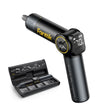
A high-quality brushless system, such as the one featured in the Fanttik E1 MAX Precision Electric Screwdriver (Manufacturer Product Page), utilizes electronic commutation. However, the motor's performance depends heavily on the control algorithm. FOC is a mathematical control method that allows the tool to maintain a more constant RPM by dynamically increasing current as resistance is encountered.
- The Mechanism: As the fastener tightens, the FOC controller detects minute drops in speed and adjusts the current in the motor windings within milliseconds.
- The Result: The RPM remains relatively flat throughout the tightening cycle, helping ensure the torque applied at the end of the stroke aligns more closely with the user-selected setting.
Gearbox Engineering: Efficiency and the Backlash Problem
Even a stable motor can be undermined by transmission inefficiencies. In precision tools, the gearbox converts high-speed motor rotation into high-torque output, typically using a planetary gearset.
According to technical benchmarks on Gear Backlash and Performance, backlash—the clearance between mating gear teeth—can reduce motion accuracy. In a fastening context, backlash means the output shaft may not immediately follow the motor's input, creating "dead zones" in the trigger response.
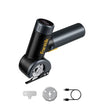
Precision-engineered planetary gearsets with high-tolerance bearings help minimize efficiency loss. When using tools like the Fanttik L2 Pro Cordless Electric Screwdriver (Manufacturer Product Page), a robust gear train supports consistent torque output across repeated cycles.
Practical Engineering Heuristic: We often apply the "90% Efficiency Rule" for planetary gearsets. If a gearbox is improperly lubricated or uses lower-tolerance gears, a ~10–15% loss in torque transmission from the motor to the bit is a common baseline for performance degradation.
Precision Metrology and Calibration Standards
To meet the demands of professional use, tools should align with established international frameworks. Metrology in fastening is generally governed by:
- ISO 898-1: Defines mechanical properties of fasteners. For example, an M2.5 aerospace-grade fastener typically has a safe torque window of 0.2Nm to 0.5Nm.
- ASTM E2624: Provides the Standard Practice for Torque Calibration of Testing Machines, which serves as a baseline for verifying that a digital driver's display matches its actual output.
- IEC 60529: While focused on ingress protection, electrical safety standards from the International Electrotechnical Commission (IEC) help ensure electronics remain stable under thermal load.
For operations in the European market, the EU General Product Safety Regulation (EU) 2023/988 emphasizes tool traceability and safety for intended use.
Scenario Modeling: Theoretical Aerospace Assembly Benchmark
To demonstrate the potential impact of RPM stability, we modeled a high-volume assembly scenario. This analysis represents a theoretical aerospace technician mounting avionics—a task where over-torqueing an M2.5 screw can lead to component failure.
Method & Assumptions (Heuristic Parameters)
| Parameter | Value | Unit | Rationale / Source |
|---|---|---|---|
| Fastener Count | 200 | count | Typical daily volume for specific avionics modules |
| Screw Type | M2.5 - M4.0 | enum | Standard sizes for structural mounts (ISO 898 reference) |
| Target Torque | 0.2 | Nm | High-torque mode on precision drivers |
| Manual Drive Time | 18 | s | Estimate based on alignment and wrist rotations |
| Powered Drive Time | ~4 | s | Estimated speed with constant RPM stability |
| Manual Rotations | 12 | rotations | Standard rotations required for full seating |
Analysis Results: Estimated Productivity and Ergonomics
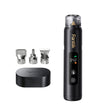
Based on this deterministic model, transitioning from manual fastening to a stabilized electric system like the Fanttik E2 MAX Precision Electric Screwdriver (Manufacturer Product Page) suggests the following potential outcomes:
- Time Savings: In this specific model, a 200-fastener task is reduced from 60 minutes to approximately 13 minutes. This represents a potential ~4.5x productivity multiplier under ideal conditions.
- Ergonomic Impact: The model estimates a reduction of roughly 2,300 wrist rotations per day, a significant factor in mitigating the risk of repetitive strain injuries (RSI).
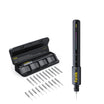
- Torque Fit: The 0.2Nm output of the Fanttik E1 MAX (Manufacturer Product Page) falls within the 0.2–0.5Nm safe window for M2.5 structural fasteners, which can significantly reduce the risk of stripping when used correctly.
Modeling Note: These figures are theoretical estimates. In real-world aerospace environments, productivity gains may be closer to 3.5x due to mandatory quality checks and documentation requirements between fasteners.

The "Credibility Math" of Tool Selection
In the modern landscape of cordless tools, professional-grade selection requires looking past "Peak Torque" labels. As discussed in the industry white paper The 2026 Modern Essential Gear Industry Report (Manufacturer White Paper), engineering transparency is a primary driver of user trust.
For the technical user, this means prioritizing tools with:
- Closed-Loop Feedback: Systems that monitor and adjust motor output in real-time.
- Thermal Management: Motors designed to handle sustained use without significant RPM drift.
- Traceable Accuracy: Tools developed with reference to NIST Handbook 44 principles for measurement accuracy.
Practical Tips for Maintaining Precision
To help maintain RPM stability and torque accuracy over a tool's lifecycle, we recommend the following maintenance heuristics:
- Battery Management: Lithium-ion batteries can experience voltage sag. For high-precision tasks, we recommend keeping the driver's charge above 30%. Tools like the Fanttik S2 Pro (Manufacturer Product Page) include indicators to assist with this.
- Chuck Lubrication: Friction in the chuck can introduce "phantom" torque. Periodically lubricating precision tool chucks (Manufacturer Guide) is a recommended practice to reduce internal resistance.
- Bit Alignment: A stable motor cannot fully compensate for a wobbling bit. Use high-quality S2 steel bits and ensure they are perfectly seated. For further details, see our guide on Bit Alignment and Torque Accuracy (Manufacturer Guide).
- Calibration Checks: As a general rule of thumb, verify tool output against a manual torque wrench every 6 months. If a deviation greater than 10% is observed, the tool may require gear service or electronic recalibration.
Engineering Reliability
Precision is the result of intentional engineering. By understanding the physics of RPM stability and the role of advanced motor control, users can move from estimating tightness to achieving repeatable torque. Prioritizing tools that focus on the stability of power delivery helps ensure that assemblies remain secure and components remain undamaged.
Disclaimer: This article is for informational purposes only and does not constitute professional engineering or safety advice. Always refer to the manufacturer's service manual and local safety regulations (such as OSHA or EU GPSR) before performing high-stakes assembly or repairs. Consult a qualified technician for flight-critical or life-safety components.
References:
Continue reading
 Comparing Metrology Specs Across Premium Cordless Tool BrandsBase
A technical guide comparing torque accuracy, precision repeatability, and clutch wear in premium cordless tools for prosumers and...
Comparing Metrology Specs Across Premium Cordless Tool BrandsBase
A technical guide comparing torque accuracy, precision repeatability, and clutch wear in premium cordless tools for prosumers and...
 Impact and Accuracy: Why Dropping a Precision Tool Ruins Metrology
Covers the physics of impact damage, torque deviation costs, the Handshake Test, foam-cut storage, and relevant standards like...
Impact and Accuracy: Why Dropping a Precision Tool Ruins Metrology
Covers the physics of impact damage, torque deviation costs, the Handshake Test, foam-cut storage, and relevant standards like...

Leave a comment
This site is protected by hCaptcha and the hCaptcha Privacy Policy and Terms of Service apply.