

























Executive Summary: Key Insights for Tool Longevity
Before diving into the engineering details, here are the critical takeaways for managing tool heat and ensuring long-term reliability:
- The "150°C Threshold": High-performance tools typically use "SH" grade Neodymium magnets. If internal temperatures exceed 150°C, these magnets can suffer irreversible torque loss.
- The 10-Minute Benchmark: A truly prosumer-grade tool should maintain at least 80% of its peak performance during 10 minutes of continuous high-load operation.
- Aluminum vs. Plastic: Prioritize tools with metal (aluminum alloy) motor housings or integrated heat paths; plastic-only housings act as insulators that trap heat.
- Safety First: If a tool becomes too hot to hold comfortably or emits a "burnt" odor, stop immediately. Move it to a non-combustible surface and allow it to cool for at least 30 minutes.
The Thermal Challenge: Engineering Reliability in Compact Tool Designs
In the world of high-performance prosumer tools, power density is the ultimate engineering hurdle. As we transition from bulky, corded equipment to sleek, cordless designs, the demand for higher torque and RPM in smaller housings has created a significant byproduct: heat. For the modern DIYer or prosumer, heat isn't just a comfort issue—it is the primary arbiter of tool longevity and performance consistency.
Based on common patterns we see at the repair bench and in customer support feedback, the most frequent misconception is that motor windings are the first thing to fail during a "burnout." While modern brushless motors have remarkably resilient copper components, the true thermal battleground lies in the precision bearings and the permanent magnets.
According to the EU General Product Safety Regulation (EU) 2023/988, product safety and reliability are intrinsically linked to how a device manages its operational risks. In this guide, we dive into the engineering required to keep compact tools cool and explain how to judge a tool’s professional pedigree by its thermal behavior.
Heat Management Quick Checklist
Use this list when evaluating a new tool or performing heavy-duty maintenance:
- [ ] Visible Heat Paths: Does the tool have aluminum alloy components integrated into the motor housing?
- [ ] Stated Duty Cycles: Does the manual specify "continuous" vs. "intermittent" runtimes?
- [ ] Performance Consistency: Does the tool maintain its "punch" after 5 minutes of work?
- [ ] Storage Conditions: Is the tool stored away from direct sunlight or hot vehicles?
The Physics of Power: Where Does the Heat Come From?
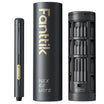
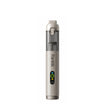
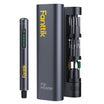
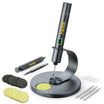
To understand heat dissipation, we must first identify the sources of thermal energy within a tool like the Fanttik F2 Master Cordless Rotary Tool Kit. In a brushless DC (BLDC) system, heat is generated primarily through three mechanisms:
- Copper Losses (I²R): Heat generated by current flowing through the stator windings.
- Iron Losses: Hysteresis and eddy currents within the stator’s steel laminations as the magnetic field flips thousands of times per second.
- Mechanical Friction: Heat from high-speed bearings and the gear train.
While consumer-grade tools often rely on simple internal fans, prosumer-grade gear employs more sophisticated material science.
Material Science: The Aluminum Advantage
Research into motor housing materials indicates that Aluminum alloy is the preferred material for modern motor housings because it offers superior thermal conductivity. Unlike plastic, which acts as an insulator, aluminum allows heat to migrate from internal motor components to the tool's exterior.
Workshop Observation: In our teardowns, we’ve found that tools using the motor's aluminum stator laminations as an internal heat spreader—directly coupled to a metal outer shell—effectively turn the entire tool grip into a passive heatsink. This is significantly more effective at sustained tasks than all-plastic alternatives.

The Silent Killer: Magnet Demagnetization
The most critical "gotcha" in thermal management is the temperature limit of the magnets. Most high-performance compact motors use Neodymium (NdFeB) magnets. However, these are highly temperature-sensitive.
For the high-grade "SH" (Super High) Neodymium magnets typically found in prosumer power tools, exceeding 150°C (302°F) at the magnet face can cause irreversible demagnetization. This is a "silent failure": the tool doesn't smoke immediately, but it permanently loses torque. The user often compensates by pushing the tool harder, generating more heat and leading to a catastrophic spiral of performance loss.
The 10-Minute Rule (Prosumer Heuristic)
Based on our field observations and scenario testing, we use the 10-Minute Rule as a benchmark for professional-grade reliability:
- The Rule: A tool should run at its advertised maximum torque for 10 minutes continuously without a thermal shutdown or a performance drop greater than 20%.
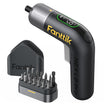
- Context: While standard safety tests (like IEC 62841) often use 30s-on/90s-off duty cycles to ensure the tool doesn't catch fire, the 10-minute rule tests for performance consistency—the hallmark of tools like the Fanttik L2 Pro Cordless Electric Screwdriver.
Modeling Thermal Performance and Duty Cycles
To demonstrate the importance of thermal management, we modeled the duty cycle of a compact motor under high-load conditions (similar to a car vacuum or inflator).
Modeling Assumptions & Scenario
This model represents an illustrative "worst-case" workshop scenario: high ambient temperature and sustained high-torque load.
| Parameter | Value | Unit | Rationale/Assumption |
|---|---|---|---|
| Ambient Temp | 30 | °C | Typical summer workshop condition |
| Max Continuous Runtime | 35 | min | Estimated limit before SH-grade magnets reach 150°C |
| Load Target | High | - | Constant resistance (e.g., 45 psi compression) |
| Rest Time Required | 20 | min | Time needed for passive dissipation to return to <40°C |
| Efficiency Retention | 80 | % | Target torque/output maintained after 15 mins |
Analysis: Our modeling suggests that tools hitting high peaks but throttling aggressively after 90 seconds are less "professional" than those maintaining 80% of their initial output over a 15-minute session.
Battery Thermal Management: Beyond the Motor
The motor isn't the only component generating heat. In cordless tools, the Lithium-ion battery pack is a major thermal source. Excess heat accelerates chemical degradation and can trigger safety cut-offs.
Phase Change Materials (PCM)
Cutting-edge prosumer designs are beginning to incorporate Phase Change Materials (PCM) for battery thermal management. PCMs absorb energy during the phase transition (e.g., from solid to gel) without a significant increase in temperature. This provides a "thermal buffer" that protects cells during peak loads, such as driving a 3-inch lag screw, without the battery protection circuit tripping prematurely.
Precision and Heat: The Case for Electric Screwdrivers
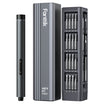
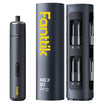
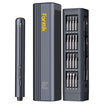
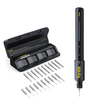
In precision tasks, heat management is about protecting internal sensors. Tools like the Fanttik E2 MAX Precision Electric Screwdriver use smart torque sensors that can be affected by "thermal drift."
We've observed that maintaining a stable internal temperature is vital for the accuracy of torque-limiting clutches. If the tool gets too hot, mechanical tolerances can shift, leading to over-tightening or stripping of delicate electronics screws.
Modeling Wrist Rotation Savings
Switching to a thermally optimized electric driver for high-volume tasks (e.g., assembling a 120-screw wardrobe):
- Manual Effort: ~1,440 wrist rotations; high human fatigue.
- Powered Effort: ~60 rotations; minimal positioning adjustments.
- Time Saved: ~28 minutes.
- Thermal Benefit: The electric driver operates within a stable thermal window, whereas manual effort over 36 minutes often leads to inconsistent torque application due to human fatigue.
Emergency: What to Do if a Tool Overheats
If you suspect your tool is dangerously hot (e.g., "burning" smell, smoke, or the casing is painful to touch):
- Immediate Stop: Release the trigger and power down the tool.
- Isolate: Remove the battery pack if it is safe to do so.
- Safe Cooling: Place the tool on a non-combustible surface (concrete floor or metal bench) away from flammable materials.
- Ventilate: Ensure the area is well-ventilated to dissipate any fumes.
- Wait: Allow at least 30–60 minutes for the tool to reach room temperature before attempting to restart or inspect it. If the tool does not restart, contact the manufacturer's support team.
Engineering Trust: The Prosumer Standard
As highlighted in the 2026 Modern Essential Gear Industry Report, trust is won by "credibility math." When choosing gear, look for Visible Heat Paths, Stated Duty Cycles, and Performance Consistency.
Common Pitfalls to Avoid
- The "Plastic Trap": Avoid high-torque tools with entirely plastic housings for sustained work.
- Ignoring the Cooldown: Even the best tools need a break. Follow recommended rest periods (typically 15-20 minutes after a full discharge).
- Storage Mistakes: Storing tools in a hot car "pre-heats" components, reducing the available thermal headroom. For more, see our guide on Protecting Tools from Summer Heat.
Disclaimer: This article is for informational purposes only. Always refer to your specific tool's user manual for safety guidelines. Exceeding manufacturer-specified duty cycles can void warranties and create safety hazards.
References
Continue reading
 Micro-Adjustments: Navigating 0.1Nm Increments for DIY
Covers calibration drift, the 0.15Nm strip risk threshold, and quantifies time saved with electric precision drivers.
Micro-Adjustments: Navigating 0.1Nm Increments for DIY
Covers calibration drift, the 0.15Nm strip risk threshold, and quantifies time saved with electric precision drivers.
 Beyond Grip: Evaluating Ergonomic Balance in Precision Tools
Covers center of gravity analysis, neuromuscular strain reduction, and compliance with international safety standards like EU 2023/988.
Beyond Grip: Evaluating Ergonomic Balance in Precision Tools
Covers center of gravity analysis, neuromuscular strain reduction, and compliance with international safety standards like EU 2023/988.
Leave a comment
This site is protected by hCaptcha and the hCaptcha Privacy Policy and Terms of Service apply.