









































Start with 24T for fast, rough ripping of dimensional lumber, 40T for general-purpose crosscuts and most ordinary plywood, and 60T for cleaner finish cuts or tearout-sensitive veneer and melamine. These three tooth counts are practical starting points from common blade application guidance, not a universal rule for every saw or wood product. Before you cut, confirm the exact blade's diameter, arbor size, and RPM rating match your saw's documentation.
Key Takeaways
- 24T is the starting choice for fast, rough rip cuts where edge appearance does not matter.
- 40T is the practical middle option for general crosscuts and most ordinary plywood.
- 60T earns its place when a visible edge, trim cut, veneer, or melamine panel is tearout-sensitive.
- Tooth count trades chip clearance and feed pace for finish quality; it does not fix a universal speed or RPM number.
- Always check blade diameter, arbor size, RPM rating, and material suitability against your saw's documentation before cutting.
Which Tooth Count Fits Your Wood-Cutting Task?
Match the tooth count to the cut you're making, not to the highest number on the blade. The table below lines up each tooth count with its strongest starting task, the finish-versus-speed tradeoff it creates, and the material condition that supports the choice.
| Tooth Count | Strongest Starting Task | Finish & Pace Tradeoff | Material or Finish Condition |
|---|---|---|---|
| 24T | Fast ripping of dimensional lumber or rough breakdown cuts | Faster feed, larger chip clearance, rougher edge | Cut edge won't be visible or finished |
| 40T | General crosscuts and most ordinary plywood | Balanced feed pace and edge quality | Mixed DIY work where one blade needs to handle several cuts |
| 60T | Fine crosscuts, trim, veneer, and melamine | Slower feed, smaller chip clearance, cleaner edge | Visible edge or tearout-sensitive panel face |
This split is directional. A wider or thicker board, a different wood species, or a specific manufacturer's blade design can shift the practical result even within the same tooth count.
What Tooth Count Changes in a Cut
Tooth count changes how much wood each pass removes and how the blade clears the resulting chips. Fewer, larger teeth cut faster and clear chips more easily, which is why a 24T blade rips through lumber quickly but leaves a rougher edge. More, smaller teeth take thinner bites and leave less material behind between passes, which produces a cleaner edge but reduces how much chip clearance the blade has at a given feed pace.
That relationship also affects how hard you can push the saw. A high tooth-count blade generally needs a steadier, more controlled feed than a low tooth-count blade doing the same rip, because there is less room between teeth to clear waste. This is a practical heuristic, not a fixed feed-rate number: wood species, board thickness, blade sharpness, and the saw's own power all affect the pace that actually works. If the saw starts to bog down, slow the feed or reassess the blade choice rather than forcing the cut.

Tooth count is also only one variable among several. Blade diameter, kerf width, tooth geometry, and the saw's RPM rating all interact with tooth count to determine the final result, so a matching tooth count alone does not guarantee the right blade for the job.
When 24T Makes Sense for Fast Ripping
Choose 24T when the job is mainly ripping dimensional lumber or breaking down stock along the grain and the resulting edge won't be visible or need finishing. The wide gaps between the 24 teeth clear sawdust quickly, which keeps the blade moving at a fast, steady pace through thick or long boards. That speed comes at the cost of a rougher edge, since fewer teeth means each one removes more material per pass.
Don't reach for 24T just because it has the lowest tooth count and sounds simple. If the cut will be a visible crosscut, a trim piece, or any edge that needs to look clean, move the shortlist toward 40T or 60T instead. The right call still depends on the exact blade's documented material use, diameter, arbor size, and RPM rating matching your saw.
When 40T Is the Practical Middle Choice
Choose 40T as the practical starting point for general-purpose crosscutting and mixed DIY wood-cutting tasks where you need one blade to handle several kinds of cuts reasonably well. It's also a workable starting point for most ordinary plywood, where a 40-tooth blade handles typical plywood cuts without excessive tearout.
That guidance shifts once the plywood has a thin decorative veneer or a melamine face. On those materials, the underside of the cut is more prone to blow out under the reduced chip clearance a 40T blade provides at a normal feed pace. If a visible edge or a delicate face matters more than cutting speed, treat that as the signal to move toward 60T instead of assuming 40T covers every sheet good. As with any tooth-count choice, confirm the exact blade and saw match before cutting.
When 60T Is Worth the Cleaner Finish
Choose 60T when a clean, visible crosscut matters more than maximum cutting speed, such as trim work, finish carpentry, or panels where the edge will show. The extra teeth take smaller bites, which produces a smoother edge but reduces the chip clearance available at a fast feed pace, so expect to slow down compared with a 24T or 40T rip cut.
Veneered plywood and melamine are the clearest supported case for choosing 60T over 40T among these three options, since thin veneer layers are prone to tearout on the underside of the cut when chip clearance is limited. That advantage doesn't carry over to rough ripping: if the task is fast breakdown work where the edge won't be seen, a 60T blade's slower practical feed pace makes it a poor fit even though it has more teeth. The material and the exact blade's documented suitability still decide the final call, not the tooth count alone.
How to Check Blade and Saw Compatibility
Before you install any blade, compare its specifications against your saw's documentation in this order: diameter, arbor or bore, rated RPM, and documented material suitability. If any one of these doesn't match, stop and choose a different blade rather than forcing the fit with an adapter or assuming it will work.

Start with the blade's outer diameter and confirm it matches the saw's documented blade size exactly. Next, check the arbor or bore against the saw's shaft requirement; an adapter does not make an otherwise unsupported blade acceptable. Then confirm the blade's rated RPM meets or exceeds the saw's operating speed, and verify the blade is documented for the wood or sheet material you're cutting, including any kerf or riving-knife relationship your saw specifies.
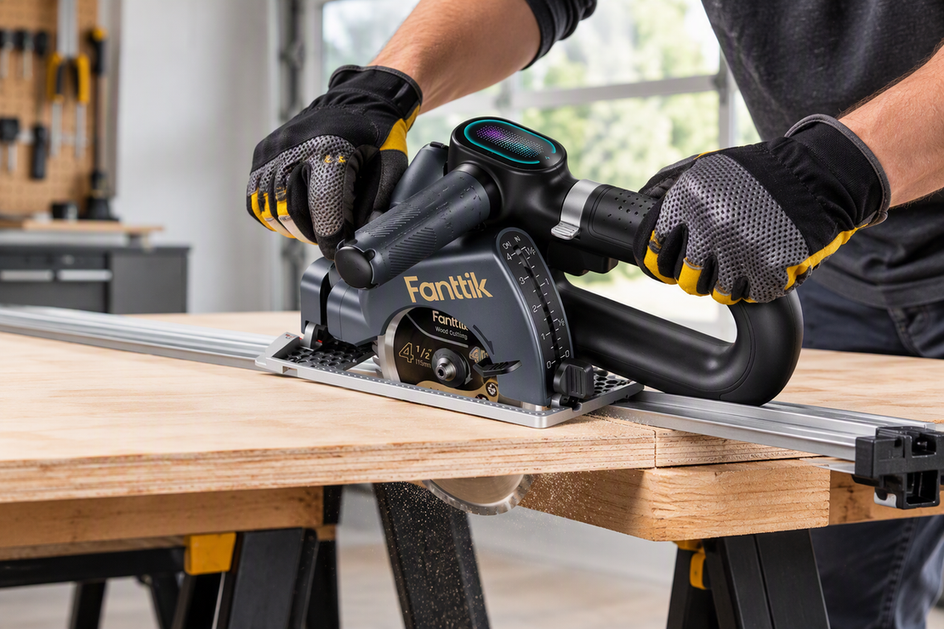
As one concrete example, our O11 Apex specifications list a 4-1/2-inch blade size, a 3/8-inch arbor hole, and a 4,700 RPM motor, with 24T and 40T blades included. Those figures confirm compatibility for that specific saw and those two included blades only; they do not establish that a 60T blade fits the O11 Apex or any other saw. Always verify the exact blade and saw documentation before use, and don't use a blade when its diameter, arbor, RPM rating, or material suitability doesn't match what the manufacturer specifies.
FAQs
Does the O11 Apex documentation confirm that I can use a 60T blade?
No. The supplied O11 Apex documentation lists 24T and 40T as the included blades, along with a 4-1/2-inch blade size, 3/8-inch arbor hole, and 4,700 RPM motor. It does not confirm a 60T blade for this saw. A shared diameter or arbor size with a 60T blade elsewhere doesn't establish compatibility on its own, so check the exact model documentation before using a 60T replacement on this saw.
Can I use the same blade for both ripping and crosscutting?
You can use a general-purpose blade like a 40T for both, but expect a tradeoff in either direction. It rips more slowly than a 24T blade and leaves a rougher edge than a 60T blade on a visible crosscut. If you regularly do both fast rip cuts and clean finish crosscuts, keeping a 24T and a 60T blade on hand and swapping based on the task gives better results than relying on one middle-ground blade for everything.
Leave a comment
This site is protected by hCaptcha and the hCaptcha Privacy Policy and Terms of Service apply.