










































A cordless battery pressure washer is worth buying only when its exact documentation supports three things at once: it can draw from the water source you plan to use, its operating pressure and flow match the task, and its runtime plus water supply can cover the session. Being cordless does not automatically mean a unit can siphon from a bucket or lake, and a high maximum PSI number does not guarantee enough water volume to rinse a patio efficiently.
Treat those three checks as gates, not preferences. If any one fails for your exact model and job, the unit is not a fit for that job, even if it works fine for a different one.
What a Cordless Pressure Washer Must Prove for Your Job
The real question is not whether a washer is cordless, but whether the exact model can pull water from your source and finish your task with the pressure and flow it actually delivers. A washer that looks capable on a spec sheet can still fall short if its documented operating pressure and flow, not its maximum PSI, are too low for the surface, or if nobody has confirmed it can draw water from your planned source at all.
Fanttik's support documentation for the NB8 model describes a specific open-water setup: submerge the weighted inlet filter fully in a bucket, barrel, or other open water, connect the hose and gun, prime until the spray stabilizes, and start on the lowest mode. That is a useful, concrete example of what a documented siphon procedure looks like, but it is scoped to that one model. The NB10 product records available for this guide list pressure modes, tank sizes, and runtime figures, but they do not include a published GPM rating, lake-water approval, or a complete siphon procedure. That gap means a remote-siphon recommendation for those models is not currently supported by the evidence on hand, and a patio job, a vehicle rinse, and a bucket-fed touch-up job can each land on a different answer depending on the exact model you're checking.
Can a Cordless Pressure Washer Siphon From a Bucket or Lake?
Use a source-by-source decision instead of a general siphon promise. A bucket or tank is acceptable only when the exact model's documentation names that source and its intake requirements; lake water needs its own explicit approval and is not covered just because a bucket works.
Bucket or tank support is not the same as lake-water approval
- A listing that mentions a bucket, bottle, or detachable tank tells you nothing about open-water or lake compatibility on its own.
- Lake water needs its own documented filtration and water-quality guidance from that exact model, because sediment and debris are different from tap or stored water.
- Never borrow another washer's intake, filter, or priming instructions. Fanttik's NB8 support page is a documented example of an open-water setup for that model only, not a universal cordless procedure, and its wording about "other open water" does not amount to explicit lake-water approval for the NB8 or any other model. Review documented NB8 setup and priming steps before testing open-water intake.
The intake details that change the buying decision
Look for the named inlet hose, filter, coupling, priming method, water-quality limit, and troubleshooting response before you trust a model with remote water. If a manual or product page is silent on any one of those, the model has not passed the remote-use test, regardless of how convenient it looks. A mismatched or worn intake connection is also a common source of leaks once you do have a supported setup, so it helps to understand hose fitting compatibility before assuming a hose or adapter will seal properly.
Fanttik's troubleshooting page for the NB8 lists the checks to run if the unit sputters or cuts out: confirm the source is full, the intake stays fully submerged, the line has no kinks, and priming has had a few seconds to work. It also warns that the pump is built to stop if it doesn't sense water moving, because running it dry can damage the seals. Check documented NB8 intake and dry-running instructions before running the pump. That guidance applies to the NB8's documented scope; treat it as a stop-and-check routine for that model rather than a rule for every cordless washer.

How Much PSI and GPM Do You Need?
PSI measures the force of the spray, while GPM measures water flow rate moving through the nozzle. A washer with strong PSI but low flow can still rinse slowly, because PSI alone does not determine total cleaning performance across a larger area.
The ranges below come from general pressure-washer guidance, not from any cordless product's specifications. Use them as starting points for the surface you're cleaning, then compare them with the exact operating PSI and GPM your candidate model documents, not its maximum PSI.
| Task or surface | PSI starting range | GPM planning band | Buying implication |
|---|---|---|---|
| Vehicles | 1,200-1,900 PSI | Not directly sourced | Favor lower pressure and a wide nozzle to protect paint |
| Wood decks and fences | 500-1,500 PSI | Not directly sourced | Start low; wood surfaces scar easily at higher pressure |
| Composite decking | 1,500-2,000 PSI | Not directly sourced | Check manufacturer pressure limits before use |
| Concrete | 2,500-4,000 PSI | Not directly sourced | Needs both higher pressure and adequate flow to clear grime |
| Light-duty general work | 1,000-1,750 PSI | 1.4-1.6 GPM | Typical starting point for smaller, delicate surfaces |
| Medium-duty (concrete, siding, asphalt) | 2,000-2,800 PSI | 2-3 GPM | Needs more flow to rinse larger areas in reasonable time |
These figures are practical starting ranges from general pressure-washer sources, not cordless specifications or safety limits. Start with a wide spray pattern and a small test area on any surface, especially wood, composite, or painted finishes, before committing to the full job.
How Battery, Runtime, and Water Volume Set Session Limits
A battery's mAh rating tells you how much energy it stores, not how many minutes of cleaning you'll get. Runtime depends on the operating mode you choose, the pressure and flow at that mode, and how often you start and stop the trigger.
Capacity is an input, not a runtime promise
Use the manufacturer's documented runtime for the mode you actually plan to run, not the battery capacity number by itself. A higher-pressure mode draws more power and shortens runtime, so the same battery can deliver very different session lengths depending on how you use it.
Match the battery to water and workload
A session ends when either the battery or the water supply runs out, whichever happens first. If a model publishes a GPM figure, you can multiply that flow rate by your expected operating minutes to estimate how much water you'll need to have on hand. When GPM or charging data is missing, don't guess at a session volume or duration; treat that gap as a reason to verify further before counting on the unit for a longer job. Repeated or larger cleaning sessions need a charging plan or a spare battery, not just a bigger capacity number.
How Portability Changes the Best Setup
Portability is a system, not a single spec. It includes the washer itself, the water source, the intake equipment, the hose, the battery, and how everything stores and travels.
Remote rinsing and short touch-up work
For a short rinse away from a spigot, prioritize a documented bucket or tank source, a simple setup, and enough runtime for one session. A compact washer isn't actually portable if the water container it needs is heavy or awkward to carry to the site.
Patios and larger surfaces
For bigger surfaces, operating pressure, flow, water replenishment, hose reach, and nozzle control matter more than headline PSI. The cordless advantage fades when you're stopping repeatedly to refill a tank or wait out a charge cycle in the middle of the job.
Storage and transport
Compare unit weight, how it folds or stores, where the hose and intake line live between uses, how you'll carry water, and where you'll charge the battery. "Portable" on its own doesn't tell you any of that; check the actual dimensions, weight, and stowed footprint.
When a Cordless Pressure Washer Is Not a Fit
Rule out a cordless unit, or change your plan, when one of these conditions applies:
- Unsupported water source: the exact model's documentation doesn't name your bucket, tank, or lake as an approved source. Change the source or the model.
- Insufficient documented flow: the operating PSI and GPM can't be compared, or the flow is clearly too low for the surface. Shorten the job or move to a higher-flow setup.
- Session exceeds runtime or water supply: the battery, charging plan, or water on hand can't cover the whole job. Shorten the session or plan a mid-job recharge and refill.
- Operating conditions outside the manual: the surface, nozzle, or water-quality limits fall outside what the exact manual allows. For the NB8's documented scope, an unsubmerged intake, a kinked line, failed priming, or no sensed water flow is a reason to stop and check, not a reason to keep running the pump.
What the Manual Must Say Before You Use It
Treat the exact model's manual as the operating boundary, not a formality to skim. If it doesn't clearly answer the checks below, don't improvise the missing step.

The pass/fail facts to confirm
- Approved water source and required intake hardware: pass if your bucket, tank, or hose setup matches what's named; fail if it isn't listed.
- Priming, filter, and water-quality instructions, plus what to do about weak flow: pass if the steps match your situation; fail if your source or symptom isn't covered.
- Nozzle, surface, and water-temperature limits: pass if your surface and water fall within the stated range; fail if they don't.
- Storage, drying, and battery charging instructions: pass if you can follow them as written; fail if your storage conditions or charging setup conflict with them.
Fanttik's NB8 support documentation, for example, calls for draining the lines and rinsing the inlet filter after use, storing the unit indoors away from frost and direct sun, and not operating it while it's charging. Review the NB8 storage and charging steps as an example of the level of detail to expect; confirm the same points against your own model's manual, and see general pressure washer hose care guidance for keeping the line itself in good shape between jobs.
Stop when the setup is outside the manual
An unclear or missing instruction is not proof that your plan is fine. If the manual doesn't explicitly support your water source, surface, or charging setup, stop and use a documented alternative instead of improvising a lake-water, dry-running, or charging workaround.
FAQs
How much water will a cordless pressure washer use in one session?
You can only estimate this when the exact model publishes a GPM figure. Multiply that documented flow rate by your expected operating minutes, then compare the result with the water you have on hand in a tank, bucket, or other container. Without a published GPM, don't estimate water use from PSI or battery capacity alone; treat the number as unverified until the model documents it.
Can I use lake water with a cordless pressure washer?
Not automatically. Bucket or tank compatibility does not extend to lake water on its own. Use lake water only if the exact model's manual explicitly names that source and states the filtration and water-quality conditions required. Fanttik's NB8 support page describes an "other open water" setup, but that wording is scoped to the NB8 and does not amount to blanket lake-water approval for that model or any other. If your model's documentation doesn't address lake water directly, choose a documented clean-water source instead.
Can a cordless pressure washer replace a corded or gas model for a large patio?
It depends on whether the documented flow, runtime, water supply, and charging plan can cover the entire session, not on maximum PSI. A cordless unit becomes a poor fit for a large or repeated patio job when refilling a tank, waiting on a battery charge, or a flow rate too low for the surface would stretch the job out past what's practical. Compare the full session's requirements against what your exact model documents before assuming it can substitute for a higher-volume setup.
Continue reading
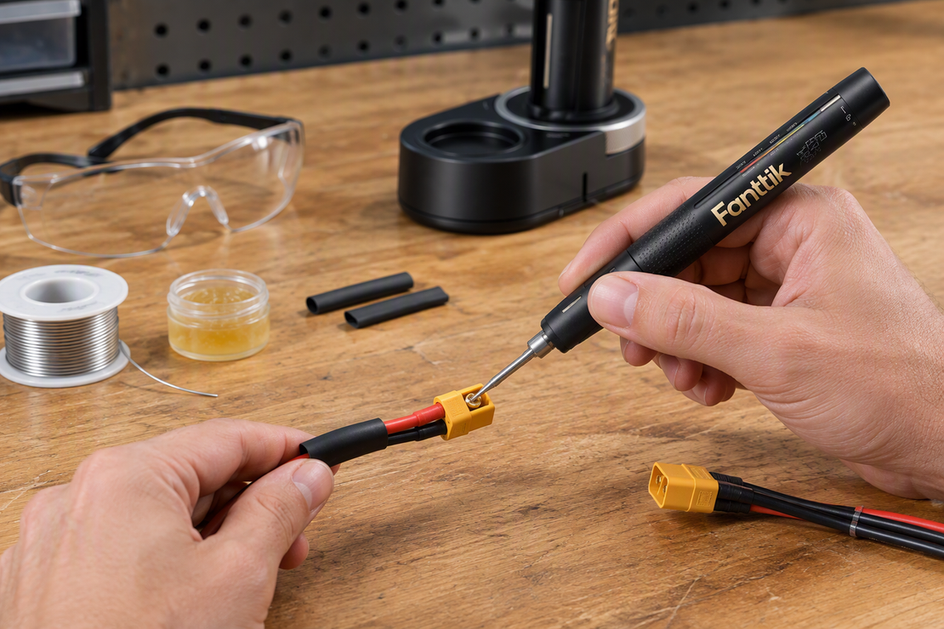 How to Solder XT60 Battery Connectors Without Melting the Plastic Housing
A technical walkthrough of XT60 soldering temperature, tip setup, and a step-by-step 12 AWG joining sequence that avoids...
How to Size and Stake a Tent Footprint: Preventing Water Pooling Under Your Floor
A practical guide to sizing a footprint to your tent floor, staking it without exposed edges, and telling...
How to Solder XT60 Battery Connectors Without Melting the Plastic Housing
A technical walkthrough of XT60 soldering temperature, tip setup, and a step-by-step 12 AWG joining sequence that avoids...
How to Size and Stake a Tent Footprint: Preventing Water Pooling Under Your Floor
A practical guide to sizing a footprint to your tent floor, staking it without exposed edges, and telling...
Leave a comment
This site is protected by hCaptcha and the hCaptcha Privacy Policy and Terms of Service apply.