











































Judge top-rated camping tents by using the rating to build a shortlist, then ruling out any tent that fails your family's real needs. Check three things in order: whether your sleeping layout fits the floor plan, whether your crew can manage the pitch, and whether the manufacturer's weather guidance covers your trip. A tent that fails any of those checks is the wrong tent for this campout, whatever its score.
Use Ratings to Shortlist, Not to Choose
A high rating tells you a tent is worth a closer look. It can't tell you whether your air mattress, your toddler's pad, and your gear bins will fit, so there's no star cutoff that settles the choice.
The more useful signal is the detail behind the score. Before trusting any top-rated camping tent list, look for what was tested, who tested it, and in what conditions. Outside's car-camping guide is a good example of that transparency because it explains how its tent tests were run: 30 testers tried 29 tents, mainly four- to eight-person three-season models. Testers evaluated functionality, setup and takedown, durability, comfort, and livability, and the gear team then compared their feedback.
Apply the same test to customer reviews. A comment from a parent who pitched the tent alone with two kids tells you more than a five-star rating with no explanation. If a review offers no method and no details that match your trip, keep the tent on your list only until you can check its published specs and instructions.
Does the Floor Plan Fit Your Family?
Capacity is a starting point, not proof of fit. Outside suggests counting your sleepers and adding at least one, noting that ultra-wide pads often need extra room. Its testers also found that wall shape changes how a floor feels, with two families of four remarking on how one steep-walled interior maximized space and freedom of movement.

To run this check, list everything that must sleep or stay inside the tent. Measure the length and width of each pad, mattress, and crib, then compare those footprints with the published floor dimensions and shape. Masking tape on a garage floor makes the layout easy to see.
If two adults, two children, and a portable crib all need to fit, place all of those footprints and then look for a path to the door. If someone would have to climb over a sleeping child to get out, rule out that floor plan, even if the capacity label covers your headcount.

Outside's family testers offer a useful reference for reading these reports. One family fit a double air mattress, a single pad, and a regular-sized Pack-N-Play in a six-person tent and still had a narrow, one-foot corridor at their heads. The reviewers added that the same tent might feel cramped for a larger family with older children. Your kids' ages can change the answer as much as their number does.
Keep the dimensions handy after you decide. You'll need them again if you decide a tent footprint is worth adding.
Can Your Setup Crew Pitch It?
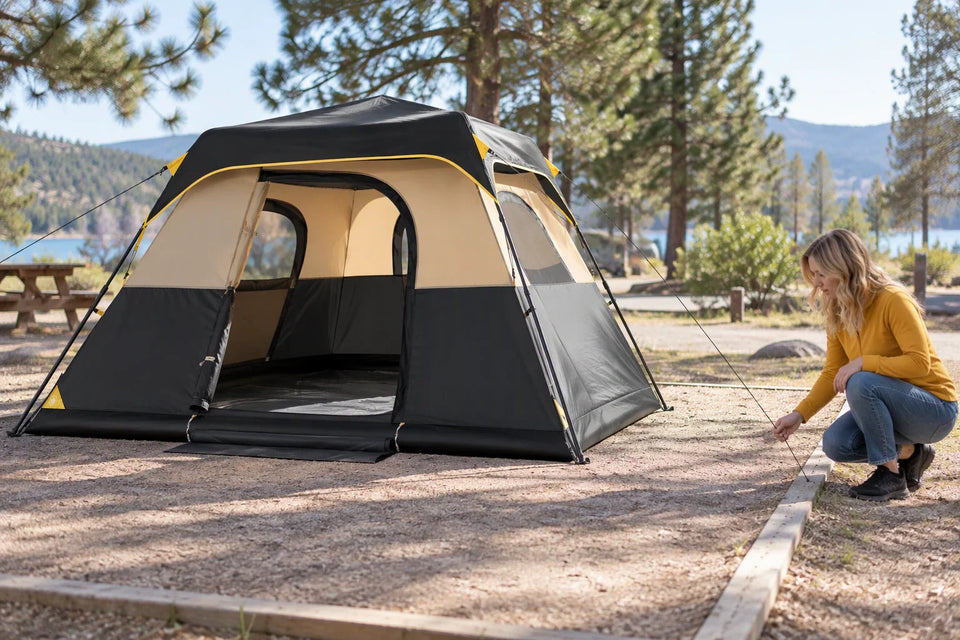
A tent passes this check when its steps suit the people who will actually pitch it, including on the night one adult is also watching the kids. Read the instructions or setup notes with that person in mind, and treat "easy setup" as a claim to investigate.
Outside's setup observations in context show why the circumstances matter. One veteran tester pitched a four-person tent by herself in about 15 minutes. Another tent's first setup took 17 minutes while two parents skipped the instructions and tended to a baby and a toddler. Neither number is a promise, and the two aren't a fair head-to-head because the conditions differ. They are useful because they tell you who was working and what else was going on.
Then look for steps a short label can hide. One account of rainfly setup steps says the fly, the waterproof outer layer, needed its own pole and had to be staked taut. The reviewers found that setup got easier with time, though not much quicker. If one person will often pitch alone, or you expect to arrive with restless kids, count those extra pole and staking steps against the tent. If two adults can work together and you can practice at home first, they may not be a deal breaker.
If the frame style itself is your deciding factor, our tent setup-style comparison looks at how pop-up and inflatable air beam designs differ on setup speed and wind resistance.
Does the Weather Guidance Fit Your Forecast?
Start with the trip, not the tent. Write down the rain, wind, and temperatures you expect at your campground, then verify that current manufacturer guidance for that exact model clearly covers those conditions. If the documentation does not address them, do not assume suitability from a rating or review alone; ask the manufacturer or keep looking.
Reviews still add useful context when you read them within their limits. Outside's reported rain-test conditions describe one rainfly staying dry after 72 hours of constant rain in the Rockies. The same testers noted that the heavy-duty fly wasn't immune to condensation in soggy settings, although a mesh front door and windows can help manage moisture. So a strong rain result answers one question about one tent. It doesn't promise a dry night in every storm, and staying leak-free isn't the same as staying free of condensation.
Waterproofing numbers need the same care. A hydrostatic head rating tells you how much water pressure a fabric can hold back, measured in millimeters of water. Seams can leak separately, so that number alone doesn't settle whether a tent suits a wet forecast. Use it alongside the manufacturer's stated guidance, not in place of it.
FAQs
Can a vestibule replace sleeping-floor space?
No. Count sleepers against the enclosed floor and treat the vestibule, the covered area outside the main tent, as storage. Outside's example of vestibule gear storage describes one family keeping camp gear, clothes, a kid carrier, and the dog there at night, which freed up room in the main tent. That can solve a gear problem, but it won't make a too-small sleeping area work.
Does more headroom always make a family tent easier to use?
Not always. Standing room makes it easier to get dressed and stretch, but Outside's note on headroom and solo setup points out that a taller tent will be harder to pitch, especially alone. If two adults will share the job, the extra height may be well worth it. If one person usually handles setup, weigh that comfort against the harder pitch.
Does car camping make packed size irrelevant?
No, especially when the car is already full. Outside's advice on packed size and trunk space is to consider a more packable option if storage is limited, since it's easier to fit around coolers and propane. Compare the packed dimensions with the space left after your other gear is loaded. If you have plenty of room, you can give interior space more weight when choosing between top-rated tents.
Continue reading
 Late-Night Tent Setup: Make an Instant Tent Familiar Before Arrival
How to rehearse your own instant tent before a trip, then pitch it by headlamp at a dark...
 Cleaning a Patio Before a New Coating: Avoid Surface Damage and Trapped Moisture
You don't have to pressure wash a patio before coating it. Use the coating maker's cleaning, etching and...
Leave a comment
This site is protected by hCaptcha and the hCaptcha Privacy Policy and Terms of Service apply.