








































Leave the tent rainfly on if rain or changing weather is possible at any point while you sleep, or if your tent's instructions call for it. Take it off only when the forecast for the whole night looks dry and your tent is designed to be used without the fly.
Going fly-off can give you an open view of the sky and more airflow. The trade is that you give up a layer of weather protection until you put the fly back on.
Should You Leave the Rainfly on a Clear Night?
Keep the fly on by default. A clear night has to earn the fly-off option, and pretty sky alone doesn't earn it.
Before you pull the fly, three things should all be true. The forecast for the hours you'll actually be asleep shows no rain, not just the sky at sunset. Your tent's instructions say the body can be pitched without the fly. And you're willing to get up in the dark and put it back on if the weather turns. If any one of those is missing, leave the fly where it is.

Most of what you gain is comfort. With the fly off, you can look up through mesh panels, and more outside air can move through the tent. One backpacking guide suggests removing the fly when clear skies are in the forecast to limit condensation. The same guide adds a caveat: be ready to set the fly up at a moment's notice if rain starts.

What you give up is the outer shell. Without it, any rain or moisture that shows up overnight hits the tent body directly. How well the body handles that depends on its design.
Think about what guessing wrong would cost you. On a multi-day trip, a 3 a.m. shower could leave you with a wet sleeping bag you can't dry by tomorrow night, so that's a strong case for keeping the fly on. On a one-night trip close to home with a dry forecast, the downside of a quick re-pitch is smaller.
What the Overnight Forecast Says About Rain and Dew
A clear sky at bedtime only tells you about right now. Your decision covers every hour until morning, so base it on the overnight forecast, not on what you see when you zip the door.
Pull up the hourly forecast for your campsite and read it from bedtime to wake-up. Look at the chance of rain and at any shift in cloud cover or wind later in the night. If it shows showers, a change in the weather, or wording you can't pin down, keep the fly on. No single percentage marks the safe point, so treat any real chance of rain as a reason to keep your protection.
Rain isn't the only moisture to plan for. The National Weather Service lists clear skies and light winds among the conditions that favor dew. It also points to a small gap between the nighttime temperature and the dewpoint. The dewpoint is the temperature where moisture in the air starts to condense onto surfaces, and dew forms once the air cools down to it. So the same calm, cloudless night that looks perfect for stargazing can also be the kind of night that leaves things damp by morning.
You can apply this with numbers that most forecasts already show. Compare the overnight low with the forecast dewpoint. When the two sit close together on a clear, calm night, a damp morning becomes more plausible. None of these signs promises dew at your exact site. When several of them show up together, though, the case for keeping the fly on gets stronger.
Weather varies a lot across the US, so the same clear evening can lead to different nights in different places. Go by the local forecast for where you're camped, not a rule of thumb from another trip.
How Your Tent's Design Changes the Fly-Off Choice
Your tent's own instructions decide whether fly-off is an option at all. A setup that works on one model doesn't carry over to another.
Start with the setup instructions for your exact tent. Check whether they show the body pitched without the fly, and whether the body holds its shape with just the poles. Also check whether the fly is a separate piece. A single-wall tent, or a design where the outer layer is built into the tent, has no fly-off mode. If your instructions never describe using the tent without its fly, treat the fly as part of the tent and leave it on.
How much you actually gain depends on the tent body. A body with lots of mesh, especially on the roof and upper walls, opens up more view and more airflow once the fly comes off. A body made mostly of solid fabric changes much less. Insect protection works the same way. It comes from the body's mesh and zippers, not from the fly. Before dark, check that every door and window on the body closes with mesh before you count on it to keep bugs out.
Plan the return trip, too. Check that the instructions let you attach the fly over a tent that's already pitched, and practice it once in daylight so you know how it lines up. On rock or hard-packed ground where stakes won't bite, work out how to guy out a tent on rocky ground before bed. That way the fly has anchors waiting if you need to put it back on.
FAQs
Will keeping the rainfly on cause condensation?
It can. Warm air from inside the tent moves out to the fly, which is cooler because the outside air is cooler. Moisture then condenses on the underside of the fly. If you keep the tent rainfly on, these tent condensation prevention tips suggest opening all rainfly vents, especially opposing ones for cross ventilation. They also suggest opening the inner tent windows and rolling back fly doors and roll-up sections until rain actually starts.
What should you do if it starts raining with the fly off?
Put the fly back on right away instead of waiting to see if the rain passes. Before bed, leave the fly unpacked beside the door, with the edge that goes over the door already figured out, so you can find and orient it by headlamp. Once it's on, close the fly doors and reconnect the tie-outs. Then expect a similar forecast to call for a fly-on night next time.
Does damp ground make dew more likely on a clear night?
It can add to the odds. The National Weather Service counts decent soil moisture as a dew-favorable condition, along with clear skies, light wind, and a small gap between temperature and dewpoint. If you're pitched on ground that's still wet from recent rain, lean toward keeping the fly on, even when the forecast shows no rain.
Continue reading
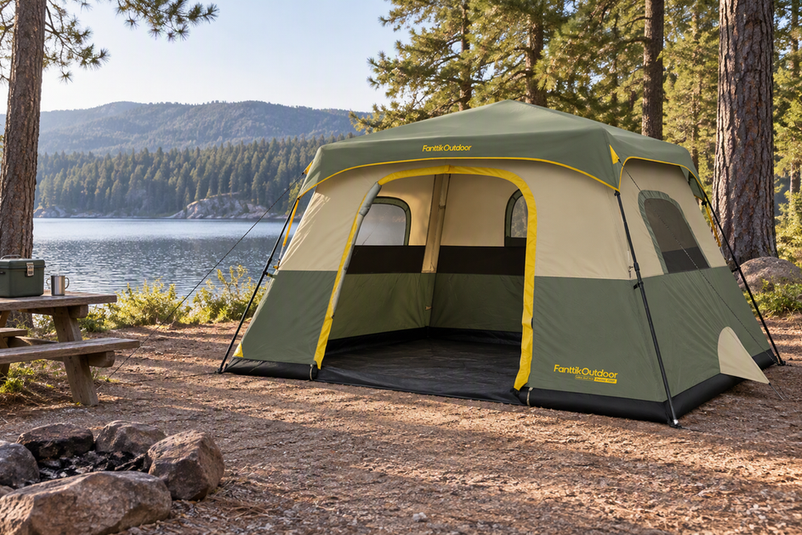 Which Way Should a Tent Door Face at a Campsite?
A practical way to pick your tent's entrance direction: check the forecast, secure dry ground first, then point...
Which Way Should a Tent Door Face at a Campsite?
A practical way to pick your tent's entrance direction: check the forecast, secure dry ground first, then point...
 How to Use a Detail Sander on Trim Without Rounding Its Edges
A step-by-step method for sanding trim faces with a detail sander, plus the stop point for narrow or...
How to Use a Detail Sander on Trim Without Rounding Its Edges
A step-by-step method for sanding trim faces with a detail sander, plus the stop point for narrow or...
Leave a comment
This site is protected by hCaptcha and the hCaptcha Privacy Policy and Terms of Service apply.