































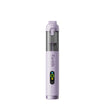






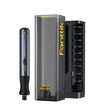
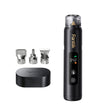
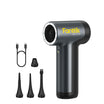


Short answer: how strong should a car vacuum be? Strong enough to lift crumbs and sand from dense automotive carpet — and that strength is kPa read with runtime, not kPa alone. A 19 kPa rating is peak sealed suction; on Fanttik's Slim V8 APEX that setting lasts 13 minutes before eco mode drops to 8 kPa. Pet hair needs a brush more than a bigger number. A handheld car vacuum is not a home vacuum or a shop vac.

How Strong Should a Car Vacuum Be?
Search results for this question are full of single numbers: 5,000 Pa, 12,000 Pa, 19,000 Pa. Those figures are not interchangeable, and none of them is a complete answer.
For a cordless handheld used on a car interior, published peak suction in the compact class is typically around 13–19 kPa (13,000–19,000 Pa). That is enough to pick up crumbs, dry dirt and loose sand if the nozzle can reach them. It is not enough to pretend the tool is a garage shop vacuum. Independent testers measuring water lift — a different test than a sealed kPa claim — have found miniature battery car vacuums averaging about 5 inches of water lift, against about 64 inches for wet/dry shop vacuums and about 75 inches for coin-operated car-wash machines (Vacuum Wars, 2026).
So the useful answer is a pair of facts, not a trophy number:
- A compact cordless handheld in the 13–19 kPa class is the right strength band for weekly interior cleaning.
- That peak is available for a short window. You also need enough runtime and dustbin volume to finish the car you actually have.
If you already know you want a cordless handheld and need a model-by-model pick, that job belongs on the car vacuum suction and runtime comparison. This page is how to read the numbers so that page makes sense.
What car vacuum suction (kPa) actually measures
kPa is kilopascals. 1 kPa = 1,000 Pa. On a spec sheet it is almost always sealed suction: the pressure difference the motor can create when the nozzle is blocked. It describes lifting force at a sealed inlet. It does not describe airflow — how much air moves when the nozzle is open, which is what carries sand off a floor mat.
That is why two vacuums with the same kPa can clean differently. Air watts (AW) combine pressure and airflow, which is why some brands quote both. Fanttik's Slim V8 APEX lists a maximum of 45 AW / 19 kPa; the Slim V10 Ultra lists 19 kPa / 45 AW on high and 10 kPa / 20 AW on low. Those AW figures sit at the high end of the handheld range that suction charts typically put around 15–40 AW (Home Vacuum Zone). They still are not shop-vac numbers.
Three traps show up on almost every product page:
- Peak, not typical. The headline kPa is the maximum setting.
- Sealed, not open. Blocked-nozzle pressure is easier to make look large than real pickup on carpet.
- Clean-filter lab conditions. Manufacturers quote max suction with an empty bin and a clean filter. A clogged filter is the usual reason a unit “loses power,” not a dying motor.
Electrical watts on the motor (90 W, 120 W, 145 W) are power draw, not cleaning power. Ignore them as a suction score.
Why a 19 kPa figure is meaningless without runtime
This is the claim that actually decides whether 19 kPa is “good.” Peak suction and battery life trade off. The same motor cannot hold 19 kPa for the whole charge.
| Model (illustration) | Suction (max / eco) | Runtime at those settings | Dustbin |
|---|---|---|---|
| Slim V8 APEX | 19 kPa / 8 kPa | 13 min / 40 min | 120 ml |
| Slim V10 Ultra | 19 kPa / 10 kPa | 17 min / 35 min | 120 ml |
| V8 Mate | 13 kPa / 9 kPa | 17 min / 30 min | 120 ml |
| Fold V10 APEX | 17 kPa / 9 kPa | 13 min / 35 min | 500 ml |
Read the Slim V8 APEX row as a sentence: you get 19 kPa for 13 minutes, or 8 kPa for 40 minutes. If a full interior takes 20 minutes, you will spend part of that session at 8 kPa unless you recharge. The Slim V10 APEX holds 19 kPa for 15 minutes (10 kPa for 30). The Slim V10 Ultra stretches the same peak to 17 minutes. The V8 Mate never claims 19 kPa; it publishes 13 kPa for 17 minutes, which is the more honest shape of a smaller battery doing crumbs and dust.
Is 19,000 Pa suction good? As a peak for a 1.1–1.2 lb handheld, yes — it is a strong figure in this class. As a description of what the vacuum does for a whole charge, no. A 19 kPa model run in eco mode is an 8–10 kPa vacuum. Anyone quoting only the headline number is selling the lab, not the session.
Crumbs vs sand vs pet hair
Different debris asks for different parts of the spec sheet. Suction helps all of them. It is the deciding spec for only some of them.
| Debris | What actually lifts it | What to look for |
|---|---|---|
| Dust, crumbs, dry food | Airflow at the nozzle; eco/low mode is usually enough | A crevice tool and enough runtime to finish the cabin |
| Sand in carpet and floor mats | Peak suction plus agitation; sand sits between fibers | Max-mode kPa you can actually use, plus a brush to loosen grit |
| Pet hair on fabric seats | A pet or rubberized brush to break the weave, then suction | Attachments first, kPa second. The V8 Mate ships with a pet brush at 13 kPa; the Slim V10 Ultra pairs 19 kPa with a larger brush set |
| Grit in vents, rails, cup holders | Reach, not motor size | Crevice nozzle and a flexible hose |
| Wet spills, mud cakes, construction dust | Wrong tool | These handhelds are dry vacuums with small filters. Use a shop vac or an extractor |
Pet hair is the case people get backwards. Fur wraps into upholstery. Extra sealed suction on a smooth nozzle often just tugs the surface. A brush that agitates the fibers does more than jumping from 13 kPa to 19 kPa. Sand is the opposite problem: it is heavy and it hides, so peak suction and a stiff brush both matter, and a 120 ml bin fills fast.

Dustbin size is the third spec
Suction that cannot hold debris is wasted. Compact Slim-class units in the table above use a 120 ml cup. That is sized for a car cleaned often. The Cruise V11 APEX steps up to 300 ml; the Fold V10 APEX lists 500 ml (16.9 oz). If you empty a 120 ml cup twice in one session, the bin is too small for that job. The motor is not the bottleneck.
A larger cup usually comes with more weight. The Fold V10 APEX is 2.56 lbs against 1.1 lbs for the Slim V8 APEX. You hold a car vacuum at arm’s length under seats, so that gap shows up after ten minutes. Strength here is not only kPa. It is kPa you can still aim.
Handheld car vacuums are not home vacuums
This is the other half of “how strong.” A cordless car vacuum is a small-bin, short-runtime, tight-space tool. Using one on a whole house means constant emptying and recharging. Home stick and upright vacuums are built around airflow through a floorhead and a much larger dust path. Shop vacs are built around water lift and a tank.
If the car has years of embedded sand, or you detail several vehicles in a row, a compact handheld will feel weak even at 19 kPa — because the class is wrong, not because 19 kPa is a fake number. Vacuum Wars’ water-lift gap between mini cordless units and wet/dry machines is the honest version of that limit. Keep the handheld for glovebox and weekly work. Borrow or buy a shop vac for the deep clean.
Filters change the result too. True HEPA, as the U.S. EPA defines it, is a filter that can theoretically remove at least 99.97% of 0.3-micron particles. Many compact car vacuums use a smaller HEPA-style or H11 filter; Fanttik’s Slim V8 APEX lists a HEPA 11 filter and a 95.99% capture claim, which is not the EPA 99.97% figure. A tighter filter also adds resistance, so a clogged one cuts suction. For what that means in a cabin, see how HEPA filtration affects car vacuum performance.

How to read a spec sheet before you buy
- Write down max kPa and the minutes at max. If only one number is printed, assume the impressive one is the short setting.
- Check eco kPa and eco minutes. That is the setting you will live with on a long tidy-up.
- Match the cup to the mess. 120 ml for a regularly cleaned commuter car; 300–500 ml if kids, pets, or a truck dump more debris than one emptying can hold.
- Look at the nozzles before the motor. Crevice tool, hose, and a pet or multi-surface brush decide whether peak suction can touch the dirt.
- Confirm it is a dry vacuum. Liquid in a dry motor and filter is a failure, not a feature.
Then go vacuum in an order that does not fight the tool: mats out, big debris first, crevices last. That sequence is in how to vacuum a car interior in order.
What this class of vacuum is not for
- Whole-home floors. Runtime and bin size are sized for a cabin, not a house.
- Wet spills or soaked mats. These are dry vacuums.
- Set-in stains on cloth seats. Vacuuming lifts loose debris. Stains need an extractor or shampooer.
- Replacing a coin-op or shop vac on neglected carpet. Peak handheld kPa is not the same test as 60-plus inches of water lift.
If the question you still have is “which cordless model,” use the guide to choosing a car vacuum by suction, runtime and bin size. To see the current handheld range in one place, open the Fanttik cordless car vacuum lineup.

Continue reading
 How to Vacuum a Car: Floor, Seats, Crevices, Then Trunk
Vacuum a car in a set order: cabin floor, seats, crevices, then trunk. This how-to covers attachments, pet...
How to Vacuum a Car: Floor, Seats, Crevices, Then Trunk
Vacuum a car in a set order: cabin floor, seats, crevices, then trunk. This how-to covers attachments, pet...
 Essential Safety Tips for Women's Car and Tent Camping
Discover must-know safety tips for women's car and tent camping! Plan, pack, and protect yourself with essential advice...
Essential Safety Tips for Women's Car and Tent Camping
Discover must-know safety tips for women's car and tent camping! Plan, pack, and protect yourself with essential advice...
Leave a comment
This site is protected by hCaptcha and the hCaptcha Privacy Policy and Terms of Service apply.