










































When deciding between a car wash that vacuums for you and buying a compact handheld vacuum, the payoff comes down to local service pricing and your cleaning frequency. In one Southern California example, four $29.99 full-service visits total $119.96. That exceeds a $99.99 handheld vacuum purchase by $19.97 across three months before factoring in taxes, electricity, filters, or personal labor.
Beyond upfront math, the choice hinges on tight access around seat tracks, console seams, and preventing interior wear. Here is how both detailing approaches balance cost, reach, and material protection.
Which Option Costs Less Over Three Months?
Whether a handheld vacuum beats a car wash that vacuums for you over three months depends entirely on local wash prices and how many visits you replace. In one documented example, owning a handheld reaches break-even after four avoided visits.
| Option | Cost input | Recurring cost | Time-efficiency input | Three-month implication |
|---|---|---|---|---|
| Paid full-service wash | $29.99 per visit (local example) | Scales with visit count | Travel + wait per visit | 4 visits = $119.96 |
| DIY handheld purchase | $99.99 purchase (model-specific) | Charging, filters, storage | Setup once, then on-demand | One-time cost, reusable |
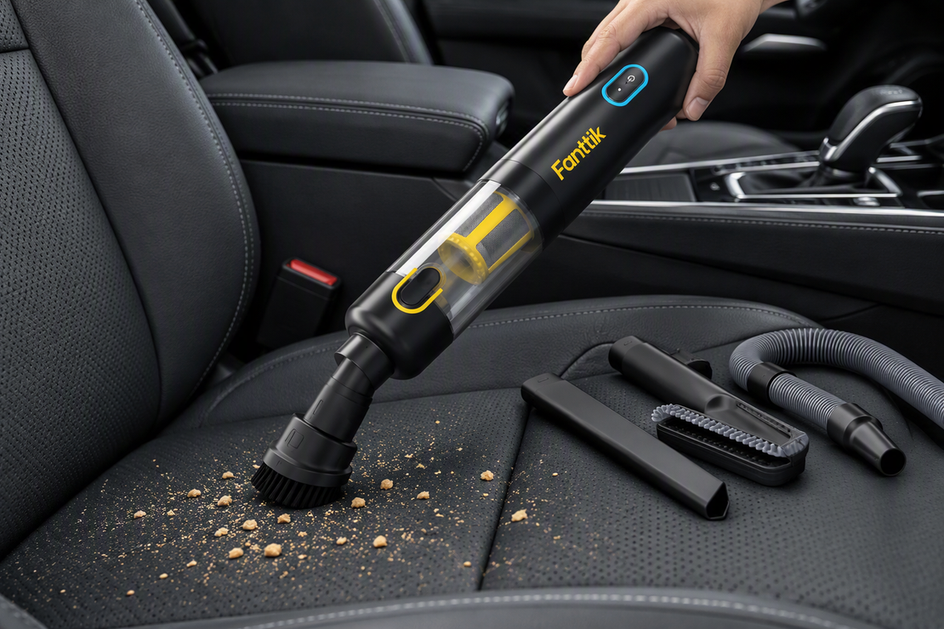
At one Southern California car wash, a full-service package charges $29.99 and includes vacuuming carpets, mats, and seats after crevices are treated with compressed air. Compare that to the Slim V8 APEX product page, which lists a $99.99 sale price for a cordless handheld with a crevice nozzle and flexible hose.
The formula divides the purchase price by the per-visit service fee to find break-even visits:
$$\text{Purchase Price} \div \text{Service Fee} = \text{Break-Even Visits}$$

Here, $99.99 divided by $29.99 yields roughly 3.33 visits. Because service trips cannot be fractional, four avoided visits ($119.96 total) are required to surpass the $99.99 purchase price, creating a $19.97 difference. This three-month model serves as a practical break-even selector rather than a universal guarantee, excluding local sales tax, replacement filters, electricity, and the value of personal time.
What Does Each Option Actually Save You in Time?
Paid service and DIY vacuuming save contrasting types of time, and each routine involves distinct friction points.
What Paid Service Removes
Outsourcing interior vacuuming removes manual labor, bin emptying, and equipment maintenance from your schedule. However, it requires driving to the facility and waiting in line during peak hours. That travel investment makes sense during a full interior reset but adds unnecessary friction for minor touch-ups.
What DIY Makes Easier
Keeping a dedicated handheld vacuum ready lets you clean crumbs or gravel immediately in your driveway without traveling. The tradeoff lies in equipment ownership: you must manage battery recharging, store the unit within reach, empty debris bins, and clean filters periodically. Skipping this maintenance degrades suction and slows down spot cleaning.
Which Option Reaches Seat Tracks and Console Crevices More Thoroughly?
Neither routine guarantees superior debris pickup across seat tracks and console crevices; thoroughness depends strictly on attachment geometry and tool access.
Seat Tracks and Under-Seat Areas
Reaching underneath seat rails requires narrow tool profiles and flexible reach rather than peak suction ratings. According to Ford's attachment guidance, a narrow crevice accessory is specifically intended for hard-to-reach areas like under the seats, while a brush attachment helps dislodge stubborn dirt. Paid services vary widely in execution: while our researched local example applies compressed air to dislodge debris before vacuuming, broad service packages do not guarantee consistent manual crevice detailing across all providers.
Console Crevices and Seams
Narrow console seams and cupholder recesses demand precise angles without forcing hard plastic against delicate trim. A handheld tool provides direct tactile control over nozzle positioning and applied pressure. However, accessibility does not automatically prove higher overall debris removal compared to commercial vacuums. Match your choice to whether a local wash explicitly covers crevice detailing or whether your handheld includes dedicated narrow attachments.

For readers managing larger cargo holds or truck beds alongside cabin detailing, checking a multi-tool setup like our foldable car vacuum kit helps address wider utility needs without transferring assumptions across different tool classes.
How Do You Reduce Interior Wear While Vacuuming?
Preventing cabin wear requires pre-cleaning prep, proper dry-pickup setup, and matching attachment materials to sensitive surfaces.
Set Up for Dry Debris
- Clear coins, charging cables, and hard items from footwells and seat cushions before vacuuming to avoid blockages or surface scratches.
- Verify that the vacuum is configured strictly for dry pickup, as standard car-wash stations and compact handheld units are not intended for liquid extraction.
- Treat liquid spills separately using dedicated extraction or towels; never vacuum wet debris unless the equipment explicitly documents wet-rated operation.
Control Contact With Interior Surfaces
- Use soft brush bristles to agitate dirt on carpeting and floor mats before applying direct suction.
- Guide slim crevice nozzles along seams without driving rigid plastic edges into leather, vinyl, or piano-black dashboard finishes.
- Adhere to manufacturer material instructions: Ford guidance notes that cloth, leather, vinyl, and seatbelts should be wiped clean with a damp cloth and mild soap solution rather than scrubbed with bare vacuum nozzles.
Which Routine Fits Your Cleaning Pattern?
Choosing the right approach depends on your mess frequency, targeted debris locations, and willingness to maintain equipment.
Occasional Versus Frequent Cleaning
- Occasional cleaning: If you clean your car only a few times a year, paid full-service visits avoid upfront hardware costs and ongoing maintenance duties.
- Frequent cleaning: If family travel, pets, or commuting create weekly debris, avoiding four paid visits over three months typically offsets an illustrative $99.99 vacuum purchase.
Targeted and Hybrid Routines
- Targeted crevices: Choose a dedicated handheld if your primary headache is recurring debris in console gaps, seat tracks, and child car seats where immediate nozzle control is required.
- Hybrid approach: Many drivers rely on professional full-service washes for seasonal deep cleaning while keeping a compact cordless vacuum in the vehicle for immediate spot maintenance.
FAQs
How does the comparison change if I already own a suitable handheld vacuum?
When you already own a functional vacuum, the purchase price is a sunk cost and should be removed from the calculation. Compare only the per-visit cost of paid washes against minimal ongoing maintenance expenses, such as replacement filters, recharging electricity, and your personal time.
Can a handheld vacuum replace commercial car wash suction power?
A compact handheld vacuum cannot match the peak airflow or motor capacity of industrial car-wash vacuum systems. However, effective vehicle cleaning depends primarily on attachment access, agitation brushes, and frequent spot maintenance rather than raw motor wattage alone.
Does professional car wash vacuuming always include seat tracks?
Full-service car washes do not universally detail seat tracks or narrow console seams. While some packages incorporate compressed-air blowouts, standard drive-through vacuuming frequently focuses on open carpet areas, floor mats, and seat cushions unless a dedicated crevice tier is specified.
Continue reading
 Wet vs Dry Car Messes: Why Standard Cordless Car Vacuums Should Never Suck Up Spilled Coffee
Standard cordless car vacuums are dry-only tools. Here's the spill-cleanup order that protects your vehicle interior and keeps...
Jump Starter Frozen Car Battery Safety: Why You Must Never Boost a Frozen Lead-Acid Battery
A frozen or damaged lead-acid battery should never be jump-started; here's how to spot the danger signs and...
Wet vs Dry Car Messes: Why Standard Cordless Car Vacuums Should Never Suck Up Spilled Coffee
Standard cordless car vacuums are dry-only tools. Here's the spill-cleanup order that protects your vehicle interior and keeps...
Jump Starter Frozen Car Battery Safety: Why You Must Never Boost a Frozen Lead-Acid Battery
A frozen or damaged lead-acid battery should never be jump-started; here's how to spot the danger signs and...

Leave a comment
This site is protected by hCaptcha and the hCaptcha Privacy Policy and Terms of Service apply.