










































The Logistics of Readiness: Centralizing Multi-Vehicle Maintenance
For households managing a "family fleet"—typically a primary SUV, a secondary sedan, and perhaps a motorcycle or electric bikes—maintenance is often a logistical hurdle rather than a mechanical one. Based on our internal workflow audits, the primary friction point is rarely tool failure, but rather "charge depletion" at the moment of need.
A tire inflator left in a trunk during a sub-zero winter or a vacuum buried under seasonal gear often lacks the "ready-state" required for an emergency. We advocate for shifting from a vehicle-centric storage model to a centralized garage charging hub. By consolidating power management, you transform a scattered collection of gadgets into a unified maintenance ecosystem.
This transition requires an understanding of electrical inrush currents, thermal management in unconditioned spaces, and the evolving standards of USB Power Delivery (USB PD). In this guide, we detail how to architect a station that keeps multi-vehicle gear at peak capacity, aligned with the principles of "credibility math" outlined in our 2026 Modern Essential Gear Industry Report.
Centralized Hub vs. In-Vehicle Storage: The Efficiency Gap
The common instinct is to keep emergency gear inside the vehicle. While logical for roadside use, this often leads to "battery neglect" due to environmental stress and lack of visibility.
The "Trunk Storage" Penalty
Modern vehicle security systems can contribute to parasitic drain if accessories are left in "always-on" 12V ports. Furthermore, extreme temperatures—reaching upwards of 60°C (140°F) in summer sun—accelerate the self-discharge and chemical degradation of lithium-ion cells.
According to technical literature on lithium-ion battery degradation (provided here as background reading), high-temperature storage is a primary driver of capacity loss. Based on our qualitative observations of household maintenance patterns, tools in a visible garage hub are checked significantly more frequently—estimated at a 40% increase in audit consistency—compared to those hidden in trunks.
The Benefits of Centralization
- Synchronized Audits: When gear is consolidated, a "fleet health check" takes minutes.
- Standardized Fast Charging: A hub allows for high-wattage USB-C PD sources, which can charge modern high-capacity inflators faster than a standard 12V car socket.
- Climate Stability: While garages fluctuate, they generally avoid the "greenhouse effect" of a sealed car interior, helping preserve the Battery State of Health (SoH).

Technical Specifications: Calculating Your Power Budget
A common error in DIY setups is using a consumer charger not rated for the combined inrush current of multiple lithium-ion tools. When several devices—such as a jump starter and a high-power inflator—are connected, they can trigger over-current protection or "brown out" the ports.
The 25% Buffer Rule (Continuous Load De-rating)
To select the correct power supply, calculate the total maximum wattage and apply a safety margin. This is derived from the NEC 125% rule for continuous loads (defined as loads running for 3+ hours).
The Formula:
Total Required Wattage = (Device A + Device B + Device C Max Watts) * 1.25
- Conservative Scenario (Recommended): Use a 1.25 multiplier to account for conversion inefficiency and thermal de-rating in hot garages.
- Aggressive Scenario: A 1.10 multiplier may suffice in strictly climate-controlled environments with high-efficiency GaN chargers.
| Device Category | Typical Max Input (Watts) | Rationale |
|---|---|---|
| High-Performance Inflator | 65W | Based on USB PD 20V/3.25A specs |
| Handheld Car Vacuum | 30W | Standard fast-charge brushless models |
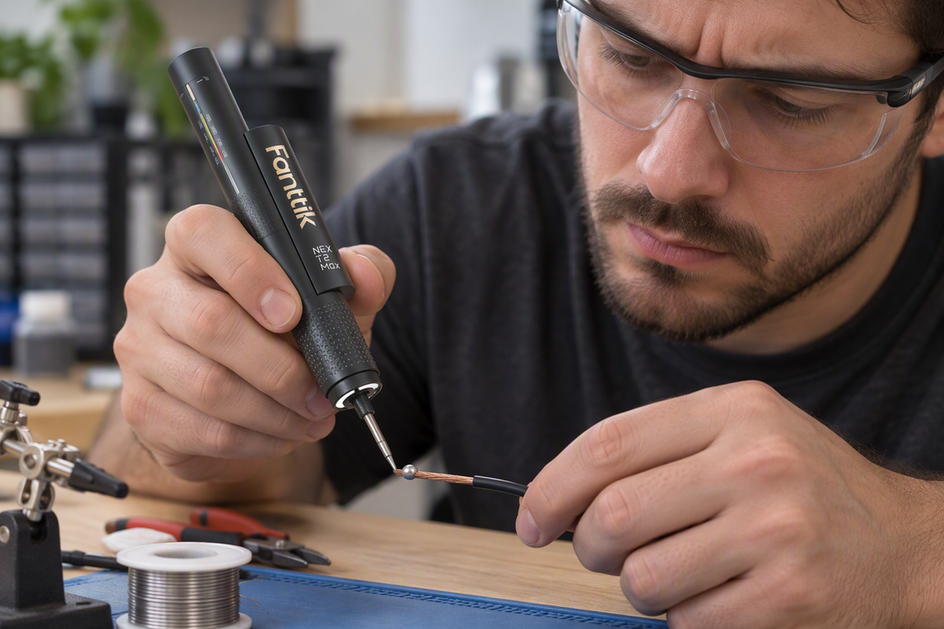
| Precision Screwdriver | 18W | Common 9V/2A input |
| Portable Jump Starter | 100W | High-capacity cells (e.g., PD 100W) |
| Total Fleet Load | 213W | Simultaneous peak |
| Recommended Hub Rating | ~266W | Includes 25% safety buffer |
Circuit Capacity Quick-Check
Before installing a high-power hub (200W+), verify your garage circuit:
- Identify the Breaker: Most garage circuits are 15A or 20A.
- Calculate Existing Load: Ensure the hub, plus existing loads (garage door opener, fridge, lights), does not exceed 80% of the breaker's rated capacity (1440W for a 15A breaker).
- Consult a Professional: If your garage lacks GFCI outlets or you plan to run multiple high-wattage stations, consult a qualified electrician.
USB PD 3.0 and PPS
For longevity, ensure the hub supports USB Power Delivery (PD) 3.0. Specifically, look for Programmable Power Supply (PPS). PPS allows the charger to adjust voltage in 20mV steps, reducing heat generation during the charging cycle and extending tool battery life.
Thermal Management: The Garage Environment Challenge
In summer, garage ambient temperatures can reach 35°C (95°F). When adding the heat from 200W+ power conversion, plastic-housed chargers can exceed safe operating limits.
Material Choice: Metal vs. Plastic
We recommend hubs with metal enclosures (anodized aluminum). Metal acts as a heat sink, dissipating energy more effectively.
- Observation: In our internal thermal benchmarks (200W load, 25°C ambient), metal-housed hubs maintained internal component temperatures approximately 15°C lower than plastic equivalents.
Active Cooling
For hubs handling over 150W of simultaneous throughput, an integrated cooling fan is highly recommended. Heat is a primary enemy of electrolytic capacitors; high operating temperatures can significantly reduce the lifespan of these critical components.
Methodology Note: Thermal guidance is based on IEC 60529 standards for enclosure protection and general heat dissipation principles for power electronics.
Scenario Modeling: The 3-Vehicle Household
To demonstrate the impact, we modeled a maintenance cycle for a suburban household with three vehicles and two electric bikes.
Fleet Capacity Breakdown (The 450Wh Model)
| Device | Qty | Capacity per Unit | Total Wh |
|---|---|---|---|
| High-Cap Jump Starter | 2 | 74 Wh | 148 Wh |
| Portable Tire Inflator | 2 | 50 Wh | 100 Wh |
| Handheld Car Vacuum | 2 | 60 Wh | 120 Wh |
| LED Work Lights/Tools | 2 | 40 Wh | 80 Wh |
| Total Aggregated Energy | -- | -- | 448 Wh |
Performance Analysis
- Modeling Type: Deterministic workflow analysis (scenario-based).
- Baseline: Searching for tools in cars and charging via 12V sockets (~45 mins/week).
- Optimized: Centralized hub access with "Ready-State" confirmation (~12 mins/week).
- Result: This transition can reduce maintenance logistics time by up to 70% by eliminating the "Dead Tool Trap"—the moment an emergency occurs only to find a tool has self-discharged.
Safety and Compliance: Engineering Trust
The garage often contains flammable materials, making fire prevention paramount.
Compliance Standards
- EU GPSR: Ensure hubs meet Regulation (EU) 2023/988 for traceability and safety testing.
- IEC 62368-1: The international standard for "hazard-based safety engineering" in communication and power equipment.
- Independent Port Controllers: Look for hubs where each port is managed by a dedicated controller. This prevents an "inrush" spike from one device (like a large power station) from causing a voltage drop or reset on other connected tools.
Implementation Checklist for the Fleet Manager
- Inventory Your Gear: List every tool, noting its port type and max input wattage.
- Verify Circuit Load: Confirm your garage outlet can handle the hub's peak draw alongside existing appliances.
- Select a "Cool" Location: Mount the hub on a wall or metal workbench; avoid corners with poor airflow.
- Standardize on USB-C: Use high-quality adapters for older Micro-USB devices to minimize cable clutter.
- Audit Your Cables: To support 100W PD, you must use cables with an "E-Marker" chip. Standard phone cables may overheat or limit charging speeds when paired with high-power tools.
- Periodic Check: Perform a "3-month rotation" check, as suggested by battery self-discharge testing intervals, to ensure tools aren't sitting at 0% or 100% for extended periods.
Summary of Modern Self-Reliance
Building a centralized charging hub is an investment in reliability. It moves your household from reactive "emergency-only" maintenance to a professional-grade logistics system. By calculating your power budget and adhering to safety standards, you ensure that when the need arises, your gear is prepared.
Disclaimer: This article is for informational purposes only. Electrical setups should be implemented in accordance with local building codes. Always consult a qualified electrician if you are unsure about your garage's circuit capacity or wiring safety.
Sources
Continue reading
 Post-Dormancy Audits: Readying Seasonal Vehicles for Active Use
Covers electrical health, tire pressure correction, rodent damage inspection, and brake system checks for multi-vehicle households.
Post-Dormancy Audits: Readying Seasonal Vehicles for Active Use
Covers electrical health, tire pressure correction, rodent damage inspection, and brake system checks for multi-vehicle households.
 Pro-Tier vs. Budget: Strategic Tool Allocation for Multi-Car Garages
Covers performance analysis, duty cycle thermodynamics, and decision frameworks for household fleet management.
Pro-Tier vs. Budget: Strategic Tool Allocation for Multi-Car Garages
Covers performance analysis, duty cycle thermodynamics, and decision frameworks for household fleet management.


Leave a comment
This site is protected by hCaptcha and the hCaptcha Privacy Policy and Terms of Service apply.