










































Short answer: match the bit to the screw recess first, then to size. A Phillips (PH) cross is not a Pozidriv (PZ) cross. Torx is a six-lobe star, hex is six flats, and tri-wing is three wings. The bit should fill the recess with no wobble. Cam-out is usually a shape or size mismatch. Precision kits use a 4 mm (5/32 in) hex shank; furniture drivers use 1/4 in.

How to choose the right screwdriver bit in three checks
Most stripped screws start with the wrong bit, not with a cheap driver. Run these three checks before you apply power.
- Identify the recess. Look at the screw, not the bit tray. Four arms with no extra ticks is Phillips. Four arms plus four small ticks at 45 degrees is Pozidriv. Six rounded lobes is Torx. Six flats is hex. Three wings is Tri-Wing or Y-type.
- Match the size so the bit cannot rock. A PH1 in a PH2 head, or a T8 in a T10, will turn once and then round the fastener. If you can see daylight or feel wobble, stop.
- Match the shank to the tool. A precision driver takes 4 mm / 5/32 in hex bits. A cordless furniture driver takes 1/4 in hex bits. The two families are not interchangeable. See 4 mm vs 1/4-inch hex shank compatibility before you buy a refill pack.
Bit steel matters for how long the tip stays sharp, but it does not tell you which screwdriver bit to use on this screw. That is a geometry question. For hardness and wear, use the S2 steel vs chrome vanadium comparison.
Phillips vs Pozidriv vs Torx vs hex vs tri-wing
These five drives cause most mix-ups. Tool maker Wiha’s screw-profile guide is the cleanest visual reference; Pro Tool Reviews’ specialty-bit roundup covers spanner, clutch, Torq-Set, and security-pin heads.
| Drive | How to spot it | Common sizes | Where it shows up | Cam-out |
|---|---|---|---|---|
| Phillips (PH) | Four-arm cross, tapered, no ticks between arms | PH000, PH00, PH0, PH1, PH2, PH3 | US electronics, appliances, outlet plates, general hardware | Designed in: the bit climbs out under high torque |
| Pozidriv (PZ) | Cross plus four small ticks at 45 degrees; flatter flanks | PZ0–PZ4 (PZ1–PZ3 most used) | European furniture, electrical, construction screws | Lower than Phillips when you use a PZ bit |
| Torx (T / TR) | Six-lobe star. Security versions have a pin in the center | T2–T10 on electronics; T15–T30 on appliances and cars | Laptops, consoles, cars, modern appliances | Very low if the size is exact |
| Hex (H / Allen) | Six flat sides, same as an Allen key | 0.7–3 mm precision; 3–6 mm furniture | Flat-pack furniture, bikes, machinery | Low if the bit is fully seated |
| Tri-Wing / Y-type | Three wings. Y-type (tri-point) is a related but different profile | Y0.6, Y00, Y0, Y1; Tri 2.0–2.5 | Game consoles, some Apple internals, appliances | Low, but the two three-wing families are not interchangeable |
Phillips vs Torx is not a quality contest. Phillips self-centers and was built to slip out once assembly torque was high enough, which protected 1930s tools that had no reliable clutch. On a laptop screw that extra downward force scratches the case. Torx stays seated because the six lobes have near-vertical walls. Use the drive that is already in the screw. Do not grind a PH2 into a T10.
Phillips and Pozidriv are not interchangeable. A PH bit will drop into a PZ screw far enough to turn, contact only the main cross, then chew the recess. A PZ bit will not seat fully in a PH screw. Wiha is blunt: the mismatch wears both bit and fastener. Look for the four small ticks between the arms. If they are there, you need PZ. Many US electronics kits, including Fanttik’s E1 Max 50-bit set, skip Pozidriv. For European furniture, buy a labeled PZ1/PZ2 pair.
Hex is not a worn-down Torx (six flats versus six rounded lobes). A Torx bit forced into a hex socket slips as torque rises. Tri-Wing and Y-type are not the same either. Nintendo Joy-Con shells use Y00 (tri-point). A Y bit in a Tri-Wing recess, or the reverse, rounds the fastener in a few turns. If the kit labels both “Tri” and “Y,” treat them as separate drawers.

Size matching: if it wobbles, it is the wrong bit
Shape gets you into the right family. Size holds the screw. Seat the bit by hand until the wings or flats fill the recess, then twist with no downward stabbing. Zero rock means you are on size. Any tilt means go one step up or down. On Phillips, a too-small bit bottoms out in the cross; a too-large bit rides the rim. Either strips PH00/PH000. On Torx, an oversized star can feel seated while only the lobe tips touch.
| Job | Bit you usually want |
|---|---|
| Phone, glasses, watch, earbuds | PH000 / PH00, P2 pentalobe, Y00, T2–T4 |
| Laptop, tablet, handheld console | PH00 / PH0, T5–T8 (often security TR), P5 pentalobe on some MacBooks |
| PS5 / Xbox outer shells | T8 / TR8 (T8 security), PH00 inside |
| Outlet plates, light fixtures, PC case | PH1 / PH2 |
| Flat-pack furniture | PH2, hex 4–5 mm, sometimes PZ2 in Europe |
| Appliances, automotive interior | T15–T25, PH2, hex 4–6 mm |
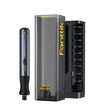
A 50-bit precision kit looks excessive until you hit a P2 iPhone screw or a TR8 faceplate. The Fanttik E1 Max user manual lists 50 S2 bits on a C4 (4 mm) shank, covering Phillips PH0000–PH2, hex, Torx T2–T4, security Torx TR5–TR15, Y-type, Tri-Wing, and pentalobe P2/P5/P6. If your work is furniture rather than phones, a smaller 1/4 in set with PH2 and hex is the right density.
Why bits cam out
Cam-out is the bit walking up and out of the recess as torque rises. On slotted and Phillips drives it is geometry: tapered flanks turn rotation into a lift-out force. Extra downward pressure delays it and is also how you punch a bit through a plastic boss.
What actually reduces cam-out is the correct family and size, a drive that was not designed to slip (Torx, hex, square), a tip that is still sharp, and torque that matches the fastener. A precision driver at 0.05–0.2 N·m will not overpower a PH00 the way a drill clutch can. For those numbers, read the cordless screwdriver torque guide. Steel grade is how long the tip lasts; it is not a substitute for fit. Do not add body weight to “make it bite.” Change the bit.
When magnetic bits help
Magnetic tips hold the screw. They do not tighten it. On small electronics screws they save the time you would spend fishing a fastener out of a chassis. Fanttik’s precision kits magnetize both the chuck and the bits; the E1 Max case includes a magnetizer zone you swipe if a screw will not stick.
Use magnetism on chassis screws and anything you start one-handed overhead. Ease off for mechanical watch movements and analog compasses, and wipe grit off the tip. Finish the last turn on a tiny Phillips by hand so the magnet does not snatch the screw off-axis. A magnetized bit will not wipe phone storage. The failure mode is still a dropped or scratched fastener.

4 mm vs 1/4-inch hex shank
The hex on the back of the bit is the shank, not the drive. Mixing shanks is how people buy a “universal” pack that fits nothing they own.
| 4 mm / 5/32 in (C4) | 1/4 in (6.35 mm) | |
|---|---|---|
| Typical tool | Pen-style precision driver | Cordless screwdriver, drill/driver |
| Fanttik example | E1 Max: 50 S2 bits, 0.05 / 0.2 N·m electric, 3 N·m manual, 200 RPM | S1 Pro: 16 coated S2 bits, 1.5 / 3 / 4.2 N·m, 1/4 in chuck |
| Fasteners | Phones, glasses, drones, laptops, small appliances | Furniture, fixtures, PC case screws, household hardware |
| Do not use for | Cam locks, deck screws, anything that needs several N·m | Phone and eyeglass screws; bit and torque are both too coarse |
The E1 Max product page calls the shank 5/32 in; the user manual calls the same bits C4 × 28 mm. 5/32 in is 3.97 mm, the precision 4 mm standard. The S1 Pro uses a 1/4 in hex holder. Adapters add runout; for small screws, skip them. S2 is on those product pages (“50 S2 Metal Bits”; “coated S2 hardened steel”). That is a material claim, not a reason to pick PH over T8. Buy S2 if the listing says S2, then pick the bit by shape and size.

What this page, and these bits, are not for
- Not a steel lecture. Hardness and Cr-V versus S2 live on the durability article linked above.
- Not a drill, and not for lag bolts or decking. Those jobs need holes or tens of N·m, not a precision driver.
- Not “PH2 for everything.” PH2 is the default US household cross. It is wrong for PH00 electronics, PZ furniture, and any star or hex recess.
- Not PC assembly on a 0.2 N·m precision driver. Fanttik’s E1 Max page states it is not suitable for PC assembly. Case screws belong on a 1/4 in cordless driver.
- Not JIS, unless you bought JIS. Japanese cross-recess screws look like Phillips but have sharper corners. If every PH size wobbles, you need a JIS bit, not more pressure.

FAQs About This Topic
Which screwdriver bit should I use?
The one that matches the recess and fills it with no wobble. Identify Phillips, Pozidriv, Torx, hex, or tri-wing by shape, then step sizes until the bit cannot rock.
Is Torx better than Phillips?
Torx resists cam-out and takes higher torque. Phillips is still what most US consumer screws use. Use the drive already in the product.
Can I use a Phillips bit on a Pozidriv screw?
You can start the screw. You will likely strip it. Buy PZ bits for PZ heads.
Do I need magnetic bits?
For electronics and overhead fixtures, yes. They hold the screw. They do not replace a correct size. Demagnetize for watches and compasses.
What shank size do Fanttik kits use?
Precision models such as the E1 Max use 4 mm / 5/32 in (C4) bits. Cordless models such as the S1 Pro use 1/4 in hex. Browse the Fanttik precision and cordless screwdriver kits to see which family a model sits in.
Related guides
- S2 steel vs chrome vanadium bit durability
- 4 mm vs 1/4-inch hex shank compatibility
- Cordless screwdriver torque settings
- Electric screwdriver vs drill: which tool you need

Continue reading
 What Screwdrivers Do You Need? 2026 Revealed
Sick of stripped screws and slow DIY repairs? Guide pairs screwdriver types to tasks and shows why Fanttik...
What Screwdrivers Do You Need? 2026 Revealed
Sick of stripped screws and slow DIY repairs? Guide pairs screwdriver types to tasks and shows why Fanttik...
 Electric Screwdriver vs Drill: Torque, Speed and Which Tool You Actually Need
An electric screwdriver delivers 0.05-8 N·m at 180-270 RPM; a drill delivers 20-70 N·m at 400-1,500+ RPM. That...
Electric Screwdriver vs Drill: Torque, Speed and Which Tool You Actually Need
An electric screwdriver delivers 0.05-8 N·m at 180-270 RPM; a drill delivers 20-70 N·m at 400-1,500+ RPM. That...
Leave a comment
This site is protected by hCaptcha and the hCaptcha Privacy Policy and Terms of Service apply.