











































Short answer: electric screwdriver torque is the twisting force applied before the tool stops, in newton-metres (N·m). Match it to the fastener, not the highest box figure. Electronics: 0.05–0.6 N·m. Furniture and fixtures: up to about 8 N·m. Drills: 20–70 N·m. The best setting is a task question. An 8 N·m screwdriver is not a drill and will not drive lag bolts or deck screws.

What Electric Screwdriver Torque in N·m Actually Measures
Torque is rotational force: how hard the bit twists the screw. One newton-metre is one newton of force applied at a one-metre lever. On a screwdriver that force is tiny and the lever is the bit, so the useful numbers sit well below 10 N·m. US packaging often prints the same quantity in inch-pounds. NIST conversion factors put 1 pound-force inch at 0.113 N·m, so 1 N·m is about 8.85 in-lb. A 0.05 N·m electronics setting is roughly 0.44 in-lb. An 8 N·m household setting is about 71 in-lb.
The number on an electric screwdriver is not “how powerful it feels.” It is a ceiling. A torque-limiting clutch disengages once the preset value is reached, so the bit stops even if you keep holding the button. That stop is the point of the category. Without it the motor keeps turning after the screw is seated and strips the head, cracks a plastic boss, or pulls a threaded insert out of chipboard. No-load RPM is a separate spec: how fast the chuck spins with nothing in the way. Working torque is what you feel when the screw meets the material.
Typical Torque Bands by Task
People search “best torque setting for screwdriver” as if one number belonged to one model. It does not. The right electric screwdriver torque setting is the lowest value that seats the fastener and then stops. The bands below are starting points, not calibrated assembly specs. If a manufacturer prints a torque on the hardware, use that.
| Work | Typical band | About in-lb | What goes wrong if you miss |
|---|---|---|---|
| Phones, glasses, watches, M.2 screws, camera bodies | 0.05–0.2 N·m | 0.4–1.8 | Stripped micro-threads, cracked housings |
| Laptops, consoles, small appliances, PC case screws | 0.2–0.6 N·m | 1.8–5.3 | Cam-out, ruined bosses, sheared heads |
| Flat-pack furniture, cabinet hardware, outlet plates, light fixtures | 1–8 N·m | 9–71 | Blown cam locks, split particle board |
| Long wood screws, lag bolts, decking, drilling holes | 20–70 N·m (drill / driver) | 177–620 | A screwdriver stalls. This is not its job. |
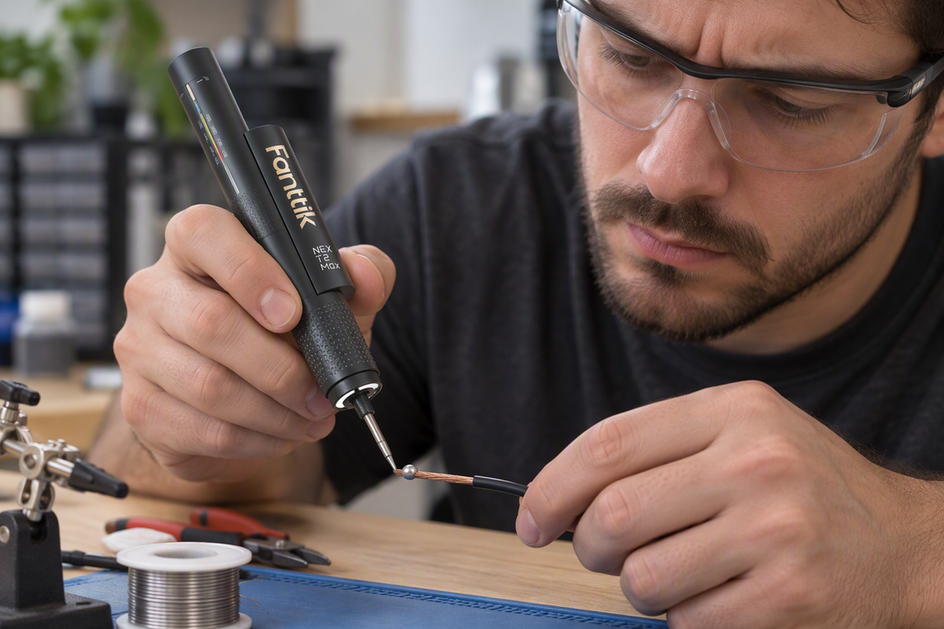
Precision and household screwdriver figures in that table follow Fanttik’s published ranges. Drill figures are the consumer cordless class, not a screwdriver spec. If you need the tool-class comparison — screwdriver versus drill versus impact driver — that lives on the electric screwdriver vs drill guide. This page is about the N·m number on the screwdriver you already have, and how to set it.

The Best Torque Setting Is a Task Question
Buying a higher-N·m model does not give you a better default. It gives you a higher ceiling, which is useful only if your fasteners live up there. A 6 N·m tool aimed at a laptop screw is the wrong tool. A 0.2 N·m tool aimed at a confirmat screw in a wardrobe is also the wrong tool. The setting you want is the one that matches the joint in front of you.
On Fanttik’s own range the published electric bands split cleanly:
- E1 Pro, E1 and E1 Max: 0.05 / 0.2 N·m, plus 3 N·m in manual mode. E1 Max’s own FAQ puts 0.05 N·m on phones, watches and glasses, and 0.2 N·m on speakers and laptops. It is not for PC assembly.
- E2 Max: 0.05 / 0.2 / 0.4 N·m at 220 RPM.
- E2 Ultra: 0.05 / 0.1 / 0.2 / 0.4 / 0.6 N·m at 270 RPM, listed for small appliances, PCs and RC cars.
- S1 Pro: 1.5 / 3 / 4.2 N·m electric, 6 N·m hard, 8 N·m manual, 220 RPM, listed for furniture and PC repair.
- S2 Pro and S2 Pro Max: seven electric settings of 0.5, 1, 2, 3, 4, 5 and 6 N·m at 250 RPM. The S2 Pro manual lists 6 N·m as the maximum electric torque and 8 N·m as the maximum manual torque, when you twist the locked handle. Either number is still screwdriver work, not drill work.
Those are bands, not a ranking. Extra household torque is unused — and unsafe — on 0.05 N·m screws. A precision driver will stall on furniture hardware. Browse the Fanttik screwdriver range with published N·m settings once you know which band you work in.
How to Set Torque Without Stripping the Fastener
A labeled N·m click is more useful than a drill clutch numbered 1–15 with no units, but the method is the same. Consumer Reports’ clutch advice still applies: start low, raise it a step at a time, and stop when the head sits where it should.
- Put the right bit in first. Torque control cannot save a PH1 in a PH2 head, or a worn bit that rides up the recess. Match drive type and size before you touch the setting. See how to choose the right screwdriver bit.
- Start at the bottom of the band for that material. Electronics: 0.05 N·m. Soft furniture board and plastic fittings: 1–2 N·m. Hardwood or larger household screws: 3–4 N·m, then up.
- Drive one screw on scrap or in a hidden hole. If the clutch chatters before the head is flush, go one step higher. If the head sinks or the bit cam-outs, go one step lower — or switch to manual for the last turn.
- Keep the bit seated and the tool square. Side load is how heads round off, even at a correct N·m.
- Finish delicate threads by hand. Precision models list a Power/Manual mode for this. The last quarter turn on a phone, glasses or M.2 screw is where powered driving does the damage.
If you are assembling flat-pack furniture, cam locks and confirmat screws in particle board fail from too much torque far more often than from too little. A 2–4 N·m setting on a household driver is the usual working zone; the full how-to sits in the electric screwdriver furniture assembly guide. Do not open at 6 or 8 N·m “to get it done faster.”

What 8 N·m Still Cannot Do
This is the correction most listings will not print. The Fanttik S2 Pro’s top electric setting is 6 N·m, with 8 N·m available only by hand. That is the top of a cordless screwdriver, not the bottom of a drill. It will not drive lag bolts. It will not sink 3-inch deck screws into joists. It will not drill a pilot hole in a stud. It will stall and heat if you try.
A consumer cordless drill/driver typically publishes 20–70 N·m, often with two speed ranges around 400–2,000 RPM. That gap is roughly an order of magnitude. Treating an 8 N·m screwdriver as a compact drill burns the motor and still fails the fastener. Holes, masonry and structural timber need a drill or an impact driver.
Manual mode does not close the gap. S1 Pro lists 8 N·m of manual torque — you twisting the locked handle, not the motor delivering drill-class output.
How to Read Torque on a Spec Sheet
Packaging mixes three different numbers. They are not interchangeable.
- Electric settings are the clutch steps you can select. These are the figures to match to a task. Fanttik prints them in N·m (0.05 / 0.2, or 1.5 / 3 / 4.2, or 0.5 through 6).
- Hard or max torque is a stall or peak figure above the highest clutch step. S1 Pro lists 6 N·m hard against a 4.2 N·m top setting. Do not use the hard number as a working setting.
- Manual torque is what you can apply by hand with the shaft locked. Useful for a last snug-up. It is not continuous powered output.
RPM is not torque. E2 Ultra at 270 RPM is still a 0.6 N·m precision tool; S2 Pro at 250 RPM is a household driver. Switching torque does not change unloaded speed — Fanttik’s E1 Max FAQ states that directly. A louder motor is not a higher N·m setting. Voltage is a weak proxy too: a 3.7 V pack tells you the tool is not an 18 V drill/driver. It does not tell you whether 0.05 or 4.2 N·m is the right click.
FAQs About This Topic
What is a good electric screwdriver torque setting?
There isn’t one. Use 0.05–0.2 N·m for phones, glasses and watches; 0.2–0.6 N·m for laptops, consoles and small appliances; 1–4 N·m for most furniture and fixtures; 5–8 N·m only when a larger household screw actually needs it. Start at the low end of the band and step up until the head seats and the clutch stops.
How many N·m do I need for furniture screws?
Usually 2–4 N·m for cam bolts and confirmat screws in particle board. Dense hardwood or longer household screws may want 4–6 N·m. Stay under the 8 N·m screwdriver ceiling. If the screw is a lag bolt or a deck screw into framing, that is a drill job.
Is 8 N·m enough for lag bolts or deck screws?
No. Fanttik S2 Pro’s 6 N·m top setting (8 N·m by hand) is still a screwdriver. Lag bolts and deck screws need drill- or impact-class torque, typically 20 N·m and up. Using the screwdriver there will stall the motor. It will not substitute.
What is screwdriver torque in N.m versus inch-pounds?
They measure the same thing. 1 N·m ≈ 8.85 in-lb. Electronics settings around 0.05–0.6 N·m are about 0.4–5.3 in-lb. A household 6–8 N·m setting is about 53–71 in-lb. A 50 in-lb screwdriver is not a 50 N·m tool; check the unit on the spec sheet.
Why does higher torque strip screws?
Once the screw is seated, extra rotation has nowhere to go except into the head, the threads or the material. The clutch exists to stop at a chosen N·m. If that N·m is above what the joint can take, the clutch is doing its job at the wrong number. Lower the setting; do not push harder.
Related Guides
- Electric screwdriver vs drill: which torque class you actually need
- How to choose the right screwdriver bit
- Electric screwdriver for furniture assembly
- Fanttik screwdriver collection with published N·m ratings

Continue reading
 Getting the Most Out of Your Electric Screwdriver: Usage Tips and Techniques
In DIY projects, repairs, and home improvement, few tools have made as significant an impact as cordless screwdrivers....
Getting the Most Out of Your Electric Screwdriver: Usage Tips and Techniques
In DIY projects, repairs, and home improvement, few tools have made as significant an impact as cordless screwdrivers....
 Why Should Every Car Owner Consider Investing in a Tire Inflator?
Properly inflated tires are critical for safety, performance, and fuel efficiency. However, tires often lose air due to...
Why Should Every Car Owner Consider Investing in a Tire Inflator?
Properly inflated tires are critical for safety, performance, and fuel efficiency. However, tires often lose air due to...
Leave a comment
This site is protected by hCaptcha and the hCaptcha Privacy Policy and Terms of Service apply.