








































Choose a compact cordless drill by the jobs you do again and again, not by its size or one big number on the box. A model is worth considering when its own documentation covers your materials, hole sizes, accessories, and workload. Its clutch and chuck also need to match your fastening and bit needs.
If any recurring job falls outside what the drill's documentation covers, choose a tool whose documentation does cover that job. Small size alone doesn't show that a drill can handle your work.

Key Takeaways
- Write down your recurring fastening and drilling jobs before you compare models.
- Clutch numbers are a scale for one drill only. You can't compare them across brands as torque values.
- Chuck capacity tells you which bit shank sizes the drill can grip. It says nothing about power.
- If a job is missing from a drill's documentation, you have no proof the drill can handle it.
Start With Your Actual DIY Jobs
Your job list is the spec sheet you shop against. Sort it into fastening, drilling, accessories, and workload so each item points to something you can check in the documentation for the exact model:
- Fastening jobs, like furniture assembly, shelf brackets, or cabinet hardware: note the fastener type and the material it goes into. These tell you how much fastening control you need from the clutch.
- Drilling jobs: note each material, such as wood, drywall, metal, or masonry, and the largest hole you plan to drill. The model's documentation should list both.
- Accessories: list the bits and attachments you own or plan to buy, along with their shank sizes. You'll compare these with the chuck capacity.
- Workload: note how often you work and how long each session runs. A weekend fence repair is a different job from hanging one picture.
Include the bigger jobs, too. Household use doesn't automatically mean light use, and one deck project a year still belongs on the list. A compact drill is a real candidate only when its documentation covers every recurring item. If your list includes drilling wood, plan how you'll hold the workpiece. OSHA's handheld drill guidance recommends using a hold-down fixture instead of your hands whenever possible, because a bit can catch the wood and twist it out of your grip.

Replacing an older corded drill? Our guide on when to switch to cordless can help you decide whether now is the right time.
What Clutch Settings Change—and What They Don't
A clutch sets a torque limit while you drive screws. Torque is the twisting force applied to the screw. When resistance reaches the limit you've set, the clutch stops passing that force to the bit, so the screw stops turning. On the dial, lower numbers mean less torque and higher numbers mean more. This gives you a way to set how hard the drill drives each fastener.
The numbers only mean something on the drill they belong to. Clutch settings aren't standardized, so a 5 on one drill isn't the same as a 5 on another. The right setting depends on the tool, the fastener, and the material. That means a setting from a friend's drill or an online chart won't carry over to yours. For starting points, use the setting guidance for your exact model.
A clutch helps you control fastening, but it doesn't guarantee protection. You can still strip a screw head, drive a screw too deep, or mark a finish if the setting, speed, or pressure is wrong for the job. When you shop, look for an adjustable clutch in the model's documentation if your job list includes regular screw driving.
Use Chuck Size as an Accessory-Fit Check
Chuck capacity is the range of shank diameters the chuck jaws can grip. The shank is the smooth or shaped end of a bit that goes into the drill. Chuck capacity is a fit check, not a measure of power or drilling performance. The only reliable number is the range listed for that exact chuck.
For example, Jacobs lists separate capacity ranges for two of its Quick-Fit keyless chucks. The 213-1P HEX is listed at 1/16 to 1/2 in. (1.5 to 13 mm). The 210-2P HEX is listed at 0.04 to 3/8 in. (1.0 to 10 mm). Jacobs also says the chuck can still be used as normal with round-shank bits, so shank shape matters as well as diameter.
Here's a simple example: a round-shank accessory with a 1/2 in. shank falls within the 213-1P HEX's listed range. It's larger than the 210-2P HEX's 3/8 in. maximum. These figures apply only to those two Jacobs chucks, so don't use them as a general rule for other drills.
Before you buy, find the shank size and shape of every accessory on your list. Then compare them with the capacity listed for the drill's chuck. If an accessory you need falls outside that range, the drill isn't a fit for that job.
When a Compact Drill Fits—and When to Choose Another Tool
A compact drill fits when every recurring job on your list appears within its documented limits. It stops being a fit when even one recurring requirement goes beyond those limits or isn't covered at all. That could be a material the drill doesn't list, a hole larger than its stated capacity, an accessory shank outside the chuck range, or a long work session the documentation never mentions. Don't treat compact size or a high headline figure as a way around that gap.
Your next choice is a more capable drill or a task-specific tool, but only one whose documentation covers the requirement the first drill missed. Judge each tool category on its own documentation. An impact driver or cordless screwdriver has its own specifications and operating limits. Don't read those numbers as if they were drill numbers, and don't assume drill advice applies to those tools.
If your list is mostly tiny screws in electronics, that's a different buying decision. Our guide to choosing a precision screwdriver set covers bit profiles and fit for that work.
FAQs
Is a higher maximum torque rating better for home projects?
Not by itself. Maximum torque is the most twisting force the drill can produce. It doesn't tell you the right force for a particular screw. For everyday fastening, the clutch is what helps you control that force. Choose based on whether your hardest recurring job needs the rating, not on which drill has the biggest number.
Will the bits from my old drill work in a new compact drill?
They'll work only if each bit's shank diameter and shape fall within the new chuck's listed capacity. Measure or look up the shank sizes of the bits you plan to keep. Then compare them with the new model's chuck specification before you buy.
Do I need a drill if I mostly drive screws?
If your list has no drilling at all, a cordless screwdriver is a separate category you can consider. Judge it by its own documented torque range and bit fit, not by drill specifications. For an example of how those ranges differ between models, see our electric screwdriver torque comparison.
Does battery capacity tell me how long the drill will run?
No. Battery capacity, usually listed in mAh or Wh, measures stored energy. Runtime is how long the drill actually works on one charge. Runtime changes with how hard the drill is working, so look for runtime or workload information in the model's documentation. If you have long sessions planned, capacity alone can't tell you whether the drill will last.
Continue reading
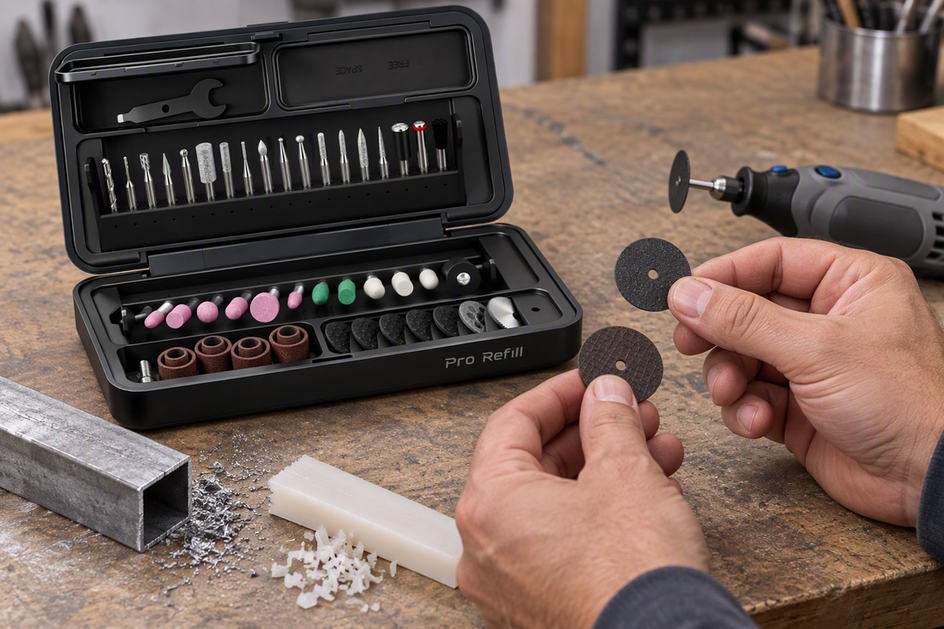 Rotary Tool Cutting Wheels: Diamond vs. Carbide vs. Fiberglass Discs
Diamond, carbide, or fiberglass? Learn why the label on a specific disc, not its material, decides metal or...
Rotary Tool Cutting Wheels: Diamond vs. Carbide vs. Fiberglass Discs
Diamond, carbide, or fiberglass? Learn why the label on a specific disc, not its material, decides metal or...
 How to Connect an Electric Bike Pump to Presta Valves Without Leaking Air
Step-by-step guide to preparing a Presta valve, matching an electric pump's screw-on or push-on head, choosing direct fit...
How to Connect an Electric Bike Pump to Presta Valves Without Leaking Air
Step-by-step guide to preparing a Presta valve, matching an electric pump's screw-on or push-on head, choosing direct fit...
Leave a comment
This site is protected by hCaptcha and the hCaptcha Privacy Policy and Terms of Service apply.