












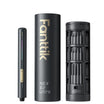
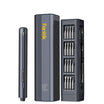
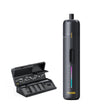
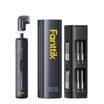
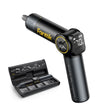






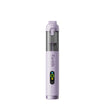


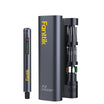
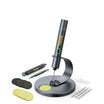
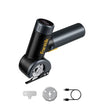

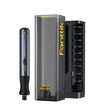
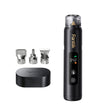
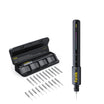


Short answer: an electric screwdriver drives screws with controlled torque, typically 0.05–8 N·m at 180–270 RPM. A drill makes holes, typically 20–70 N·m at 400–1,500+ RPM. If your work is assembling furniture, opening electronics or swapping fixtures, you want a screwdriver. If you need to bore into wood, metal or masonry, you need a drill. They are not substitutes.
The Real Difference Is Torque Class, Not Brand or Price
Most comparisons of these two tools stop at "one is smaller." That is true but not useful. The difference that actually decides which one you should own is torque — rotational force, measured in newton-metres (N·m) — and the speed at which that force is delivered.
Put the published numbers side by side and the gap is not incremental. It is roughly an order of magnitude.
| Tool class | Typical torque | Typical speed | Built to |
|---|---|---|---|
| Precision electric screwdriver | 0.05–0.6 N·m | 180–270 RPM | Electronics, eyewear, watches, small fasteners |
| Cordless electric screwdriver | 0.5–8 N·m | ~250 RPM | Furniture, fixtures, appliances, general household screws |
| Cordless drill / driver | 20–70 N·m | 400–1,500+ RPM (2 speeds) | Drilling holes, long screws into timber, heavier construction |
| Impact driver | 100–200 N·m | 2,000–3,000 RPM | Lag bolts, decking, seized fasteners |
Precision and cordless screwdriver figures above are Fanttik's published specifications for its own range. Drill and impact driver figures are the general ranges for consumer cordless tools; exact numbers vary by model and manufacturer, so check the spec sheet of any drill you are considering.
The practical reading of this table: a screwdriver is not a weak drill. It is a tool designed around a completely different problem — not stripping the screw and not damaging what you are screwing into — and it solves that problem by deliberately limiting how much force it can apply.
What an Electric Screwdriver Does That a Drill Cannot
It stops before it destroys the fastener
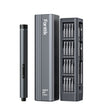
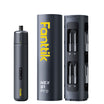
The defining feature of an electric screwdriver is the torque setting. Fanttik's precision models step between 0.05 and 0.6 N·m; the S2 Pro and S2 Pro Max step from 0.5 all the way up to 6 N·m. You pick a setting that is strong enough to seat the screw and too weak to keep turning once it is seated.
A drill has no such ceiling in its normal driving mode. It will happily keep applying 40 N·m to a 1.4 mm laptop screw, and it will strip the head, crack the plastic boss, or spin the threaded insert out of the housing. Torque limiting is not a convenience feature. It is the entire reason the category exists.
It fits where a drill physically cannot
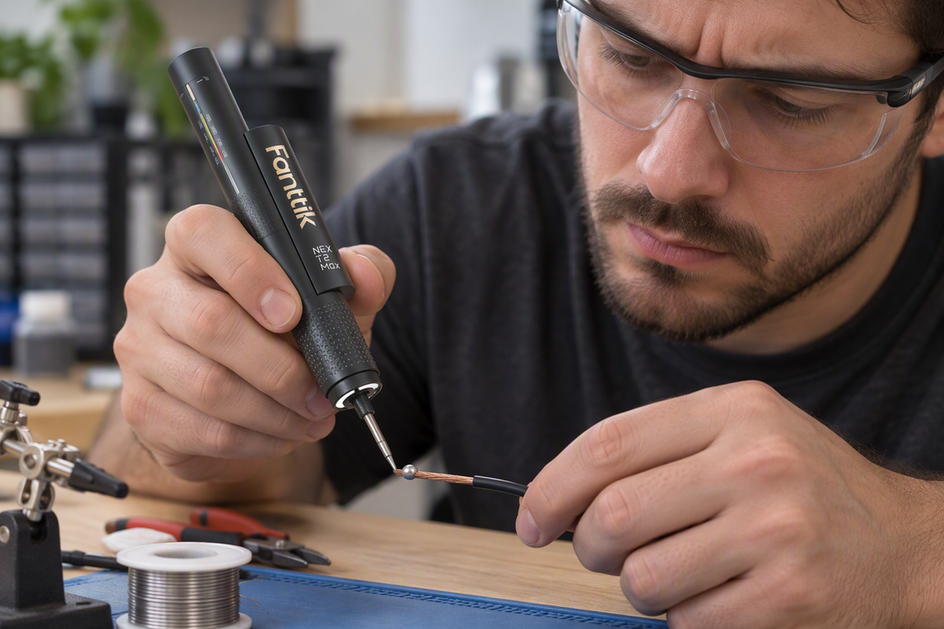
A precision screwdriver is roughly pen-sized. A cordless drill with a chuck and a battery pack is not. Anyone who has tried to reach a screw inside a car door card, behind a monitor mount, or at the back of a kitchen cabinet knows this is not a minor point — form factor decides whether the job is possible at all, not just whether it is comfortable.
It runs quietly and one-handed
At 180–270 RPM a screwdriver is quiet enough to use at a desk at night and light enough to hold in one hand while the other holds the workpiece. Both matter more than people expect for repair work, where you spend most of the time positioning parts rather than turning screws.
What a Drill Does That an Electric Screwdriver Cannot
Make holes
This is the honest dividing line. Drilling requires sustained high RPM and enough torque to keep the bit cutting under load. An electric screwdriver has neither. It will not drill a pilot hole in a stud, it will not open a hole in sheet metal, and it will stall and heat up if you try.
Drive long or large fasteners
A 3-inch deck screw into pine, a lag bolt, a 6 mm coach screw — these need torque an electric screwdriver does not have. At 8 N·m, the top of Fanttik's own cordless screwdriver range is well short of what these fasteners demand. We would rather say that plainly than let you buy the wrong tool.
Masonry and hammer action
Anything involving brick, concrete or tile needs a hammer drill or SDS drill. No screwdriver of any brand is a candidate.
Can an Electric Screwdriver Replace a Drill?
For a specific and fairly common set of people, yes — and it is worth being concrete about who they are, because "buy both" is lazy advice.
A screwdriver alone is enough if your tool use is assembling flat-pack furniture, mounting light fixtures and shelves into existing holes or drywall anchors, opening and repairing electronics, changing outlet and switch plates, and general small household fastening. This is the majority of what most apartments and homes actually require. In this scenario a drill sits in a cupboard and gets used twice a year.
You need a drill as well if you regularly make new holes, work with timber framing or hardwood, mount heavy items into studs or masonry, or do any construction-adjacent DIY.
If you can only buy one and you are unsure, the deciding question is: do you need to make holes? If yes, buy the drill first — a drill can drive screws badly, whereas a screwdriver cannot drill at all. If no, buy the screwdriver; it will be the tool you actually reach for, and it will do the job better than a drill would.
Choosing an Electric Screwdriver: Three Things That Matter
1. Match the torque range to your fasteners, not to the highest number
More torque is not better here — it is just different. Electronics repair lives between 0.05 and 0.6 N·m; a 4 N·m tool aimed at a MacBook screw is as wrong as a drill. Furniture and household work lives roughly between 1 and 8 N·m. Buy for the band you actually work in, and prefer a model with more settings inside that band over one with a higher ceiling.
For reference, Fanttik's published torque ranges: E1 and E1 Pro at 0.05/0.2 N·m in 2 settings, E2 Max at 0.05/0.2/0.4 N·m in 3, E2 Ultra at 0.05/0.1/0.2/0.4/0.6 N·m in 5, S1 Pro at 1.5/3/4.2 N·m in 3, and S2 Pro and S2 Pro Max stepping 0.5/1/2/3/4/5/6 N·m.
2. Check the bit count and standard, not just the tool
A precision screwdriver is only as useful as the bits it ships with. Modern electronics use Pentalobe, Torx Security, Tri-point and Y-type heads that a standard Phillips set will not touch. Fanttik's E1 ships with 12 S2 magnetic bits, the E1 Max and E2 series with 50. If you repair phones, consoles or laptops, bit coverage will matter more to you day to day than an extra 20 RPM.
3. Decide whether you need manual mode
The final quarter turn on a small screw is best done by hand — powered driving there is exactly how threads get stripped. Fanttik's precision models list a Power/Manual working mode so the tool can be used as a normal screwdriver for that last turn. If you work on anything delicate, treat this as a requirement rather than a bonus.
Which Fanttik Screwdriver Fits Which Job
| If your work is… | Torque you need | Model |
|---|---|---|
| Cameras, watches, general precision repair | 0.05–0.2 N·m | E1 · E1 Pro |
| Phones, laptops, consoles — wide bit coverage | 0.05–0.4 N·m | E1 Max · E2 Max |
| Small appliances, PC, RC cars | 0.05–0.6 N·m | E2 Ultra |
| Furniture installation, PC repair | 1.5–4.2 N·m | S1 Pro |
| Furniture installation and PC repair, higher torque | 0.5–6 N·m | S2 Pro · S2 Pro Max |
| Drilling holes, decking, masonry | 20 N·m and above | Not a screwdriver job — use a drill |
Torque and bit figures are Fanttik's published specifications. Browse the full range on the Fanttik electric screwdriver collection.
FAQ
Is an electric screwdriver the same as a cordless drill?
No. An electric screwdriver drives screws at controlled torque — 0.05 to 8 N·m across Fanttik's range, at 180–270 RPM. A cordless drill makes holes at 20–70 N·m and 400–1,500+ RPM. The screwdriver's torque limit is a design feature that prevents stripped screws; the drill's higher output is what lets it cut.
Can an electric screwdriver drill holes?
No. It lacks both the speed and the sustained torque to keep a drill bit cutting, and attempting it will stall the motor and generate heat. If you need holes, you need a drill.
Do I need both a drill and an electric screwdriver?
Only if you make holes. If your work is furniture assembly, electronics repair, fixtures and general household screws, a screwdriver alone covers it and will do those jobs better than a drill. If you drill into studs, hardwood or masonry, you need a drill in addition — the screwdriver will not substitute.
Which has more torque, a drill or an electric screwdriver?
A drill, by a wide margin — roughly 20–70 N·m versus 0.05–8 N·m. That is the point of the distinction. For small fasteners the drill's advantage is a liability, not a benefit, because there is nothing to stop it over-tightening.
Can I use a drill to assemble flat-pack furniture?
You can, carefully, on its lowest clutch setting. Most damage to flat-pack furniture comes from over-driving cam bolts and confirmat screws into chipboard, which a drill makes easy to do. A screwdriver set to 2–4 N·m removes that risk.
What torque do I need for electronics repair?
Between 0.05 and 0.6 N·m for almost all consumer electronics. Phone and laptop screws sit at the low end. Any tool whose lowest setting is above roughly 1 N·m is not suitable for this work regardless of what it costs.
Related Guides

Continue reading
 How to Choose the Right Screwdriver Bit? (2026)
Using the wrong screwdriver bit strips screws and wrecks gadgets during DIY repairs. Fanttik E1 Max electric screwdriver...
How to Choose the Right Screwdriver Bit? (2026)
Using the wrong screwdriver bit strips screws and wrecks gadgets during DIY repairs. Fanttik E1 Max electric screwdriver...
 Why Different Cars Need Different Tires? (2024 Updated)
From EVs to SUVs, find the right tires to transform your drive. Learn how tire specs impact your...
Why Different Cars Need Different Tires? (2024 Updated)
From EVs to SUVs, find the right tires to transform your drive. Learn how tire specs impact your...
Leave a comment
This site is protected by hCaptcha and the hCaptcha Privacy Policy and Terms of Service apply.