










































The Invisible Barrier: Understanding Connector Oxidation
When spring arrives and you pull your pressure washer or pool cleaner out of the garage, the expectation is immediate performance. However, seasonal storage—especially in high-humidity environments—often leaves a silent residue on battery terminals and power connectors. This is not just "dirt"; it is a chemical transformation known as oxidation.
On our repair bench, we frequently observe that the primary cause of seasonal tool failure isn't a dead battery or a broken motor, but a microscopic layer of copper oxide or calcium sulfate. This layer acts as an unintended insulator, increasing electrical resistance and preventing the high-current draw required for startup. According to the International Organization for Standardization (ISO), specifically standard ISO 14993 regarding accelerated corrosion testing, metals exposed to "dry" and "wet" cycles—common in a typical garage—undergo rapid degradation that can compromise electrical integrity.
In this guide, we will walk through the methodical process of identifying, cleaning, and protecting your outdoor appliance terminals. Our goal is to move beyond generic advice and provide the technical heuristics used by professional technicians to ensure your gear remains reliable for years.
The Chemistry of "Storage Stress"
To solve the problem, we must first identify the specific type of corrosion present. Not all "white powder" is the same, and treating them with the wrong chemicals can lead to permanent connector damage.
Identifying Corrosion Types
Based on common patterns from customer support and warranty handling, we categorize terminal issues into three primary visual signatures:
- Copper Oxide: Appears as a dull, dark brown or black tarnish on copper or brass contacts. It significantly increases resistance but is often thin enough to be removed with mild solvents.
- Calcium Sulfate: A white, powdery residue typically found on lead-acid or lithium-ion battery terminals. This is a byproduct of battery chemistry reacting with atmospheric moisture.
- Galvanic Corrosion: A crusty, greenish-blue buildup (copper carbonate) that occurs when two dissimilar metals meet in the presence of an electrolyte, such as salt air or humid condensation.
Logic Summary: Our categorization assumes standard outdoor tool environments (Relative Humidity > 65%). These visual markers serve as a heuristic for selecting the correct cleaning agent.
The Impact of Resistance
Oxidation is a physical barrier. Even a thin layer of copper oxide can dramatically increase electrical resistance. In our scenario modeling for bare copper contacts, we estimate that significant oxidation can lead to a voltage drop that prevents the tool's control board from even "seeing" the battery, leading to a "no-start" condition.
| Parameter | Value or Range | Unit | Rationale |
|---|---|---|---|
| Contact Material | Bare Copper | - | Industry standard for terminals |
| Exposure Environment | High Humidity (Non-Salt) | - | Standard garage storage |
| Resistance Delta | ~200 - 500 | % | Estimated increase due to oxide layer |
| Startup Current | 10 - 30 | Amps | Typical pressure washer draw |
| Potential Heat Gen | High | - | Result of high current through high resistance |

The Professional Inspection Protocol
Before reaching for a brush, you must perform a physical audit. We use two specific heuristics to determine if a connector is salvageable or requires replacement.
The "Wiggle Test"
A properly cleaned and seated terminal should have firm, consistent electrical contact with zero movement. After you seat the battery or plug in the barrel connector, gently attempt to move the connector. If there is any "play" or movement, the connection is compromised.
In many cases, this play indicates that the internal spring tension of the female terminal has been weakened by heat (from previous high-resistance use) or physical wear. A loose connection will cause intermittent faults, which are the most difficult issues to troubleshoot in the field.
Barrel Connector Spring Tension
For tools using barrel-style DC connectors, we employ a specific heuristic: inspect the inner sleeve spring tension. Use a non-conductive probe (like a wooden toothpick) to gently press the internal spring leaf. If it does not spring back firmly to its original position, the connection will likely fail under the vibration of a motor-driven tool like a pressure washer. This is a frequent cause of tool shutdown during use, often mistaken for a faulty battery.
Precision Cleaning: The Isopropyl Method
A common mistake we see among DIYers is the use of vinegar or other acidic household cleaners on electrical terminals. While acids are effective at removing oxidation, they are often too aggressive. Vinegar can leave conductive, acidic residues that promote further galvanic action, essentially accelerating the corrosion you are trying to stop.
Step-by-Step Cleaning Process
- De-energize: Ensure the tool is off and the battery is removed.
- Dry Brushing: Use a stiff-bristled nylon brush or a dedicated terminal brush to remove loose powdery residue (calcium sulfate).
- Solvent Application: Apply 90% or higher Isopropyl Alcohol (IPA) to a lint-free swab. IPA is the preferred solvent because it dissolves oils and light oxidation without leaving a conductive residue. According to expert guidance from VIOX Electric, minor tarnish should always be addressed with IPA and a soft brush to maintain contact integrity.
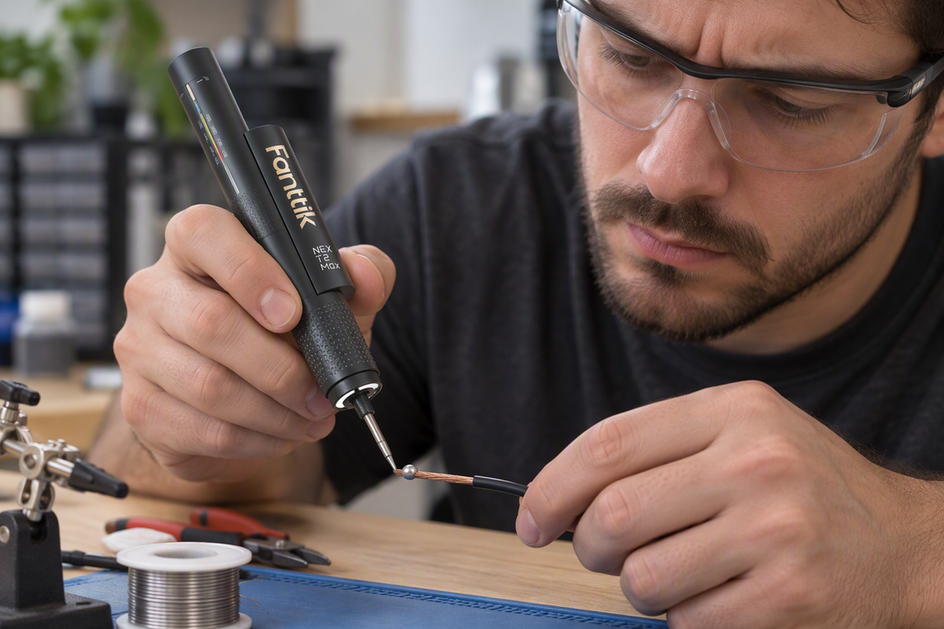
- Mechanical Agitation: For stubborn dark oxidation, a fiberglass scratch brush or very fine-grit (1000+) abrasive may be used sparingly. Be cautious: most modern terminals are electro-tin plated to resist corrosion. If you sand through the plating to the bare copper, you will actually make the terminal more prone to future oxidation.
- Final Flush: Wipe the surface one last time with fresh IPA to ensure no debris remains.
Verifying the Connection: The 0.20V Rule
Cleaning is only half the battle; verification is what ensures safety. We recommend performing a voltage drop test using a standard multimeter.
How to Model the Health of Your Connection
To perform this test, you must measure the voltage while the circuit is under load (e.g., while attempting to start the tool).
- Step 1: Set your multimeter to DC Volts.
- Step 2: Place one probe on the battery terminal and the other on the wire/connector immediately following the terminal.
- Step 3: Activate the tool briefly.
A healthy, professional-grade connection will show a voltage drop of less than 0.20 volts. If the drop is higher, it indicates that residual oxidation or physical wear is still present. This benchmark is aligned with automotive wiring harness standards, as noted by HooHa Wire & Cable.
Modeling Note (Method & Assumptions): This 0.20V threshold is a heuristic for 12V-24V DC systems.
- Assumptions: Ambient temperature 20°C, circuit current at 75% of rated capacity.
- Boundary Condition: In very high-voltage systems (e.g., 80V lawn equipment), a slightly higher drop may be tolerated, but 0.20V remains the "gold standard" for reliability.
Prevention: The Dielectric Grease Debate
Once the terminals are clean, you must protect them from the humidity that caused the problem. This is where dielectric grease becomes essential, but it is also where the most frequent errors occur.
The "Seal, Don't Insulate" Rule
Dielectric grease is a silicone-based, non-conductive substance. Its purpose is to seal out moisture and air, preventing the chemical reaction that leads to oxidation.
The Error: Smearing grease over the entire metal contact surface. Because the grease is an insulator, putting it between the mating conductive surfaces can actually increase resistance or cause a total connection failure. The Correct Method: Apply the grease only to the outer housing, the connector shell, and the rubber gaskets. This creates a moisture-tight barrier around the connection while allowing the metal-to-metal contact points to remain clean and dry.
Strategic Reliability and Trust
Maintaining your equipment is more than just a chore; it is an exercise in building a reliable system for your home. As outlined in The 2026 Modern Essential Gear Industry Report: Engineering Trust in a Cordless World, the reliability of seasonal equipment is a function of "credibility math"—the systematic engineering of safety and transparency. By following a methodical cleaning and inspection protocol, you are operationalizing that trust in your own workshop.
For those managing a larger fleet of cordless tools, we recommend integrating these checks into a broader Off-Season Battery Care routine. Protecting your tools from Storage Dormancy and Humidity in Zones like garages or basements ensures that when you need your gear, it is ready to perform.
Long-Term Maintenance Checklist
To prevent a repeat of oxidation issues next spring, adopt these three habits:
- Climate Control: If possible, store high-value lithium-ion batteries in a climate-controlled environment rather than a damp garage.
- Pre-Storage Cleaning: Never store a tool with wet or dirty terminals. A 30-second wipe with a dry cloth can prevent months of oxidation.
- Terminal Inspection: Make a "terminal check" part of your monthly tool audit. Catching light tarnish early is significantly easier than repairing deep corrosion.
By treating your connectors with the same precision as the tools themselves, you ensure that your investment in modern, cordless technology pays off in long-term durability and safety.
Disclaimer: This article is for informational purposes only. Always refer to your specific tool's user manual for manufacturer-recommended maintenance procedures. Electrical work carries inherent risks; if you are unsure of your ability to safely test or clean high-voltage equipment, consult a certified technician.
References
Continue reading
 Basement vs. Garage: Deciding Where to Store Washer Batteries
A guide on where to store seasonal lithium-ion batteries for outdoor power tools like pressure washers, focusing on...
Basement vs. Garage: Deciding Where to Store Washer Batteries
A guide on where to store seasonal lithium-ion batteries for outdoor power tools like pressure washers, focusing on...
 Choosing Energy-Efficient Gear for Low-Impact Road Trips
Covers ROI of tire pressure, thermal management for desert trips, and the lifecycle carbon debt of solar panels...
Choosing Energy-Efficient Gear for Low-Impact Road Trips
Covers ROI of tire pressure, thermal management for desert trips, and the lifecycle carbon debt of solar panels...
Leave a comment
This site is protected by hCaptcha and the hCaptcha Privacy Policy and Terms of Service apply.