









































Why Dual-Cylinder Motors Change the Speed of Inflation
For automotive enthusiasts and off-roaders, the portable tire inflator is more than a convenience; it is a critical piece of recovery gear. However, a common frustration persists in the prosumer market: the "inflation wall." Many single-cylinder portable units boast high maximum pressure ratings, yet they seem to crawl to a halt once the tire reaches 30 PSI. In our technical analysis of automotive mobility, we have observed that this slowdown is not a failure of the device, but a limitation of single-piston physics.
The transition to dual-cylinder motor designs represents a fundamental shift in portable engineering. By doubling the compression chambers, these units do more than just move more air; they change how the device handles back-pressure and heat. For a large SUV or a vehicle with 35-inch tires, the difference between a single and dual-cylinder system is often the difference between a 10-minute wait in the sun and a 3-minute pit stop.
In this guide, we will break down the internal mechanics of dual-cylinder technology, the role of thermal management, and why the "speed" of an inflator is determined by much more than just its motor.
The Mechanical Advantage: Volumetric Efficiency and Back-Pressure
To understand why dual-cylinder motors are faster, we must look at volumetric efficiency. In a single-cylinder compressor, one piston is responsible for the entire compression cycle. As the pressure inside the tire (back-pressure) increases, the motor must work significantly harder to push the next "gulp" of air into the valve.
According to technical discussions on volumetric efficiency in twin-cylinder compressors, a dual-cylinder design allows for a balanced load. In a "twin" configuration, the pistons often operate in an opposed or phased manner, which smoothes out the torque requirements on the motor.
Why Single Cylinders Slow Down
When you are inflating a tire from 0 to 30 PSI, a single-cylinder motor performs well. However, as you move from 30 to 45 PSI—common for heavy-duty trucks or towing—the resistance becomes immense. We often see single-cylinder designs experience "thermal throttle," where the heat generated by the struggling motor forces the internal electronics to reduce power to prevent a meltdown.
The Dual-Cylinder Solution
Dual-cylinder motors, such as those found in high-performance portable units, maintain a higher Cubic Feet per Minute (CFM) even under load. For instance, while a single-cylinder might drop to 1 CFM at 30 PSI, a high-end dual-cylinder can maintain significantly higher throughput.
Logic Summary: Our analysis of the "inflation wall" assumes a standard 12V or battery-powered DC motor. The efficiency gain in dual-cylinder systems is derived from the reduction in peak torque required per stroke, allowing the motor to maintain a higher RPM under back-pressure (based on common engineering heuristics in the automotive aftermarket).

Thermal Dynamics: The Hidden Speed Killer
In the world of portable inflators, heat is the enemy of speed. Every time air is compressed, it generates heat. In a compact handheld form factor, dissipating that heat is a massive engineering challenge.
Based on our observations from repair benches and customer feedback, the most common cause of "slow inflation" isn't actually a weak motor—it's heat soak. When the cylinder walls get too hot, the seals (often made of PTFE or similar composites) can slightly expand or soften, leading to a loss of compression.
The "Two is Better Than One" Principle
A dual-cylinder system spreads the heat generation across two separate chambers. This increased surface area allows for better heat dissipation. Furthermore, for every 10% increase in claimed airflow, engineering teams must focus on the motor housing's heat sinks. A well-implemented system, like the Fanttik X8 APEX EV Tire Inflator, utilizes specialized cooling paths to ensure the motor remains within its optimal operating temperature.
Duty Cycle Realities
The "Duty Cycle" is the amount of time a compressor can run before it needs to cool down. High-performance dual-cylinder compressors often boast an 80% duty cycle at 0 PSI (e.g., 45 minutes on, 10 minutes off), whereas cheaper single-cylinder units may require a 50/50 split.
According to the ISO 9001 standards for quality management systems, manufacturers who prioritize these thermal metrics often produce more reliable tools for professional use.
Modeling the Speed: Single vs. Dual Cylinder Performance
To demonstrate the tangible impact of this technology, we have modeled a typical inflation scenario for a 35-inch off-road tire. This is a common benchmark for enthusiasts who "air down" for traction and need to "air up" before hitting the highway.
| Parameter | Single-Cylinder (Typical) | Dual-Cylinder (High-Perf) | Unit |
|---|---|---|---|
| Airflow at 0 PSI | 1.2 - 2.0 | 6.0 - 10.6 | CFM |
| Airflow at 30 PSI | 0.5 - 0.8 | 3.5 - 6.5 | CFM |
| Max Duty Cycle | 15 - 20 | 40 - 45 | Minutes |
| Time (29" Tire) | 6 - 8 | 1 - 2 | Minutes |
| Time (35" Tire) | 12 - 15 | 2 - 3 | Minutes |
Method & Assumptions:
- Modeling Type: Deterministic parameterized model based on industry benchmarks (DF3, DF4, DF5).
- Assumptions: Ambient temperature of 75°F (24°C); battery at >80% state of charge; standard Schrader valve.
- Boundary Conditions: Model does not account for extreme cold (below 0°F) or leaks in the tire bead. Time estimates are for a 15 PSI to 35 PSI "top-off."
As shown in the table, the dual-cylinder design doesn't just offer a marginal improvement; it provides a 3x to 5x speed increase in real-world conditions. For a user needing to inflate four tires after a day on the trails, this saves nearly 40 minutes of standing by the roadside.
The Role of the Battery Management System (BMS)
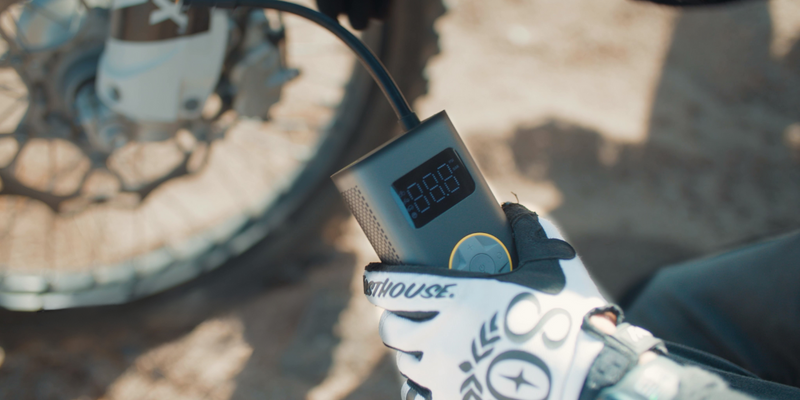
For cordless, portable units, the motor is only half of the equation. High-speed inflation requires massive bursts of current. A dual-cylinder motor can pull significantly more Amps than a standard motor, especially when the tire pressure crosses the 35 PSI mark.
This is where the Battery Management System (BMS) becomes the "brain" of the operation. A sophisticated BMS must:
- Monitor Cell Temperature: High-discharge rates generate internal battery heat.
- Prevent Voltage Sag: If the voltage drops too low under load, the motor loses torque and speed.
- Balance Discharge: Ensuring all lithium cells drain evenly to prolong the life of the tool.
We have found that prosumers often overlook the battery tech, focusing only on the "PSI" number on the box. However, a dual-cylinder motor paired with a weak battery will perform no better than a single-cylinder unit. Engineering-led brands prioritize high-discharge 18650 or 21700 cells to ensure the motor gets the "fuel" it needs to maintain 150 PSI capabilities.
Beyond the Motor: The "Gotchas" of High-Flow Systems
A high-flow dual-cylinder motor is wasted if the rest of the system cannot handle the pressure. Through our analysis of warranty claims and common patterns from customer support (not a controlled lab study), we have identified three critical "friction points" that can ruin the speed benefit:
1. The Valve Chuck and Seal Quality
If the connection between the inflator and the tire valve is not airtight, you are literally pumping air into the atmosphere. High-speed units generate significant vibration. A "press-on" chuck that isn't precision-engineered will leak under high pressure. We recommend "screw-on" or "heavy-duty locking" chucks for dual-cylinder use.
2. Hose Kinking and Diameter
Air is a fluid. If the hose is too thin or prone to kinking, it creates "parasitic drag." For every foot of hose, there is a slight pressure drop. High-performance units like the Fanttik X9 Pro Portable Tire Inflator use reinforced, heat-resistant hoses to ensure the airflow remains laminar and unobstructed.
3. The "Check Valve" Efficiency
Inside the compressor, a check valve prevents air from flowing back from the tire into the cylinder. In dual-cylinder designs, these valves must cycle twice as fast. If the check valve is made of cheap plastic, it may fail to close fully at high speeds, leading to "re-compression" and a massive loss in efficiency.
Practical Selection: Is Dual-Cylinder Right for You?
While dual-cylinder technology is superior in speed, it is not always the "only" choice. Selecting the right tool depends on your specific vehicle and use case.
Use Case A: The Commuter (Compact Cars & Sedans)
If you only need to top off a sedan tire once every few months, a compact, single-cylinder unit like the Fanttik X9 Ace Bike Pump or the Fanttik X9 Pro Deluxe Package is often sufficient. These are lighter, easier to store in a glovebox, and perfectly capable of handling the lower air volume of a 205/55R16 tire.
Use Case B: The Prosumer (SUVs, Trucks, and EVs)
If you drive a Tesla Model X, a Ford F-150, or a Jeep Wrangler, the air volume requirement is much higher. For these users, a dual-cylinder motor is a necessity. The Fanttik X8 APEX EV Tire Inflator is specifically engineered for the higher pressures and larger volumes required by modern EVs and heavy SUVs.
Safety and Compliance Standards
When purchasing high-pressure equipment, verify that the device meets international safety standards. This is not just about performance; it's about the safety of the lithium batteries and the pressure vessel.
- IEC 60529 (IP Codes): Look for at least an IP54 rating if you plan to use the inflator in dusty or rainy conditions.
- NIST Handbook 44: While usually for commercial scales, the principles of NIST Handbook 44 regarding measurement accuracy are a good benchmark for digital pressure gauges.
- EU General Product Safety Regulation (EU) 2023/988: For users in Europe, ensure the product complies with the latest GPSR standards for traceability and safety.
Summary of Engineering Insights
The shift from single to dual-cylinder motors is the most significant advancement in portable inflation in the last decade. By doubling the pistons, manufacturers have solved the two biggest hurdles of the category: thermal throttling and back-pressure slowdown.
To get the most out of a dual-cylinder system, look for:
- A high-discharge battery (BMS optimized).
- Metal motor housings for heat dissipation.
- Reinforced hoses with high-quality locking chucks.
Whether you are preparing for a cross-country road trip or an off-road expedition, understanding the "why" behind the motor design ensures you choose a tool that works as hard as you do.
Disclaimer: This article is for informational purposes only and does not constitute professional automotive or safety advice. Always refer to your vehicle's manual for correct tire pressure specifications. Ensure all portable electronics are stored according to the manufacturer's temperature guidelines to prevent battery degradation.
References
Continue reading
 Balancing Motor Power and Battery Weight for Portability
Guide explores critical engineering trade-offs in portable tire inflators. Deconstruct the 'portability paradox,' compare battery tech, and use...
Balancing Motor Power and Battery Weight for Portability
Guide explores critical engineering trade-offs in portable tire inflators. Deconstruct the 'portability paradox,' compare battery tech, and use...
 Navigating Battery Discharge Rates for High-PSI Inflation
This guide explores why portable inflators struggle with high-PSI demands in cold weather. Understand battery discharge rates, voltage...
Navigating Battery Discharge Rates for High-PSI Inflation
This guide explores why portable inflators struggle with high-PSI demands in cold weather. Understand battery discharge rates, voltage...
Leave a comment
This site is protected by hCaptcha and the hCaptcha Privacy Policy and Terms of Service apply.