






































Ergonomic Grip Techniques to Minimize DIY Wrist Fatigue
For many DIY enthusiasts and precision hobbyists, the "30-minute wall" is a familiar frustration. You begin a project—perhaps a delicate electronics repair or a detailed scale model—with steady hands and high focus. Yet, within half an hour, a dull ache begins to radiate through your thumb web, followed by a tightening in the forearm. This isn't just a sign of hard work; it is often a symptom of poor tool ergonomics and improper grip mechanics.
In our experience on the repair bench, we have observed that the single biggest contributor to wrist fatigue is rarely the tool's power or the complexity of the task. Instead, it is the result of unbalanced weight distribution and the "micro-corrections" your muscles must perform to compensate for it. When a tool is front-heavy or poorly balanced, your forearm stabilizers work overtime just to keep the bit seated.
This guide provides a methodical framework for mastering ergonomic grip techniques. By understanding the biomechanics of your hand and the physics of your tools, you can extend your comfortable working time and maintain the precision required for high-level DIY projects.

The Physics of Fatigue: Why Balance Trumps Mass
A common misconception among hobbyists is that a lighter tool is always better for preventing fatigue. However, our analysis of tool-to-hand interaction suggests that weight distribution is a far more critical variable than total mass. A tool that weighs 10 ounces but is perfectly balanced at the grip point will feel significantly "lighter" over an hour than a 6-ounce tool that is front-heavy.
When a tool is unbalanced, it creates a "lever effect." Your wrist must apply constant counter-pressure to prevent the tool from dipping or wandering. This forces the small muscles of the wrist and thumb into a state of static loading—a primary cause of repetitive strain.
The One-Minute Balance Test
To evaluate any handheld tool, we recommend a simple heuristic used by professional electronics assemblers:
- Hold the tool in your standard working position (e.g., a "pen grip" for precision work).
- Maintain this position for exactly sixty seconds without moving.
- Focus on the sensory feedback: Do you feel tension building in your thumb web? Is there a "pulling" sensation in the top of your forearm?
If tension arises within that minute, the tool's balance is likely off, or your grip is too tight. A well-balanced tool should feel like an extension of your hand, requiring almost zero conscious effort to keep steady.
Logic Summary: This "1-minute hold" test is a qualitative self-check based on common patterns from customer support and repair bench observations. It identifies early-stage muscle recruitment that leads to fatigue (not a controlled lab study).
Grip Mechanics: Handle Geometry and the "Gap Rule"
The diameter of your tool's handle is not just a matter of comfort; it dictates the amount of force your hand must generate to maintain control. According to the CDC/NIOSH guidelines on ergonomics and musculoskeletal disorders, improper tool fit can lead to excessive grip force, which is a leading risk factor for wrist injuries.
The Fingertip-Palm Heuristic
A practical rule of thumb for tool selection is the "Gap Rule." When you wrap your hand around a tool handle in a power grip (where the fingers wrap fully around), your fingertips should not meet your palm. There should be a slight gap—roughly the width of your pinky finger.
- Too Small: If your fingertips touch your palm, you are "over-gripping," which puts excessive strain on the tendons in your wrist.
- Too Large: If the handle is too thick, your hand cannot form a secure enclosure, forcing you to rely on "pinch force," which fatigues the thumb muscles rapidly.

Torque Feedback and Over-Gripping
For precision screwdriving, we often see users make the mistake of using high-torque settings for small fasteners. This creates a physiological feedback loop: the tool's motor creates a "kick," and the user instinctively grips harder to control the tool. You are no longer gripping to turn the screw; you are gripping to fight the tool.
To mitigate this, always match the tool's torque to the fastener. In delicate electronics, a low-torque setting combined with a "precision grip" (holding the tool like a pencil) allows the tool to do the work while your hand remains relaxed.
Advanced Positioning: The Pivot Principle
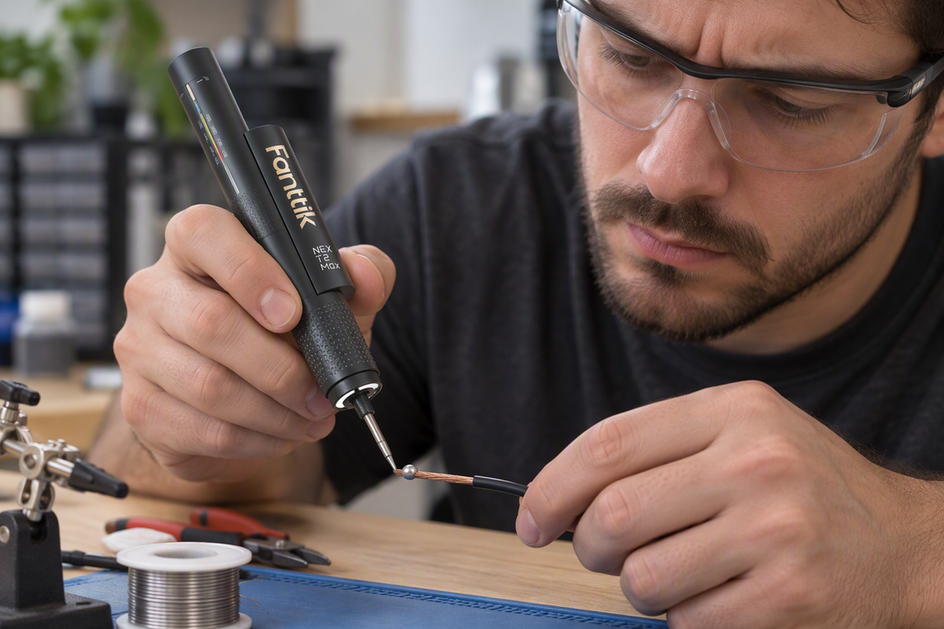
One of the most effective ways to reduce wrist strain is to stop using your wrist as the primary stabilizer. Professionals in soldering and rotary tool work emphasize the importance of supporting the tool, not just guiding it.
Creating a Stable Pivot Point
Instead of hovering your hand in the air, rest the heel of your hand or your pinky finger on the workpiece or the workbench. This creates a stable pivot point.
- The Mechanism: By anchoring a part of your hand, you transfer the load from the small, delicate muscles of the wrist to the larger, more robust muscles of the arm and shoulder.
- The Benefit: This dramatically increases your precision while reducing the "micro-tremors" that occur when muscles begin to fatigue.
Proximal Joint Adaptation
In confined spaces—such as the interior of a PC chassis or an automotive dashboard—maintaining a "neutral" wrist is often impossible. According to expert ergonomic guidance from OHSE, when the wrist must be bent, the focus should shift to "proximal joint adaptation."
This means using your elbow and shoulder to position your hand, rather than twisting your wrist to reach the target. If you find yourself "cocking" your wrist to the side, stop and reposition your entire body or the workpiece.
The "Weekend Warrior" Risk: Acute vs. Chronic Strain
Hobbyists often face a unique risk profile compared to professional tradespeople. While professionals deal with chronic, long-term wear, DIYers are prone to "acute" injuries. This is often due to sporadic, high-intensity use—spending eight hours on a Saturday doing a task the body isn't conditioned for.
Research into "weekend warrior" patterns suggests that these users have a significantly higher rate of acute musculoskeletal injuries due to a lack of conditioning and poor technique during intense sessions.
Managing Vibration and HAVS
For those using rotary tools or power drivers, Hand-Arm Vibration Syndrome (HAVS) is a real concern. While modern cordless tools are designed to dissipate vibration, long-duration exposure can still cause "white finger" or numbness.
Aligned with general ergonomic principles found in the ISO Standards Catalogue, we recommend the following "Shop Baseline" for vibration management:
- The 20/5 Rule: For every 20 minutes of continuous tool use, take a 5-minute break to stretch your hands and restore full circulation.
- Grip Pressure: Consciously remind yourself to "loosen the grip." Modern tools with high-friction coatings require less squeeze force to maintain control.
| Grip Type | Primary Muscle Group | Best Use Case | Fatigue Risk |
|---|---|---|---|
| Pencil Grip | Interossei (Fingers) | Precision Screws, Soldering | High (Static Loading) |
| Palm Grip | Forearm Flexors | Sanding, High Torque | Medium (Wrist Deviation) |
| Pivot Grip | Shoulder/Elbow | Detailed Carving, Engraving | Low (Weight Supported) |
Modeling Note: This table is a comparative analysis based on standard biomechanical models of hand function. Impact may vary based on hand size and tool geometry.
Engineering Trust: The Role of Tool Design
The tools you choose play a vital role in your long-term physical health. As highlighted in the industry report The 2026 Modern Essential Gear Industry Report: Engineering Trust in a Cordless World, the market has shifted toward "Trust Architecture." This means tools are now engineered with visible compliance and user-centric benefits like robust thermal design and explicit safety margins.
When selecting gear, look for features that reflect this "modern essential" philosophy:
- Cylindrical vs. Pistol Grips: For precision work, a cylindrical grip often allows for more neutral wrist positions compared to a traditional pistol grip.
- Tactile Feedback: High-quality switches reduce the "activation force" required, meaning you don't have to press as hard to start the tool.
- Integrated Lighting: Proper visibility prevents you from "hunching" over your work, which reduces secondary strain in the neck and shoulders.

Summary of Heuristics for the DIY Bench
To maintain your precision and protect your health during long projects, keep these expert-derived heuristics in mind:
- The 1-Minute Hold: If a tool feels "heavy" in your thumb web after 60 seconds of holding, it is poorly balanced for your hand.
- The Pinky Pivot: Always find an anchor point for your hand to offload the weight of the tool.
- The Gap Rule: Ensure your tool handles allow for a small gap between your fingertips and palm to prevent over-gripping.
- Proximal Movement: Move from the shoulder and elbow first; use the wrist only for the final 5% of precision movement.
By treating your body as the most important tool in your workshop, you can ensure that your DIY journey remains a source of creative satisfaction rather than physical frustration.
Disclaimer: This article is for informational purposes only and does not constitute professional medical advice. Ergonomic needs vary significantly based on individual anatomy and pre-existing conditions. If you experience persistent pain, numbness, or tingling in your hands or wrists, consult a qualified healthcare professional or occupational therapist.
Sources
Continue reading
 Manual vs. Electric: Choosing Drivers for Small Gadgets
Covers tactile feedback mechanisms, safety standards, and a methodical framework to prevent over-torque and repetitive strain.
Manual vs. Electric: Choosing Drivers for Small Gadgets
Covers tactile feedback mechanisms, safety standards, and a methodical framework to prevent over-torque and repetitive strain.
 Safely Extracting Stripped Micro-Screws from Game Consoles
Covers the Two-Finger Rule, bit selection, friction methods, and left-hand drill bits for high-stakes DIY repairs.
Safely Extracting Stripped Micro-Screws from Game Consoles
Covers the Two-Finger Rule, bit selection, friction methods, and left-hand drill bits for high-stakes DIY repairs.

Leave a comment
This site is protected by hCaptcha and the hCaptcha Privacy Policy and Terms of Service apply.