









































The Strategic Dilemma of Multi-Vehicle Safety
Managing a fleet—whether it is a small business’s service vans, a property manager’s utility vehicles, or a household with several cars and a trailer—presents a specific financial challenge. As the team at Fanttik, we have observed many fleet owners fall into the "equal allocation trap," where they spread a limited safety budget evenly across every vehicle. While this feels equitable, it often dilutes the impact of the investment, leaving high-risk units under-equipped while low-risk units receive upgrades they rarely use.
In our experience auditing vehicle readiness, we have found that safety requirements are not a flat line; they follow a curve influenced by mileage, driver experience, and vehicle age. To maximize the ROI of your safety spend, we suggest shifting from a "maintenance" mindset to a "risk-mitigation" mindset. This requires a methodical scoring system to identify which vehicle needs the newest technology first.
As we noted in our industry analysis, The 2026 Modern Essential Gear Industry Report, building a reliable safety infrastructure is a function of "credibility math." It is about making defensible decisions based on measurable data and practical heuristics rather than guesswork.
A Data-Driven Framework for Prioritization
To help operators allocate funds effectively, we utilize a simple but robust Risk Scoring Model. This heuristic allows you to assign a numerical value to the "danger profile" of each vehicle in your fleet.
The Fleet Risk Scoring Model
Based on common patterns we see in roadside assistance requests, we recommend assigning points based on the following criteria:
- High Annual Mileage (+2 points): Any vehicle traveling more than 15,000 miles per year has a significantly higher exposure to road hazards and mechanical fatigue.
- Vehicle Age (+1 point per year over 5 years): Older vehicles often lack modern integrated safety suites and are statistically more prone to battery or tire failure.
- Inexperienced Primary Driver (+2 points): If a vehicle is primarily operated by a driver with less than three years of experience, the risk of a roadside crisis increases due to a frequent lack of "pattern recognition" in emergencies.
- Frequent Passenger/Cargo Transport (+1 point): Vehicles used for carpooling or carrying heavy equipment have a higher "consequence of failure."
Method & Assumptions (Risk Modeling): This model is a deterministic scenario tool designed for small-scale fleets (1–15 vehicles). It assumes that roadside emergencies are a primary cause of unplanned downtime.
Parameter Value/Range Unit Rationale Baseline Risk 0 Points Standard passenger vehicle, <5 years old Mileage Threshold 15,000 Miles/Year Industry average for "high-use" classification Age Threshold 5 Years Typical warranty expiration and tech-cycle limit Driver Experience 3 Years Heuristic threshold for significant reduction in accident rates Consumables Budget 10–15 Percent Internal estimate to maintain tool peak performance
Example Calculation: Prioritizing a 3-Vehicle Fleet
To see how this works in practice, consider this hypothetical fleet:
- Vehicle A (2023 Sedan): 5,000 miles/year, experienced driver. Score: 0. (Priority: Low)
- Vehicle B (2018 Cargo Van): 18,000 miles/year (+2), 6 years old (+1), experienced driver. Score: 3. (Priority: Medium)
- Vehicle C (2015 Pickup): 12,000 miles/year, 9 years old (+4), new hire driver (+2). Score: 6. (Priority: High)
In this scenario, Vehicle C receives the first budget allocation for a high-performance jump starter and tire inflator, even if Vehicle A is the "company flagship."

Immediate ROI: Portable Tools vs. High-End Telematics
A common debate for small fleet owners is whether to invest in expensive telematics systems or high-quality portable tools. For fleets with fewer than 10 vehicles, the fixed costs of subscription-based telematics—including hardware installation and monthly fees—can often lead to a slower ROI compared to immediate-use hardware.
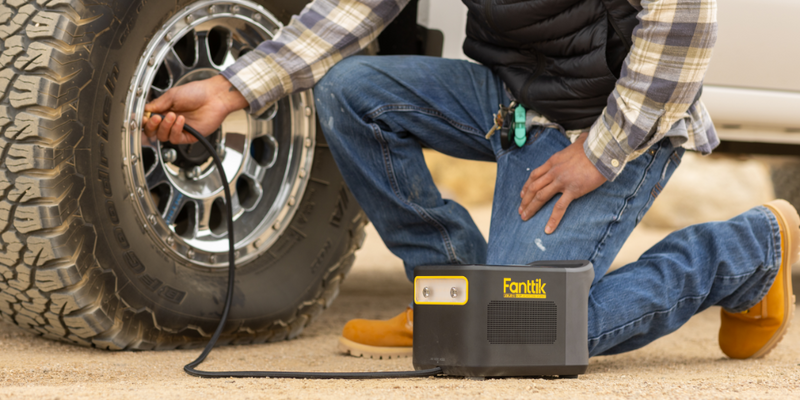
According to research on fleet management ROI, the true cost of technology includes ongoing operational expenses. In contrast, we have observed that high-impact tools like the Fanttik X8 APEX EV Tire Inflator provide an immediate safety net. The ability to perform a roadside pressure check in under three minutes can significantly mitigate the risk of prolonged downtime or tire-related accidents.
The "SUV and Light Truck" Threshold
One critical mistake we often see is choosing an inflator that lacks the power for the fleet’s largest vehicles. If your fleet includes SUVs or light trucks, you need a unit capable of high sustained PSI. While a standard car tire requires ~32 PSI, a fully loaded trailer or heavy-duty truck may require 80 PSI or more. We prioritize units that can reach 150 PSI not because you will always use that maximum, but to provide the "thermal headroom" necessary to fill large tires without the motor overheating.
Standardizing the Maintenance Ecosystem
Standardization is one of the most effective ways to reduce hidden costs. We advocate for choosing a single brand or battery ecosystem for all portable tools.
- Reduced Training Time: If every driver uses the same interface, you eliminate the learning curve during a stressful roadside emergency.
- Simplified Logistics: Standardizing on a platform like the Fanttik F2 PRO Cordless Rotary Tool Kit for minor repairs and the Fanttik B10 Pro Electric Air Duster for cabin maintenance means you only need one type of charging cable (USB-C) across the fleet.
- Muscle Memory: In high-stress situations, "muscle memory" is vital. If the controls are identical across all vehicles, the driver can operate the equipment instinctively, even in the dark.
Budgeting for the Long Haul: Consumables and Compliance
A safety budget should not be viewed as a one-time expense. We recommend two specific financial buffers based on our observations of long-term tool performance:
The Consumables Buffer (10–15%)
Allocate 10–15% of the initial tool cost annually for consumables. This includes:
- Filter bags for portable vacuums.
- Replacement bits for the Fanttik F2 PRO Cordless Rotary Tool Kit.
- Nozzle attachments and hose seals for inflators. Neglecting these small items can lead to "tool degradation," where a high-quality device fails to perform because of a worn-out $5 seal.
The Compliance Contingency (10–15%)
Regulatory environments are dynamic. For example, the EU General Product Safety Regulation (EU) 2023/988 places strict obligations on product traceability. If you operate in regulated industries, your budget must have the flexibility to update gear as safety standards evolve.
Technical Specifications and Safety Standards
When selecting gear, look beyond marketing claims to ensure performance is verifiable and repeatable.
- Battery Safety: Any cordless tool should meet UN 38.3 standards for lithium battery transport. This is critical for preventing thermal runaway if a device is stored in a hot trunk. For more, see our guide on preserving battery health.
- Pressure Accuracy: For tire inflators, look for units calibrated according to NIST Handbook 44 standards. Even a 2 PSI discrepancy can lead to uneven tire wear and reduced fuel efficiency across a fleet.
- Efficiency Modeling (110,000 RPM): Our recommendation for high-RPM motors (like the 110,000 RPM brushless motor in the Fanttik B10 Pro) is based on static pressure. Higher RPMs allow the tool to dislodge debris faster, which reduces the "duty cycle"—the time the tool must run to complete a task—thereby extending the motor's total lifespan.
Ethical and Legal "Duty of Care"
Fleet owners must consider the ethical and legal implications of their budgeting. We advise against creating a "two-tiered" safety system where older vehicles are neglected.
Under "Duty of Care" principles, employers are generally responsible for providing a minimum safety baseline for all operators. Note: Legal definitions of "Duty of Care" vary significantly by jurisdiction (e.g., OSHA in the US vs. HSE in the UK). We recommend consulting a local legal professional to ensure your fleet meets specific regional requirements.
Even if a vehicle has a low risk score, it should be equipped with essentials: a reliable jump starter, a tire inflator, and a basic tool kit. For drivers who spend long hours on the road, wellness is also a safety factor. Reducing driver fatigue—a primary contributor to accidents—can be aided by providing ergonomic rest equipment, such as the FanttikOutdoor Zeta L8 Max Rocker Camping Chair, during required breaks.

Implementing Your Upgrade Plan
To move from theory to action, we suggest a quarterly readiness audit:
- Quarterly Review: Re-score your fleet every three months. A vehicle's risk profile can change quickly due to a new driver or a sudden increase in route density.
- Inventory Check: Verify that all consumables (filters, bits, nozzles) are in stock and functional.
- Documentation: Keep a log of all upgrades. As discussed in our guide on preserving warranty rights, documented upkeep is essential for protecting your equipment investment.
By following this methodical approach, you transform your safety budget from a "sunk cost" into a strategic asset that protects your drivers and your bottom line.
Safety Disclaimer: This article is for informational purposes only. Vehicle maintenance and roadside repairs involve inherent risks. Always consult your vehicle's owner's manual and follow local safety regulations. If you are unsure about a repair, consult a certified mechanic.
References
Continue reading
 Lifecycle Staging: Rotating Primary Gear to Secondary Vehicles
Covers battery health checks, inflation speed benchmarks, and how to implement a semi-annual readiness audit based on military...
Lifecycle Staging: Rotating Primary Gear to Secondary Vehicles
Covers battery health checks, inflation speed benchmarks, and how to implement a semi-annual readiness audit based on military...
 Standardizing User Training for Household Emergency Equipment
Covers scenario modeling for multi-vehicle fleets, inflation efficiency, and a Quarterly Readiness Drill protocol for household resilience.
Standardizing User Training for Household Emergency Equipment
Covers scenario modeling for multi-vehicle fleets, inflation efficiency, and a Quarterly Readiness Drill protocol for household resilience.


Leave a comment
This site is protected by hCaptcha and the hCaptcha Privacy Policy and Terms of Service apply.