









































The Airflow Gap: Why Standard Inflators Fail Custom Builds
Quick Take: For custom builds with 35-inch to 40-inch tires, prioritize a flow rate of at least 1.5 CFM (42.5 LPM) and a 100% duty cycle. Standard "high-pressure" units often lack the volume to seat beads or the thermal endurance to finish four large tires without overheating.
We have all been there. The trail ends, the sun is dipping below the horizon, and you are standing next to a rig running 37-inch mud-terrains. You need to get back to highway pressures for a two-hour drive home. You plug in a standard "high-pressure" inflator, and ten minutes later, you have barely gained 5 PSI, the hose is too hot to touch, and the unit smells like ozone.
For the custom off-road builder, tire inflation is a critical stage of the mechanical workflow. Whether you are seating a bead on a fresh set of beadlocks or airing up after a weekend in the dunes, the physics of large-volume tires demand a different class of tool. Most consumers look at PSI (pounds per square inch) as the primary metric. However, for 35-inch to 40-inch tires, PSI is a secondary concern. The true performance indicator is CFM (Cubic Feet per Minute)—the actual volume of air moved into the tire cavity.
In this guide, we break down the technical requirements for high-volume inflation, backed by internal scenario modeling and field observations. We aim to move beyond marketing jargon to help you select a unit that survives the "two-tire test" and protects your investment in rubber.
The Physics of Volume: CFM vs. PSI
The most common mistake in custom builds is prioritizing maximum PSI over flow rate. A standard inflator might claim 150 PSI, but if it only moves 0.5 CFM, it is functionally inefficient for a 37-inch tire.
Why CFM Matters for Bead Seating
When mounting a tire to a wide off-road rim, you need to "seat the bead." This requires a sudden surge of high-volume air to push the tire sidewall against the rim flange until it "pops" into place. If your inflator lacks sufficient flow, the air escapes through gaps faster than the unit can pump it in.
Based on our practical benchmarks, we suggest a minimum sustained flow of 1.5 CFM at 30 PSI (approximately 42.5 LPM) for tires 35 inches and larger. This provides the "slug" of air necessary to overcome the initial resistance of the tire carcass.
Heuristic Rule: Our CFM recommendations are based on a "Flow-to-Cavity Ratio." For a 37x12.5R17 tire (approx. 130 liters), a 1.5 CFM flow rate allows for a 0-to-30 PSI fill in roughly 8–9 minutes. Units below this threshold typically experience excessive heat buildup before the task is complete.
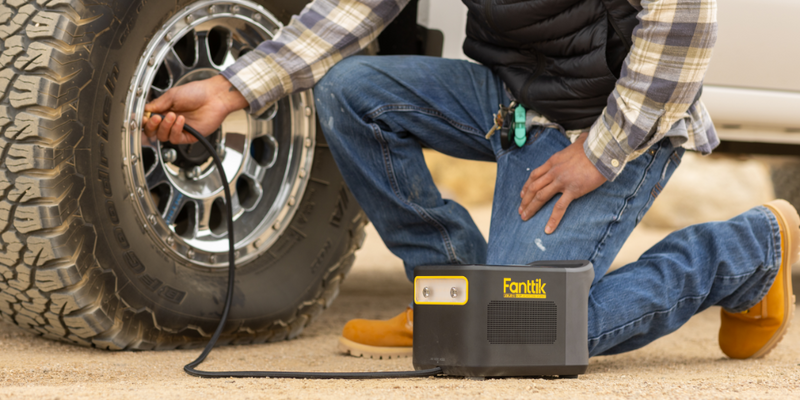
Thermal Management and the "Two-Tire Test"
In the off-road community, we use a practical rule of thumb called the "Two-Tire Test." If an inflator cannot fill two large tires back-to-back without requiring a 20-minute cool-down, it is a liability on the trail.
The Reality of Adiabatic Heating
When air is compressed, it generates heat—a fundamental law of thermodynamics. In high-volume scenarios, the air exiting the compressor head can reach temperatures as high as 85°C (185°F). Lower-tier units using plastic internal components or thin-walled hoses often fail under this thermal load.
We modeled the cumulative heating for a set of four 37-inch tires. While the first tire might be filled easily, the fourth tire receives air that is significantly hotter, reducing air density and increasing motor strain.
| Parameter | Value | Unit | Rationale |
|---|---|---|---|
| Tire Size | 37x12.5R17 | ISO-Metric | Standard enthusiast build size |
| Cavity Volume | ~130 | Liters | Calculated geometric volume |
| Fill Time (per tire) | ~8.5 | Minutes | Based on ~42.5 LPM (1.5 CFM) flow |
| Total Runtime | ~34 | Minutes | Continuous fill for 4 tires |
| Est. Exit Temp | ~85 | °C | Adiabatic compression model |
Our Technical Benchmarking Methodology
To derive these figures, we applied the following internal model parameters:
- Conversion Standard: 1 CFM = 28.3168 LPM.
- Thermal Model: Ideal Gas Law with an adiabatic index ($\gamma$) of 1.4.
- Test Conditions: 30°C (86°F) ambient temperature at sea level, using a 12V/40Ah power supply baseline.
- Note: These are scenario-based estimations intended as practical guidelines, not laboratory-certified constants. Actual performance varies by altitude and battery health.
Duty Cycle: The 100% Rule
Look for the "Duty Cycle" rating—the percentage of time a compressor can run in a 10-minute window. A 50% duty cycle means 5 minutes of work followed by 5 minutes of rest. For custom builds, we strongly recommend units with a continuous runtime of at least 40 minutes. This ensures you can finish all four tires—and potentially help a trail mate—without triggering thermal protection circuits.
The Adapter Ecosystem: Brass vs. Plastic
Precision inflation is not just about the pump; it is about the connection. Custom off-road wheels often use beadlock rings or recessed valve stems that are difficult to access.
The Torque Problem
Based on patterns observed in repair and support data, plastic screw-on adapters are a frequent failure point. In cold weather or muddy conditions, it is easy to over-torque these fittings. Plastic threads eventually shear, leading to "slow leaks" that are difficult to fix on the trail.
For any custom project, brass fittings are the professional standard. Brass handles the vibration of high-volume motors and provides the structural integrity required for a gastight seal on beadlock stems.
Precision Pressure Control
Off-roaders "tune" their tires: 12 PSI for rocks, 18 PSI for sand, and 35 PSI for the highway. This requires a digital gauge with high accuracy. While trail inflators aren't lab-grade, a unit that fluctuates by more than 2 PSI can lead to uneven tire wear. We recommend units that align with NIST Handbook 44 principles for measuring device tolerances where possible.
Economic Impact: The ROI of Proper Inflation
Investing $200–$300 in a high-performance inflator may seem high, but the "math of neglect" suggests otherwise. For a vehicle with 37-inch tires, the financial consequences of improper pressure are magnified.
Fuel Economy and Tire Longevity
Large off-road tires have high rolling resistance. Running 8 PSI below highway recommendations can significantly drop fuel economy. According to the US Dept of Energy, proper pressure is vital for efficiency.
ROI Calculation Assumptions:
- Annual Mileage: 12,000 miles.
- Base Fuel Economy: 14 MPG.
- Fuel Price: $3.50/gallon.
- Tire Replacement Cost: $1,800 per set.
Estimated Annual Savings:
- Fuel Savings: Maintaining proper pressure can save $240–$360 annually by preventing a 5–10% drop in MPG.
- Tire Life: Under-inflation causes "cupping" and shoulder wear, reducing tire life by ~15%. This equates to $90–$120 per year in avoided premature replacement costs.
- Total Annual Benefit: $330–$480.
- Payback Period: 7 to 9 months for a premium unit.
Beyond the numbers, safety is paramount. As noted in the 2026 Modern Essential Gear Industry Report (a manufacturer-led study by Fanttik), reliability in high-consequence categories like tire safety is built on "credibility math"—using tools with verifiable performance limits.
Scenario Analysis: Choosing Your Setup
Scenario A: The Weekend Trail Runner
- Build: 33-inch to 35-inch tires, standard alloy wheels.
- Need: Portability and speed.
- Recommendation: A high-output cordless unit. These allow for "airing up" at the trailhead without popping the hood. Ensure the unit can handle at least two tires back-to-back at 1.5 CFM.
Scenario B: The Expedition Builder
- Build: 37-inch to 40-inch tires, heavy beadlocks, fully loaded rack.
- Need: Maximum thermal endurance.
- Recommendation: A dedicated high-volume unit with a 100% duty cycle. We often suggest a "Two-Battery Minimum" setup, as inflating four 40-inch tires consumes significant amp-hours that might strain an older single-battery system.
Compliance and Safety Standards
When buying gear, safety is non-negotiable. In the European market, the EU General Product Safety Regulation (GPSR) ensures tools meet rigorous mechanical standards. Furthermore, if your inflator uses lithium batteries, follow IATA Lithium Battery Guidance for transport and store units at a proper state of charge (SoC) to prevent degradation.
Summary Checklist for Selection
- CFM Rating: Minimum 1.5 CFM (42.5 LPM) at 30 PSI.
- Duty Cycle: Rated for 30–40 minutes of continuous use.
- Construction: Brass fittings and heat-shielded hoses.
- Accuracy: Digital gauge with ±1 PSI precision.
- Thermal Protection: Integrated auto-shutoff to prevent motor failure.
Selecting a high-volume inflator protects your build, your budget, and your safety. By focusing on volume over pressure and thermal endurance over aesthetics, you ensure your rig is always ready for the transition from dirt to pavement.
This article is for informational purposes only. Always consult your vehicle and tire manufacturer's specific pressure recommendations. Improper tire inflation can lead to vehicle instability or tire failure.
Sources
- Manufacturer Report: The 2026 Modern Essential Gear Industry Report (Fanttik internal study).
- EU General Product Safety Regulation (EU) 2023/988
- US Dept of Energy: Proper Tire Pressure Saves Fuel
- NIST Handbook 44: Specifications for Measuring Devices
- IATA Lithium Battery Guidance
- FTC Endorsement Guides (16 CFR Part 255)
Continue reading
 Managing Duty Cycle Limits During Multi-Vehicle Inflation
A professional guide to duty cycle management for portable tire inflators. Learn the risks of motor heat and...
Managing Duty Cycle Limits During Multi-Vehicle Inflation
A professional guide to duty cycle management for portable tire inflators. Learn the risks of motor heat and...
 Mastering PSI Increments for Vintage Tire Restoration Projects
Covers pre-inspection, the 60°F Rule, and determining Maximum Safe Operating Pressure for irreplaceable vintage tires.
Mastering PSI Increments for Vintage Tire Restoration Projects
Covers pre-inspection, the 60°F Rule, and determining Maximum Safe Operating Pressure for irreplaceable vintage tires.

Leave a comment
This site is protected by hCaptcha and the hCaptcha Privacy Policy and Terms of Service apply.