








































The Urban Workshop: Why Safety Standards are the Foundation of Craft
For the urban maker, the living room often doubles as a laboratory. When your "workshop" is a desk three feet from your sofa, the technical specifications of your tools are more than just performance metrics—they are the boundaries of your home's safety. We often see a recurring anxiety in our community: the fear that a high-powered lithium-ion tool might fail in a confined, poorly ventilated apartment.
This concern is well-founded. Modern precision tools pack significant energy into compact footprints. However, safety in these environments is not a matter of luck; it is a matter of engineering and compliance. Understanding the "alphabet soup" of certifications like UL, CE, and IEC allows you to transition from being a risk-averse hobbyist to a confident, informed practitioner. As noted in The 2026 Modern Essential Gear Industry Report: Engineering Trust in a Cordless World, trust in modern gear is a function of "credibility math"—the systematic communication of reliability and safety.
In this guide, we will demystify the regulatory landscape and share the "shop-floor" heuristics we use to evaluate tool safety beyond the basic labels.

Decoding the Certification Labels: UL, CE, and Beyond
When you unbox a tool like the Fanttik S2 Pro Cordless Electric Screwdriver, you will notice several small icons stamped into the casing. These are not decorative; they are legal declarations of safety.
1. UL (Underwriters Laboratories)
In North America, the UL mark is a gold standard for electrical safety. According to UL Standards & Engagement, this certification indicates that the product has been tested to meet specific safety requirements, particularly regarding fire and electrical shock. For an indoor maker, a UL-listed tool means the internal circuitry has been vetted for "worst-case" failure scenarios.
2. CE (Conformité Européenne)
The CE mark is mandatory for products sold within the European Economic Area. It signifies that the manufacturer has verified the product meets EU safety, health, and environmental protection requirements. As outlined in the EU General Product Safety Regulation (EU) 2023/988, this regulation places strict obligations on manufacturers regarding traceability and risk mitigation.
Logic Summary: We treat CE marks as a baseline for "market entry" safety. However, for high-load indoor tasks, we look for additional specific standards like the Low Voltage Directive (LVD) to ensure the device handles electrical stress without overheating.
3. IEC (International Electrotechnical Commission)
While UL and CE are regional, IEC standards are international benchmarks. For tools involving batteries, we look for IEC 62133. This standard specifically addresses the safety of portable sealed secondary cells (batteries) and ensures they can withstand thermal abuse, overcharging, and physical crushing without entering "thermal runaway."
Lithium-Ion Integrity: Understanding UN 38.3 and IEC 62133
For tools powered by lithium-ion batteries, the risks are concentrated in the energy storage. A common misconception is that all lithium batteries are equal. On our repair bench, we distinguish between "transport-safe" and "operation-safe" batteries.
- UN 38.3: This is a global standard for the safe transport of lithium batteries. It includes tests for altitude simulation, vibration, and impact. If a tool lacks this, it technically shouldn't be on a plane or a delivery truck.
- IEC 62133: This is the "indoor safety" standard. It tests how the battery behaves during a short circuit or if the charging circuit fails.
According to research from Inntbattery on Lithium-Ion Safety Standards, these standards are fundamental safeguards for everyday consumer electronics.
The Battery Management System (BMS)
A certified tool is only as safe as its Battery Management System. The BMS acts as the "brain," monitoring voltage and temperature. When using the Fanttik E2 MAX Precision Electric Screwdriver for long sessions, the BMS prevents the cells from reaching a state of Thermal Runaway, where an internal chemical reaction creates uncontrollable heat.
The "Pro-Heuristics": Safety Beyond the Sticker
Certifications are a baseline, not a guarantee of infinite safety. Experienced makers develop a "sensory" approach to safety that manuals rarely cover.
The 50-70% Runtime Heuristic
In our experience, a common oversight is assuming CE-marked tools are safe for continuous high-load use in poorly ventilated areas. Real-world thermal throttling often occurs well below the manufacturer's stated maximum runtime.
- The Rule: For any cordless tool, treat the safe continuous runtime as 50-70% of the manufacturer's claim when working in a warm, enclosed room. If a tool is rated for 30 minutes of continuous use, we recommend a 5-minute cooldown after 15-20 minutes.
Diagnostic Listening
The audible and tactile feedback from a tool is a vital diagnostic. A high-pitched whine or excessive vibration from a motor under load is often a precursor to bearing wear or commutator issues. These issues increase electrical resistance and heat—a safety precursor not covered by initial certifications. If your Fanttik F2 Master Cordless Rotary Tool Kit sounds "strained," it is time to back off the pressure.
Physical Isolation of Batteries
While storing batteries at a 50-60% charge is a well-known longevity tip, we emphasize physical isolation. In a cramped apartment workshop, stray metal debris (like clipped wires or solder bits) is a leading cause of accidental short circuits. We recommend using non-conductive, separate cases or sleeves for all spare batteries.
Modeling Safety: Thermal Margins and Ergonomic Gains
To demonstrate how these safety choices impact your daily work, we have modeled two common scenarios faced by urban DIYers.
Scenario 1: Assembly Productivity & Strain Reduction
We modeled the physical impact of using an electric precision screwdriver versus a manual one for a standard electronics repair task (e.g., repairing a laptop).
| Variable | Manual Tool | Powered Tool (e.g., E2 MAX) | Unit |
|---|---|---|---|
| Screws per Task | 60 | 60 | count |
| Time per Screw | 18 | 4 | seconds |
| Total Task Time | 18 | 4 | minutes |
| Wrist Rotations | 720 | ~60 | rotations |
Modeling Note: This scenario assumes a standard laptop teardown. The manual wrist rotations are calculated based on ~12 rotations per screw. By using a tool like the Fanttik E2 MAX Precision Electric Screwdriver, a user saves approximately 14 minutes and reduces repetitive wrist strain by over 90%.
Scenario 2: Thermal Safety in "Apartment Summer"
In poorly ventilated apartments, ambient temperatures can rise quickly. We modeled the safety margin for high-torque tool batteries when the room temperature hits 85°F (29°C).
- Assumption: Tools are operating at a 35% sustained load fraction.
- Finding: Under these conditions, heat dissipation is reduced by approximately 20% compared to a standard 68°F (20°C) workshop.
- Actionable Insight: In "Apartment Summer" conditions, the 50-70% runtime heuristic becomes a 40-50% rule. If you feel the tool body getting hot to the touch, you have already exceeded the optimal thermal safety margin.
Workshop Best Practices for High-Density Living
Operating safely in a small space requires a "clean-as-you-go" philosophy. Based on patterns we've observed in community feedback and safety reports, here are the non-negotiables:
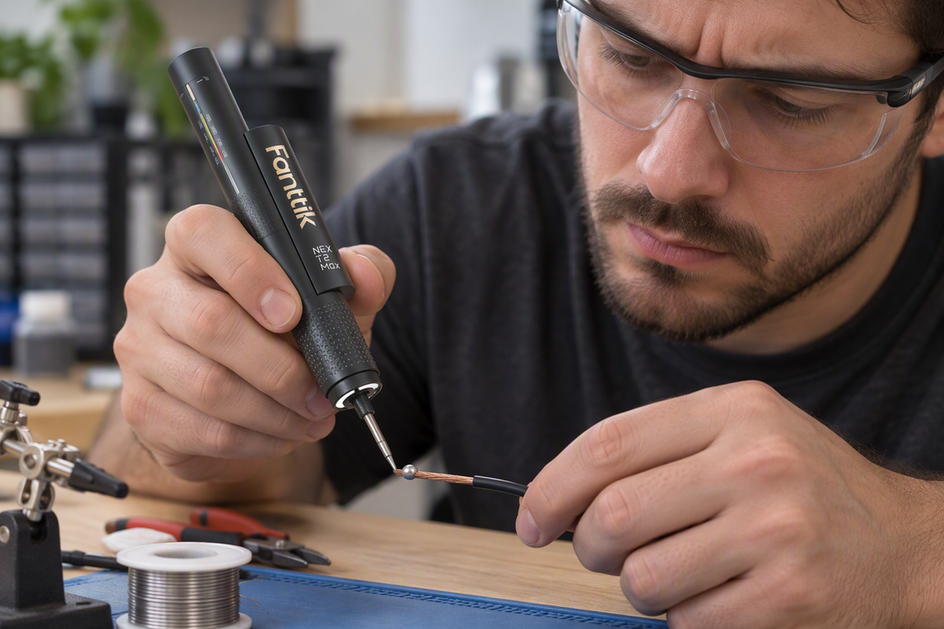
- Air Intake Awareness: The placement of air intakes and exhausts on a tool body is a telltale sign of thoughtful safety design. Ensure your grip does not block these ports. Tools like the Fanttik T1 Max Soldering Iron Kit are designed with ergonomics that naturally keep your hands away from heat-sensitive areas.
- The "Battery First" Rule: According to the Canadian Centre for Occupational Health and Safety (CCOHS), you should always remove the battery before changing accessories or making adjustments. This prevents accidental activation in tight quarters.
- Insulated Tools for Electronics: When working with live or potentially charged components, use insulated tools specifically designed for electronics work. This simple step prevents the metal body of a tool from creating a bridge between two conductive points.
- Manage Your "Footprint": In an apartment, storage is safety. Tools that come with dedicated, compact cases—like the Fanttik F2 Master Cordless Rotary Tool Kit—ensure that sharp bits and conductive batteries aren't rolling around in a junk drawer where they could cause injury or fire.
Summary of Safety Selection Criteria
When evaluating your next tool for an indoor workshop, use this checklist to ensure it meets the highest standards of reliability:
- Certification: Does it have a visible UL, CE, or IEC mark?
- Battery Compliance: Is the battery tested to UN 38.3 and IEC 62133?
- BMS Features: Does the manual mention overcharge, over-discharge, or thermal protection?
- Physical Design: Are the air vents positioned to stay clear during use?
- Storage: Does the tool include a non-conductive case?
By prioritizing these technical benchmarks, you aren't just buying a tool—you're investing in the safety of your home. For more on maintaining your gear, see our guide on Extending Precision Tool Life Through Proper Indoor Storage.
Disclaimer: This article is for informational purposes only and does not constitute professional safety, legal, or electrical advice. Always read your tool's specific manual and consult with a qualified professional for complex electrical work. If you have pre-existing respiratory or physical conditions, ensure your workspace is appropriately ventilated and ergonomically assessed.
References
Continue reading
 Bit Management: Organizing Precision Accessories for Easy Access
Covers sorting by drive type, tray depth rules, and storage hardware specs for optimal efficiency.
Bit Management: Organizing Precision Accessories for Easy Access
Covers sorting by drive type, tray depth rules, and storage hardware specs for optimal efficiency.
 Sub-Trunk Secrets: Maximizing Hidden Storage for Tools
Covers space measurement, the 40-60% lithium battery rule, tool degradation prevention, and safety implications of DIY modifications.
Sub-Trunk Secrets: Maximizing Hidden Storage for Tools
Covers space measurement, the 40-60% lithium battery rule, tool degradation prevention, and safety implications of DIY modifications.

Leave a comment
This site is protected by hCaptcha and the hCaptcha Privacy Policy and Terms of Service apply.