










































The Professional Necessity of Torque Calibration
In precision assembly—whether you are securing the delicate housing of a medical device or fastening critical components in an aerospace assembly—the margin for error is effectively zero. For the professional technician or the serious DIYer, "tight enough" is a liability. Precision is not merely a performance metric; it is a legal and safety requirement. When accuracy is professionally mandated, an ISO torque calibration certificate is your primary defense against catastrophic failure and regulatory non-compliance.
We have observed in our field service patterns that many users assume a tool’s factory "accuracy rating" is a permanent state. In reality, accuracy is a perishable commodity. Mechanical wear, environmental shifts, and even the way a tool is stored contribute to "calibration drift." This article provides a methodical framework for selecting drivers based on verified ISO credentials, ensuring your tool kit meets the rigorous demands of lab-grade and industrial applications.
As highlighted in the industry-leading white paper, The 2026 Modern Essential Gear Industry Report: Engineering Trust in a Cordless World, the transition from "consumer tool" to "essential gear" is defined by the transparency of its performance claims. Selecting a driver with a valid calibration certificate is the first step in building what we call "credibility math"—the systematic validation of tool reliability.
Understanding the ISO 6789 Metrological Framework
When evaluating a precision driver, you will likely encounter references to ISO 6789. However, the standard was significantly updated in 2017, splitting into two distinct parts. Understanding the difference is critical for selecting the right tool for your specific compliance environment.
ISO 6789-1:2017 vs. ISO 6789-2:2017
- Part 1 (Conformity): This section specifies the requirements for design and manufacture. A tool compliant with Part 1 is stated by the manufacturer to be within a certain tolerance (typically ±4% or ±6%). This is a "declaration of conformity."
- Part 2 (Calibration): This is the more rigorous standard. It requires a detailed calculation of measurement uncertainty. A certificate issued under Part 2 doesn't just say the tool is "good"; it provides a mathematical range of exactly how much the reading might vary under specific conditions.
For high-stakes environments like aerospace or medical electronics, a Part 1 declaration is often insufficient. Auditors look for the detailed uncertainty analysis provided by Part 2.
Methodology Note: Modeling Calibration Validity Our assessment of tool suitability is based on the "Metrological Hierarchy" model. This assumes that for a tool to be valid for a specific task, its certified uncertainty must be significantly smaller than the fastener's required tolerance band.
- Scope: Professional assembly environments.
- Assumption: Tools are used within their middle 20% to 80% torque range for maximum stability.
- Boundary: This model excludes tools used outside their rated capacity or those showing visible mechanical damage.

The Math of Trust: Measurement Uncertainty and Tolerance Budgets
A common pitfall we see in quality control audits is the "Naked Number" fallacy—believing that if a tool is "certified ±3%," it can be used on any fastener with a ±3% tolerance. This is mathematically incorrect.
The Tolerance Budget Calculation
To determine if a tool is truly suitable, you must calculate your "Tolerance Budget." This involves subtracting the tool's uncertainty and its "As-Found" error from the fastener's allowed range.
Formula for Practical Suitability:
(Fastener Tolerance Band) - (Tool As-Found Error) - (Measurement Uncertainty) > 0
If the measurement uncertainty on your certificate consumes 30-70% of your tolerance budget, the tool is functionally unusable for that specific application, even if it is "certified." According to data from ISO/IEC 17025 accredited labs, measurement uncertainty values can vary wildly depending on the lab's equipment and the tool's internal consistency.
| Parameter | Impact on Accuracy | Source of Data |
|---|---|---|
| As-Found Error | Direct offset from nominal | Calibration Certificate |
| Measurement Uncertainty | The "statistical blur" around a reading | ISO 6789-2 Analysis |
| Operator Variability | ±2-3% typical deviation | Internal Field Studies |
| Thermal Drift | ~2-3% per 10°C shift | Environmental Modeling |
| Vibration Degradation | 300-500% acceleration of drift | SIMCO Calibration Services |
Identifying and Managing Calibration Drift in the Field
Experienced technicians don't wait for an annual audit to check their tools. They develop a sensory "feel" for accuracy, backed by practical heuristics.
The "Three-Bolt Test"
In our repair and maintenance workflows, we utilize the Three-Bolt Test as a quick field check. If a calibrated driver produces noticeably different resistance or "click" behavior on three identical fasteners in the same material, it is likely drifting. Even if the tool is within its nominal 12-month calibration window, high-vibration environments can cause micro-movements in internal components that degrade accuracy much faster than time-based intervals account for.
Environmental Sensitivities
Torque accuracy is highly sensitive to temperature and humidity. Tools stored in unheated workshops or service vans can drift by 2-3% overnight due to the expansion and contraction of internal springs and lubricants. This is why top-tier facilities maintain climate-controlled calibration rooms and allow tools to "soak" in the ambient temperature of the workspace for at least 30 minutes before use.
Logic Summary: Heuristic for Re-calibration Based on observed patterns from field service and warranty handling, we recommend the following "5,000/Quarterly Rule":
- Heuristic: Calibrate after every 5,000 cycles or every 3 months, whichever comes first.
- Context: This applies to high-usage professional environments. For light DIY use, an annual check is usually sufficient, provided the tool is stored in a climate-controlled environment.
Selecting the Right Precision Driver for Your Application
When selecting a driver, the goal is to match the tool’s certified range to your most common tasks. Using a high-torque driver for low-torque electronics is a recipe for stripped threads and cracked PCBs.
For Delicate Electronics and Micro-Assemblies
In scenarios involving smartphones, laptops, or drones, you need a driver optimized for the lower end of the torque spectrum. The Fanttik E1 MAX Precision Electric Screwdriver is designed for these high-finesse tasks. With 50 magnetic bits and a specialized motor, it provides the control necessary to avoid over-torquing delicate components.
For those who require a bit more versatility in light assembly, the Fanttik K2 Nano 3.7V Precision Power Drill offers a compact solution for drilling and driving in materials like plastic or aluminum plate, where maintaining a consistent, low-torque output is vital for material integrity.
For Finishing and Precision Repair
If your work involves removing burrs, polishing, or intricate carving where "run-out" (axial wobble) must be minimized, the Fanttik F2 Master Cordless Rotary Tool Kit provides a brushless motor capable of 25,000 RPM. While not a torque driver in the traditional sense, its variable speed control is essential for maintaining the precision required in lab-grade finishing work.
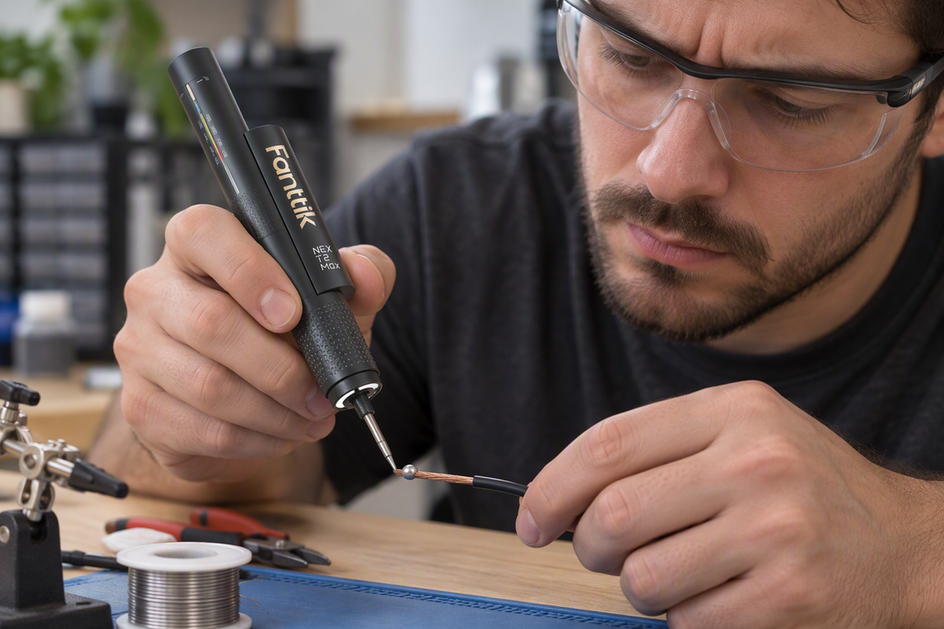
Finally, for technicians working on circuit board repairs, the Fanttik T1 Max Soldering Iron Kit complements a precision driver set by providing the thermal accuracy needed for delicate soldering, reaching 390°F in just 7 seconds.

The Documentation Infrastructure: ISO 17025 and Traceability
The most overlooked aspect of precision work is not the tool itself, but the "paper infrastructure" behind it. In a professional audit, a tool without a traceable certificate is legally non-existent.
Why ISO 17025 Matters
Not all calibration labs are created equal. You must ensure the lab that issued your certificate is accredited to ISO/IEC 17025. This accreditation proves the lab has the technical competence to produce valid results.
Crucially, you must check the lab’s Scope of Accreditation. A lab might be accredited to calibrate heavy industrial wrenches (100-500 N·m) but lack the sensitivity to calibrate precision drivers (0.1-5 N·m). If they calibrate your tool outside their accredited range, the certificate is technically invalid for professional compliance.
Traceability to National Standards
Every valid certificate must show a "Chain of Traceability" to a national metrology institute, such as NIST (National Institute of Standards and Technology) in the United States. This ensures that your "1.0 N·m" is the same as a "1.0 N·m" anywhere else in the world. As noted in the EU General Product Safety Regulation (EU) 2023/988, maintaining clear traceability and documentation is a core obligation for ensuring product safety and compliance in the European market.
Scenario Analysis: Matching Tools to Mission Criticality
To illustrate how selection changes based on requirements, consider two distinct professional scenarios:
Scenario A: The Aerospace Field Technician
- Environment: High-vibration, varying temperatures, strict FAA/EASA compliance.
- Requirement: ISO 6789-2:2017 Part 2 certification with full uncertainty analysis.
- Tool Choice: A driver with a narrow, highly accurate range and a quarterly calibration schedule. Documentation must be stored in a digital traceability system.
Scenario B: The Professional Electronics Repair Shop
- Environment: Climate-controlled, high-volume, low-torque.
- Requirement: ISO 6789-1:2017 Part 1 declaration of conformity is often sufficient, supplemented by internal "Three-Bolt" checks.
- Tool Choice: A versatile, ergonomic driver like the Fanttik E1 MAX Precision Electric Screwdriver, which prioritizes bit variety and ease of use for repetitive tasks.
Summary of Best Practices for Precision Tool Selection
- Verify the Standard: Ensure the certificate references the latest ISO 6789:2017 standards.
- Check the Lab: Confirm the calibrating facility is ISO/IEC 17025 accredited for your specific torque range.
- Review the Uncertainty: Don't just look at the pass/fail; calculate your tolerance budget.
- Monitor the Environment: Account for 2-3% drift if your tools are exposed to significant temperature swings.
- Implement Heuristics: Use the "Three-Bolt Test" and the "5,000 Cycle Rule" to identify drift before the next scheduled calibration.
By treating torque calibration as a rigorous discipline rather than a checkbox, you protect your professional reputation and ensure the safety of every assembly you complete. Precision is a commitment to the math of trust.
Disclaimer: This article is for informational purposes only and does not constitute professional engineering, legal, or safety advice. Precision assembly requirements vary by industry and jurisdiction; always consult your specific regulatory guidelines (e.g., FAA, FDA, OSHA) and a qualified metrology professional before finalizing tool selection for mission-critical applications.
Sources
- ISO 6789-1:2017 - Assembly tools for screws and nuts
- ISO/IEC 17025:2017 - General requirements for the competence of testing and calibration laboratories
- NIST Handbook 44 - Specifications, Tolerances, and Other Technical Requirements for Weighing and Measuring Devices
- EU General Product Safety Regulation (EU) 2023/988
- The 2026 Modern Essential Gear Industry Report: Engineering Trust in a Cordless World
Continue reading
 Impact and Accuracy: Why Dropping a Precision Tool Ruins Metrology
Covers the physics of impact damage, torque deviation costs, the Handshake Test, foam-cut storage, and relevant standards like...
Impact and Accuracy: Why Dropping a Precision Tool Ruins Metrology
Covers the physics of impact damage, torque deviation costs, the Handshake Test, foam-cut storage, and relevant standards like...
 Field Verification: How to Validate Your Tool’s Torque Output
Covers torque drift physics, step-by-step verification, and a precision electronics case study for high-stakes assembly.
Field Verification: How to Validate Your Tool’s Torque Output
Covers torque drift physics, step-by-step verification, and a precision electronics case study for high-stakes assembly.
Leave a comment
This site is protected by hCaptcha and the hCaptcha Privacy Policy and Terms of Service apply.