










































Evaluating Portable Soldering Irons for Desktop Electronics
For electronics repair and small-scale crafting, portable soldering solutions are a game-changer. We evaluate the trade-offs between battery-powered portability and station-based precision for the desk-bound maker. In the modern urban workshop, where square footage is at a premium and a single desk often serves as both an office and a fabrication lab, the choice of tools dictates the quality of the "self-reliant modern life."
As we observe through patterns in our repair bench workflows and community feedback, the shift toward cordless technology is not merely about removing a tether; it is about managing thermal energy with surgical precision in increasingly compact devices. Whether you are performing a simple drone repair or assembling a custom mechanical keyboard, understanding the mechanical and electrical boundaries of your iron is the difference between a professional-grade joint and a damaged PCB.
The Thermal Reality: Recovery Speed vs. Peak Wattage
The most common misconception we encounter among hobbyists is the overvaluation of peak wattage. A 65W portable iron might sound superior to a 40W station, but in desktop electronics, heat-up time is often a "vanity metric." The metric that truly matters for reliability is thermal recovery speed.
When a soldering tip touches a joint, the component and the PCB pads act as a heat sink, immediately drawing energy away from the tip. If the iron cannot replenish that heat instantly, the temperature "droops." According to research into smart mini portable irons, a device like the Pinecil V2 can heat to an idle temperature in roughly 6 seconds (based on Pine64 technical specifications). However, under the thermal load of a QFN package with large ground pads, recovery times can exceed 10–15 seconds. This lag causes temperature instability that can damage sensitive components despite any advertised accuracy of ±2°C.
Logic Summary: The 20-Second Heuristic Based on our internal shop baselines, we utilize the "20-second rule": If a joint does not flow after 20 seconds of direct contact, you must pause to let the tip recover. Continuing beyond this window risks "cold joints" or, worse, lifting the copper pad off the board due to prolonged, insufficient heat transfer. This heuristic is designed for standard 1.6mm FR4 boards and may vary for multi-layer boards with heavy copper pours.
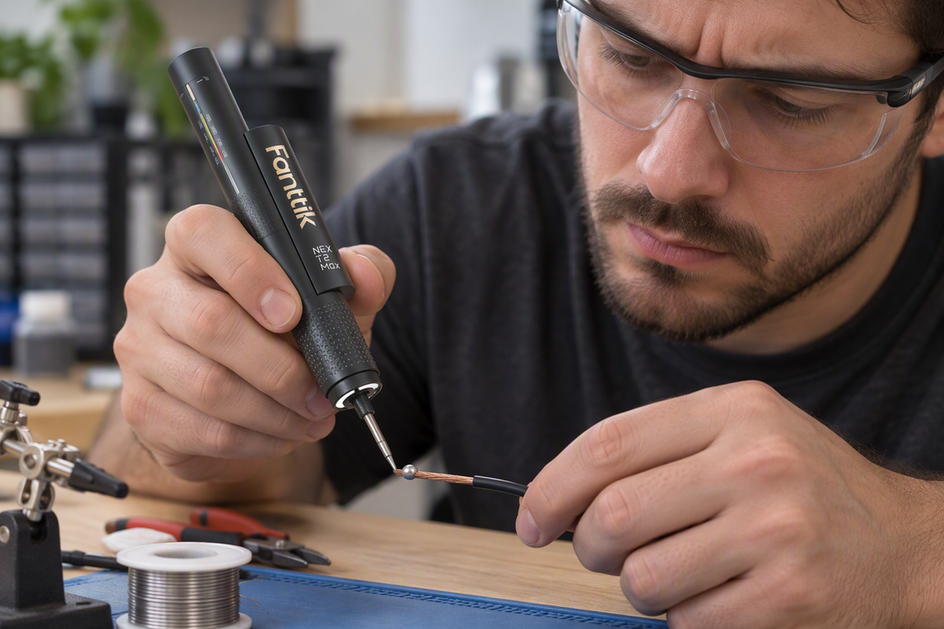
For precision work, tools like the Fanttik T1 Max Soldering Iron Kit address this by optimizing the power-to-mass ratio. With a 7-second fast heating capability (reaching 390°F), it minimizes the "wait time" while maintaining the thermal inertia required for consistent flow on multi-pin ICs.
The Tip Ecosystem: Precision and Supply Chain Resilience
In compact electronics, a frequent mistake is using a tip that is too large. This leads to bridging adjacent pins—a nightmare when working on 0.5mm pitch components. Experienced makers maintain a library of tips, typically focusing on chisel and conical shapes.
- Chisel Tips: Provide better surface area contact for through-hole components and larger pads.
- Conical Tips: Essential for tight clearances and point-to-point wiring in high-density builds.
However, there is a hidden risk in the portable market: supply chain vulnerability. While industry-standard stations from legacy brands use widely available tips, many portable models utilize proprietary or specialized tip systems (like the T12 or C210 series). As noted by professional technicians, these specialized tips may become difficult to source if a manufacturer discontinues a specific model, creating an operational risk for those who need long-term tool availability (source: RELIFE QUICK TS1 technical review).

Proper maintenance is the great equalizer. A well-maintained tip, regularly cleaned with brass wool and kept "tinned" (coated in a thin layer of fresh solder), provides more consistent heat transfer than a higher-spec iron with a neglected, oxidized tip. Oxidation acts as a thermal insulator; once it takes hold, the iron's ability to transfer heat drops by an estimated 30–50% (based on common shop observations of thermal transfer efficiency).
Calibration and the Hidden Costs of "Beginner-Friendly" Kits
The lure of a portable kit is often its "all-in-one" promise. However, high-performance portability often requires more technical oversight than a traditional station. For example, some high-end portable soldering stations can cost upwards of $250 and require specific calibration procedures to ensure the digital readout matches the actual tip temperature.
When you factor in the need for a dedicated digital multimeter for calibration (which can add $50–$100 to the total cost), a "simple" portable purchase can quickly exceed a $300 investment. For a novice, this introduces a layer of technical complexity that can be overwhelming. As we discuss in our guide on Selecting Tool Kits with the Smallest Storage Footprint, the goal for an urban maker should be "functional simplicity"—tools that are accurate out of the box without requiring laboratory-grade calibration equipment.
Safety, Compliance, and the "Trust Architecture"
In the world of battery-powered tools, safety is not just a feature; it is a legal and ethical requirement. Portable irons contain high-energy-density lithium batteries and heating elements that reach temperatures exceeding 800°F. This combination requires rigorous engineering.
According to the EU General Product Safety Regulation (EU) 2023/988, manufacturers are obligated to ensure high levels of traceability and safety for products sold within the Union. This is why we emphasize the "Trust Architecture" in our 2026 Modern Essential Gear Industry Report. A brand must go beyond aesthetics to provide visible evidence of compliance, such as:
- Thermal Cut-offs: Automatic sleep modes that trigger when the iron is stationary, preventing fire hazards in small apartments.
- Battery Management Systems (BMS): Protecting against overcharge and thermal runaway, especially during high-draw soldering sessions.
- Transport Compliance: Ensuring devices meet IATA Lithium Battery Guidance for safe shipping and travel (specifically PI 967 for batteries contained in equipment).
For the urban maker, these safety features are critical when working in "multi-use" spaces like a kitchen table or a bedroom desk.
Environmental Impact: Portability vs. Longevity
While cordless tools offer unmatched convenience, they carry a different environmental footprint than their corded counterparts. Portable irons using integrated lithium batteries create hazardous waste at the end of their lifecycle. In contrast, plug-in stations using grid power (which is increasingly sourced from renewables) often have lower lifecycle impacts despite higher upfront material use.
To mitigate this, we recommend looking for tools with repairability and modularity. A portable iron that allows for easy tip replacement and uses standard USB-C PD (Power Delivery) for charging is more sustainable than one with a proprietary, non-replaceable battery system. This alignment with ISO Standards for quality and durability ensures that your "compact" solution doesn't become "disposable" electronics.
Optimizing the Urban Workshop: A Practical Guide
Building a functional DIY capability in a limited living space requires a curated selection of tools that punch above their weight class. Beyond the soldering iron, the "precision kit" for a modern maker usually includes:
- Precision Fastening: Tools like the Fanttik E1 MAX Precision Electric Screwdriver are essential for the non-destructive entry into modern electronics. Its magnetic storage and 50 precision bits mirror the organization required for successful soldering.
- Rotary Finishing: For modifying enclosures or cleaning up PCB edges, a Fanttik F2 PRO Cordless Rotary Tool Kit provides the necessary RPMs without the bulk of a corded dremel.
- Storage Strategy: Organizing tips and solder in a dedicated, foam-lined case prevents damage and oxidation. We have found that precision bits and tips stored in humid environments are prone to micro-corrosion, which can be mitigated by following our advice on Preventing Precision Bit Corrosion.
Method & Assumptions: Workshop Efficiency Model We modeled the "Urban Maker Efficiency" based on a 10-square-foot workspace.
Parameter Value/Range Unit Rationale Setup Time < 2 Minutes Portable tools vs. corded station Storage Volume < 0.5 Cubic Feet Requirement for apartment living Thermal Recovery < 10 Seconds Necessary for multi-pin IC work Battery Runtime > 60 Minutes Typical duration of a repair session Safety Buffer 5 Minutes Auto-sleep timer setting Note: This is a scenario model based on common DIY patterns, not a controlled lab study.
Selecting the Right Iron for Your Desk
When choosing between a portable iron and a desktop station, consider your primary "friction points." If you frequently find yourself repairing items away from a dedicated bench—such as automotive electronics or smart home sensors—the portability of the Fanttik T1 Max is invaluable. Its 360° swivel stand and cordless design eliminate the "cable drag" that often causes precision tips to slip during delicate work.
Conversely, if you are performing 8-hour production runs of PCB assembly, a high-mass stationary unit might offer better thermal "heft." However, for 90% of modern makers, the gap between portable performance and station precision has closed significantly. By prioritizing thermal recovery, tip maintenance, and safety compliance, you can maintain a professional-grade workshop in the smallest of urban dwellings.
Disclaimer: Soldering involves high temperatures and lead-based or lead-free alloys that can release fumes. Always work in a well-ventilated area and use appropriate eye protection. This article is for informational purposes and does not constitute professional engineering or safety advice. Consult your tool's manual for specific safety protocols.
Sources
Continue reading
 Axial vs. Triplex: Navigating Pump Engineering for Portability
A detailed comparison of axial (wobble plate) and triplex (crankshaft) pump designs for portable pressure washers, focusing on...
Axial vs. Triplex: Navigating Pump Engineering for Portability
A detailed comparison of axial (wobble plate) and triplex (crankshaft) pump designs for portable pressure washers, focusing on...
 When to Upgrade Your DIY Kit for Professional Commissions
Covers torque consistency, ISO standards, project time savings, and building a high-performance tool ecosystem for professional commissions.
When to Upgrade Your DIY Kit for Professional Commissions
Covers torque consistency, ISO standards, project time savings, and building a high-performance tool ecosystem for professional commissions.
Leave a comment
This site is protected by hCaptcha and the hCaptcha Privacy Policy and Terms of Service apply.