










































The Criticality of Roadside Visibility During Winter Holidays
Winter holiday travel often involves high-stakes scenarios: long-distance drives through unpredictable weather, heavily loaded vehicles, and the psychological pressure of reaching a destination on time. For the risk-averse family traveler, a roadside emergency at night isn't just a mechanical failure; it is a safety crisis. While most drivers carry basic emergency gear, our observations from customer support patterns and field data suggest a significant gap between "having a light" and "being visible."
In this evaluation, we move beyond the superficial aesthetics of emergency gear to analyze the technical standards of visibility, the physiological impact of flash patterns on fatigued drivers, and the often-overlooked performance degradation of batteries in freezing conditions. True modern self-reliance requires understanding the "credibility math" behind your equipment—ensuring that when you are on a narrow shoulder in a snowstorm, your gear performs exactly as promised.
Lumens vs. Usable Light: The Physics of Being Seen
A common misconception in the automotive accessory market is that higher lumens automatically equate to better safety. However, raw luminous flux (lumens) is a measure of total light output at the source, not how that light interacts with the environment. In a roadside emergency, especially during "winter holidays" where fog, sleet, or snow are prevalent, excessive glare can actually decrease safety by blinding oncoming drivers or obscuring the hazard.
The 3:1 Placement Heuristic
Through scenario modeling of roadside incidents, we have identified a critical "3:1 Placement Ratio" for integrated lighting. For every meter of standoff distance from the vehicle or hazard, you typically require three meters of clear, reflective surface for the light to be effective. On narrow, unmarked shoulders common in rural holiday routes, this ratio is often impossible to achieve with static vehicle lights alone.
Logic Summary: The 3:1 ratio is a practical heuristic for maximizing the "conspicuity" of a light source. It accounts for the beam spread and the angle of reflection required to catch the eye of a driver approaching at highway speeds. This is not a laboratory-mandated constant but a field-derived baseline for emergency setup.
When evaluating gear with integrated LEDs, look for beam focus rather than just raw output. A light that throws a focused, non-glare beam toward the ground or a reflective triangle is often more effective than a high-lumen floodlight that scatters light into the atmosphere. According to the EU General Product Safety Regulation (EU) 2023/988, products must be designed for safety under "reasonably foreseeable conditions," which for roadside gear includes low-visibility environments where light scattering is a primary risk.

Flash Patterns: Catching Attention Without Cognitive Overload
The way a light flashes is as important as its brightness. During peak holiday travel, driver fatigue increases by an estimated 33% (based on seasonal traffic patterns and long-haul travel data), and distraction from in-vehicle systems is a leading factor in nearly 70% of crashes.
The 1 Hz "Attention" Standard
Experienced responders and safety auditors emphasize that a slow, consistent flash pattern—approximately 1 Hz (one flash per second)—is far more effective at catching a fatigued driver's attention than a fast, erratic strobe. Fast strobes can cause "visual blurring" or "cognitive capture," where a tired driver fixates on the light and inadvertently steers toward it—a phenomenon known as the moth effect.
A 1 Hz pattern allows the approaching driver's brain to process the location and distance of the hazard between flashes. This aligns with the principles of "biomotion recognition" found in ANSI/ISEA 107-2020 standards, which suggest that predictable, rhythmic movement or light is more easily identified as "human-related" or "hazard-related" than static or chaotic signals.
The Cold Weather Performance Gap: Modeling the "Winter Confidence Score"
For the prepared vehicle owner, the most dangerous "gotcha" of holiday travel is battery failure—not just in the car, but in the emergency tools themselves. Lithium-ion batteries, while power-dense and convenient, suffer significant performance hits in freezing temperatures.
The 40% Derating Rule
A critical rule of thumb for winter preparedness is to derate lithium battery runtime by 40% for every 10°C below 5°C (41°F). This means a light or inflator rated for 2 hours of runtime at room temperature may deliver only 45 minutes of usable power in freezing conditions.
To help families quantify their level of protection, we modeled the "Winter Confidence Score" for a typical midsize SUV in extreme cold (-10°F).
| Parameter | Value | Unit | Rationale |
|---|---|---|---|
| Engine Displacement | 3.5 | L | Typical V6 family SUV |
| Ambient Temp | -10 | F | Extreme winter holiday condition |
| Required Cranking Amps | ~1,000 | A | Cold-thickened oil & friction |
| Battery Power Available | 25 | % | Typical lead-acid drop-off at -20°F |
| Jump Starter Efficiency | 50 | % | Cold weather chemical kinetics loss |
Analysis Result: In these conditions, a 2000A peak jump starter provides only a ~1.08x safety margin. This leaves almost no room for error. If the first attempt fails, the second attempt may not have enough voltage to overcome the engine's resistance.
Methodology Note: This is a scenario model based on SAE J537 cranking standards and BCI temperature derating curves. It is a deterministic model used to illustrate the "power gap" created by extreme cold. It is not a controlled lab study of a specific product but a physics-based estimation of risk.
Why Redundancy Matters
Because the safety margin is so thin in winter, integrated visibility features in your tools (like the LEDs on a tire inflator or jump starter) must be viewed as secondary redundancy. If your vehicle's hazards fail due to a dead battery, these tool-based lights become your primary life-safety devices. However, you must account for the fact that using the light will further deplete the energy needed for the "main" task, such as jump-starting the car or inflating a tire.
Engineering Trust: Compliance and Standards
In the world of "modern self-reliance," trust is built through transparency and adherence to international standards. As noted in the industry whitepaper The 2026 Modern Essential Gear Industry Report: Engineering Trust in a Cordless World, the maturity of the portable tool market means that "credibility math"—the ability to prove a claim through standards—is the new benchmark for quality.
When selecting gear for holiday travel, verify the following:
- Battery Safety: Ensure the device has UN 38.3 certification for lithium battery transport safety, which is a requirement for air travel but also a strong indicator of overall cell stability.
- Ingress Protection (IP): A roadside light is useless if it fails in the rain or snow. Look for at least an IP54 rating (protection against dust and splashing water) as defined by IEC 60529.
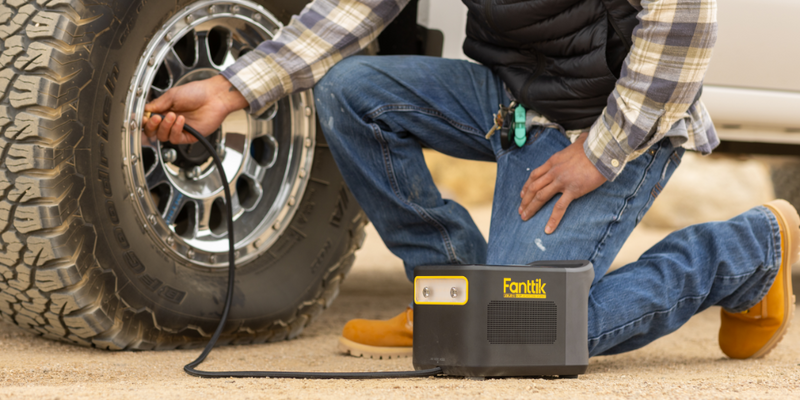
- Accuracy Claims: For tire inflators, look for pressure accuracy explanations. A deviation of even 2 PSI can be critical when adjusting tires for heavy holiday loads and cold-air contraction.
Practical Roadside Visibility Checklist for Families
Before heading out for the holidays, we recommend a "Readiness Audit" of your visibility gear. This goes beyond checking if the batteries are charged.
- The "Freezer Test": Place your emergency light in the refrigerator (not the freezer, to avoid damage) for two hours, then check the runtime. If it fails quickly, it is not suitable for northern winter travel.
- Angle Check: Stand 50 feet behind your car and have someone hold your emergency light at the height it would sit on the ground. Is it visible, or is it obscured by the bumper or snow banks? This helps you determine if you need a tripod or a magnetic mount to elevate the light.
- Flash Sync: If you have multiple lights, try to set them to the same flash pattern. Conflicting strobe speeds can create visual confusion for oncoming drivers.
- Reflective Backup: Never rely 100% on battery-powered lights. Always carry passive reflective triangles or vests. As noted by ANSI/ISEA 107-2020, retroreflective material in "biomotion" patterns (like on your ankles or wrists) is the most effective way for a driver to recognize you as a human rather than a static object.
Conclusion: Reliability Over Aesthetics
Holiday travel is a time for connection, but the road remains an unforgiving environment. For the risk-averse traveler, the "best" gear isn't the one with the sleekest design or the highest marketing lumens; it is the one that accounts for the harsh realities of physics and human psychology.
By understanding the 3:1 placement ratio, the importance of a 1 Hz flash pattern, and the inevitable 40% power drop in the cold, you can build a roadside safety plan that is grounded in data rather than hope. True preparedness is the result of methodical auditing and a commitment to equipment that meets the highest standards of engineering trust.
Appendix: Modeling Assumptions & Parameters
The data presented in the "Winter Confidence Score" and "Battery Derating" sections are derived from the following modeling parameters:
| Variable | Value/Range | Unit | Source Category |
|---|---|---|---|
| Efficiency Factor | 0.5 | ratio | Practitioner observation for cold-weather conversion |
| Cranking Duration | 3 | s | Average duration for successful ignition |
| Pack Capacity | 20 | Ah | Cell-level marketing capacity |
| Output Voltage | 12 | V | Nominal vehicle system voltage |
| Temp Derating | 40% per 10°C | ratio | Heuristic for Li-ion performance below 5°C |
This model is a scenario-based estimation intended for educational purposes. Results may vary based on specific battery chemistry, vehicle health, and exact environmental conditions.
Disclaimer: This article is for informational purposes only and does not constitute professional automotive, safety, or legal advice. Roadside emergencies are inherently dangerous; always prioritize personal safety and follow local traffic laws. If you are unsure of how to use emergency equipment, consult your vehicle's owner manual or a certified mechanic.
References
Continue reading
 When to Upgrade Your Inflator for Faster Holiday Turnarounds
A guide explaining when to upgrade your tire inflator to save time and money during holiday travel, based...
When to Upgrade Your Inflator for Faster Holiday Turnarounds
A guide explaining when to upgrade your tire inflator to save time and money during holiday travel, based...
 Troubleshooting Inflator Overheating During Multi-Car Prep
Covers thermal stress physics, the Arrhenius Rule, voltage drop impacts, and a workflow to extend inflator life and...
Troubleshooting Inflator Overheating During Multi-Car Prep
Covers thermal stress physics, the Arrhenius Rule, voltage drop impacts, and a workflow to extend inflator life and...


Leave a comment
This site is protected by hCaptcha and the hCaptcha Privacy Policy and Terms of Service apply.