








































The Architecture of Exclusion: Why Proprietary Bits Matter
We have all been there: a high-end smartphone or a sleek laptop sits on the repair bench, its internal battery failing, but the path to restoration is blocked by a fastener that looks like a star, yet refuses to accept a standard Torx bit. These proprietary fasteners—often termed "security screws"—are the first line of defense in what many in the repair community call the "architecture of exclusion."
For the detail-oriented DIYer, sourcing the correct bit is not merely about buying a tool; it is about reclaiming the right to maintain your own property. However, as we have observed on our own repair benches, the challenge has shifted from finding a "weird shape" to navigating a landscape of undocumented sub-variants and varying material grades.
In this guide, we will break down the methodical approach to identifying, verifying, and sourcing the precision bits required for modern gadgets. We will also examine the "credibility math" behind tool selection, ensuring your efforts lead to a successful repair rather than a stripped screw head and a permanent lockout.
Identification: The Precision Measurement Phase
The most common mistake we see in precision repair is the assumption of "visual parity." A screw might look like a standard Pentalobe P2, but in the world of sub-millimeter tolerances, eyesight is an unreliable narrator. Genuine P2 bits used for Apple’s iPhone battery screws, for instance, possess a specific tip angle and taper that many mass-produced clones lack. Using a bit with a slightly off-angle leads to "cam-out"—the phenomenon where the bit slips out of the head under torque—instantly damaging the shallow drive recesses.
The Technician’s Verification Protocol
To avoid this, we recommend a methodical identification process using a digital caliper. Relying on manufacturer schematics is ideal, but when they are obscured, physical measurement is the only path to truth.
- Major Diameter Measurement: Measure the widest point of the screw head.
- Point-to-Point Distance: For star or pentalobe shapes, measure the distance between opposite peaks.
- Cross-Reference: Compare these measurements against known standards, such as those documented in iFixit’s repair guides, which provide detailed specifications for proprietary fasteners.
Logic Summary: This identification heuristic assumes that physical dimensions are the primary indicator of bit compatibility. However, users should note that some manufacturers use "tamper-evident" coatings that can slightly alter initial measurements.

Material Science: S2 Alloy Steel vs. Chrome Vanadium
Once the shape is identified, the next hurdle is material integrity. In precision electronics, the screws are often made of hardened steel, while the bit is the "sacrificial" component. However, if the bit is too soft, it deforms; if it is too brittle, it chips.
Based on our patterns of tool wear and community feedback, we distinguish between two primary materials:
- S2 Alloy Steel: This is generally considered the gold standard for precision bits. It offers a superior balance of hardness (typically HRC 58-62) and toughness. In high-torque applications involving small security fasteners, S2 steel maintains its edge profile longer and is less likely to "round off" inside the screw head.
- Chrome Vanadium (CR-V): While ubiquitous and excellent for larger automotive tools, CR-V can be problematic at the micro-scale. It is more prone to chipping when encountering the sharp, narrow edges of a Security Torx or Tri-wing screw.
According to technical analysis on OEM vs. Aftermarket bit quality, the hardening process is just as critical as the base alloy. A $2 aftermarket bit often skips the cryogenic tempering phases that high-end bits undergo, leading to a tool that fails exactly when you apply the final bit of pressure.
Modeling the Impact: Efficiency and Ergonomics
To understand why specialized precision tools are a necessity for the modern hobbyist, we modeled a scenario involving a professional technician. This analysis helps quantify the transition from manual to electric precision driving.
Modeling Note: Method & Assumptions
Our analysis of a professional repair persona assumes a high-volume environment where repetitive motion and torque accuracy are the primary constraints. This is a scenario model, not a controlled lab study.
| Parameter | Value | Unit | Rationale |
|---|---|---|---|
| Daily Screw Volume | 120 | count | 3-4 devices with ~30 screws each |
| Manual Drive Time | 12 | s | Includes alignment and careful manual torque |
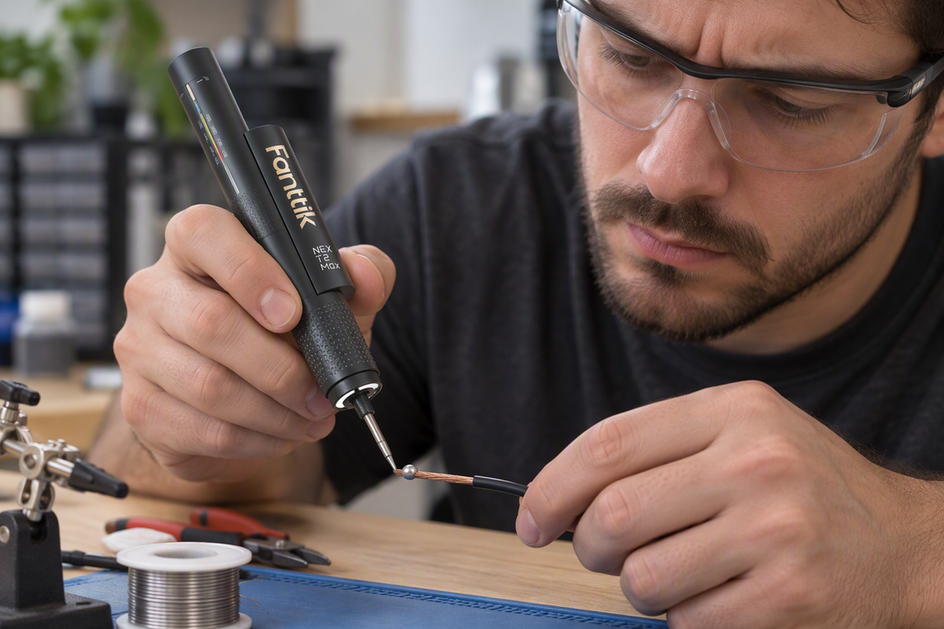
| Powered Drive Time | 2.5 | s | Based on Fanttik E2 MAX performance specs |
| Manual Rotations | 15 | count | Typical thread count for M1.2-M2.0 screws |
| Torque Limit (Safe) | 0.1 | Nm | ISO 898 safety threshold for micro-electronics |
The Results of Modernization
By shifting from manual drivers to a precision electric system, the data suggests a significant reduction in physical strain and a massive gain in throughput:
- Time Savings: We estimate a saving of ~19 minutes per day. Over a standard work week, this equates to over 1.5 hours of reclaimed time.
- Ergonomic Protection: The model shows a reduction of ~1,740 wrist rotations daily. This is a critical factor in preventing repetitive strain injuries (RSI) like carpal tunnel syndrome, which often plagues long-term repair enthusiasts.
- Torque Safety: Using a tool with a calibrated 0.05Nm setting (like the low-torque mode on the Fanttik E2 MAX) fits perfectly within the safe window for M1.2 screws (0.02Nm to 0.1Nm). Conversely, using a "high-torque" setting of 0.2Nm on these same screws creates a high risk of stripping the threads.
Sourcing Strategies for the "Unfindable" Bit
When a standard kit doesn't have the bit you need, where do you turn? The sourcing landscape is divided into three tiers:
1. The Manufacturer's Ecosystem
Some brands have begun offering official repair kits due to "Right to Repair" legislation. These are the most reliable but often the most expensive. According to Kowatek's analysis of Oregon's Right to Repair law, legislation is forcing more OEMs to make these tools available to the public.
2. Specialized Repair Databases
Platforms like iFixit and various enthusiast forums act as the "Rosetta Stone" for proprietary fasteners. They often identify that a "proprietary" screw is actually a standard ISO fastener with a non-standard head, allowing you to search for the specific commodity code.
3. The "Master Kit" Approach
For most hobbyists, the most efficient strategy is to invest in a master bit ecosystem. Rather than buying one-off drivers, a high-quality precision driver handle paired with a 50+ bit collection (including P2, P5, Tri-wing, and Torx Security) covers 95% of modern consumer electronics.
The New Frontier: Software Locks and Serialization
It is important to acknowledge a growing trend in the industry: the "Software Screw." As discussed in The 2026 Modern Essential Gear Industry Report, trust in a product is now tied to its lifecycle transparency.
Even if you source the perfect S2 steel P2 bit and successfully open a device, you may encounter serialized parts. Apple’s serialization system for components like displays and batteries means that parts are digitally "locked" to the logic board. Without proprietary calibration software, a genuine part from another device may still trigger a "non-genuine" warning or lose functionality. This makes sourcing the tool only half the battle; the other half is advocating for software transparency.
Best Practices for Bit Maintenance and Organization
A precision bit is a delicate instrument. To maintain the "Trust Architecture" of your toolkit, follow these shop heuristics:
- Dedicated Compartmentalization: Dedicate a separate, clearly labeled compartment for each proprietary bit type. Mixing a P2 with a P5, even if they look similar, can lead to accidental use and a stripped screw.
- The "Feel" Test: If a bit doesn't seat perfectly with zero wobble, stop. Re-measure the screw. A proprietary bit should feel like it "locks" into the fastener.
- Avoid Over-Torquing: In electronics, "finger-tight" is often too much. Use tools with electronic torque limiting to ensure you stay within the 0.05Nm range for delicate internal components.
Building a Future-Proof Toolkit
The goal of a precision toolkit isn't to own every bit ever made—that's an impossible task given the rate of proprietary innovation. Instead, focus on the 5-10 most common proprietary fasteners across major brands (Apple P2/P5, Nintendo Tri-wing, and Torx Security).
By combining high-quality materials like S2 alloy steel with the efficiency of electric precision drivers, you transform a frustrating "proprietary puzzle" into a methodical, solvable task. As the industry moves toward greater transparency, having the right tools and the knowledge to use them ensures you remain self-reliant in an increasingly complex digital world.
Disclaimer: This article is for informational purposes only. Precision electronics repair involves risks to the device and the user (particularly regarding lithium-ion batteries). Always consult manufacturer service manuals and follow anti-static protocols. If you are unsure, seek professional assistance.
References
Continue reading
 Expanding Utility: Selecting Socket Adapters for Precision Tools
Covers hex-to-square conversion pitfalls, retention mechanisms, tolerance stack-up, and compliance with ISO 9001 and EU safety regulations.
Expanding Utility: Selecting Socket Adapters for Precision Tools
Covers hex-to-square conversion pitfalls, retention mechanisms, tolerance stack-up, and compliance with ISO 9001 and EU safety regulations.
 Titanium vs Black Oxide: Evaluating Friction in Precision Work
An analysis of TiN and Black Oxide tool coatings for prosumers, comparing friction, thermal stability, and longevity for...
Titanium vs Black Oxide: Evaluating Friction in Precision Work
An analysis of TiN and Black Oxide tool coatings for prosumers, comparing friction, thermal stability, and longevity for...

Leave a comment
This site is protected by hCaptcha and the hCaptcha Privacy Policy and Terms of Service apply.