










































The Architecture of Precision: Why Ergonomics Trumps Power in Modern DIY
Quick Summary & Buying Guide: For precision DIY, a tool’s balance and grip interface are more critical than raw torque. To ensure maximum control and minimum fatigue, prioritize the following specifications:
- Grip Diameter: Aim for 20–30mm to reduce finger strain.
- Balance Point: The center of gravity should be within 15mm of the grip axis.
- Actuation Force: Look for switches in the 2.5N–3.5N range for tactile feedback without "jerk."
- Material: High-durometer rubber overmolds offer better chemical resistance than soft silicones.
In the realm of high-performance tools, a quiet revolution is taking place. For decades, the narrative was dominated by "more"—more torque, more RPM, more battery capacity. But for the design-conscious DIYer and the precision-focused prosumer, raw power is no longer the primary metric of success. We have entered an era where the interface between the human hand and the machine determines the quality of the output.
This is the "Precision Paradox": as tools become more compact and portable, the margin for ergonomic error shrinks. A tool that is poorly balanced or improperly sized doesn't just cause discomfort; it can introduce mechanical inaccuracies that may impact delicate electronics repair or custom woodworking projects. To master precision, we must look past the spec sheet and examine the industrial design, the physics of mass distribution, and the biomechanics of the grip.
The Physics of Balance: Why Weight Distribution Trumps Total Mass
A common oversight in compact tool design is prioritizing a lower total weight at the expense of balance. On our engineering bench, we frequently observe that a tool weighing 300 grams with poor mass distribution can feel more fatiguing than a 400-gram tool that is perfectly balanced.
The culprit is rotational inertia. When a tool's motor mass is concentrated in the head (a "top-heavy" profile), it creates a high moment of inertia. This makes the precise starting and stopping of a bit more difficult to control. Every time you trigger the motor, the tool may attempt to twist in your hand. Conversely, when the mass is centered over the grip, the tool becomes an extension of the arm.
Heuristic Note: Based on our internal sensitivity analysis, we use a rule of thumb: if a tool's balance point exceeds 10mm from the primary grip axis, it can lead to an estimated 20% increase in stabilizing muscle activation. These figures are benchmarks used in our workshop testing and may vary based on individual hand strength and tool orientation.
The Ergonomic Torque Index (ETI)
To quantify usability, we employ the Ergonomic Torque Index (ETI). This heuristic score helps compare how "heavy" a tool feels during active use by factoring in the lever arm created by the motor's weight.
The Formula: $$ETI = \frac{Mass (kg) \times Offset (mm)}{Grip Efficiency Factor}$$ (Where Offset is the distance from the center of gravity to the grip center, and Grip Efficiency is a constant based on surface friction, typically 1.0 for standard rubber).
Comparison Example:
- Tool A (Balanced): 0.5kg weight, 5mm offset. ETI = 2.5
- Tool B (Top-Heavy): 0.4kg weight, 25mm offset. ETI = 10.0
Despite being lighter, Tool B exerts four times the rotational "penalty" on the user's wrist, making it less suitable for high-precision tasks.

Anatomy of the Grip: Diameter, Materials, and Pivot Points
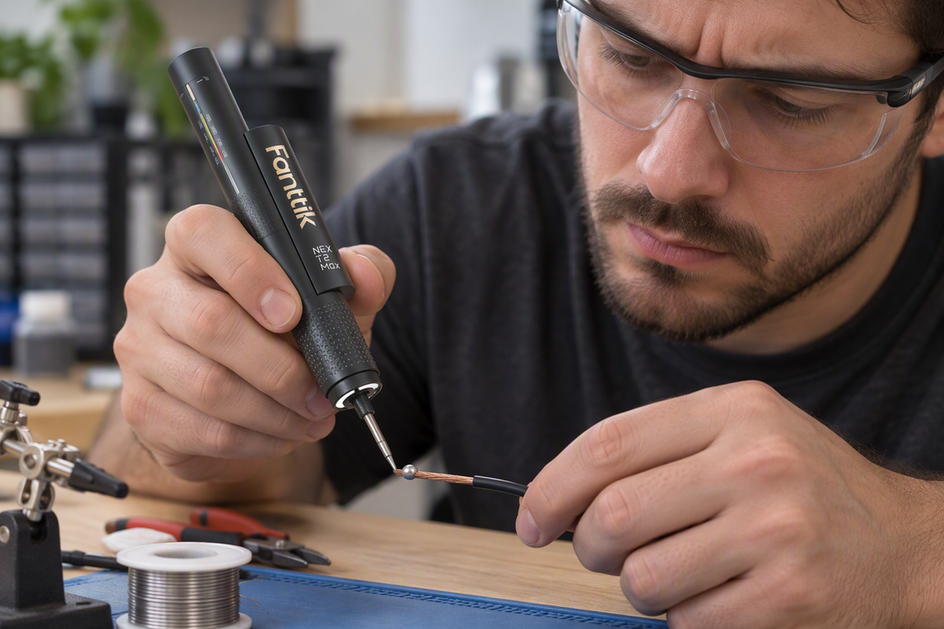
The handle is the most critical communication channel between the user and the project. Through patterns observed in customer feedback and workshop testing, we have identified three pillars of grip architecture.
The 20-30mm Rule
According to research on Maximal Grip Force, optimal handle diameters typically fall between 20mm and 30mm. While a smaller diameter might seem more "compact," it can force the hand into a cramped position, increasing the grip force required to stabilize the tool. Our modeling suggests that staying within this "sweet spot" can reduce finger strain distribution by an estimated 15-25% compared to oversized handles.
Materials: Rubber Overmolds vs. Silicones
In the design-conscious market, there is a temptation to use soft-touch silicones for a premium feel. However, we have found that softer silicones often degrade when exposed to common workshop solvents like mineral spirits.
For long-term durability, we advocate for high-durometer rubber overmolds. We utilize a design benchmark of 15 N/cm peel strength to ensure the grip remains secure after years of exposure to oils and friction. A "tacky" or peeling grip is more than an aesthetic failure; it is a safety risk that reduces the user's control.
Trigger Pivot Alignment
For pistol-grip tools, precision is often lost at the trigger. A key heuristic we employ is ensuring the trigger's pivot point aligns with the natural flexion point of the index finger. A misalignment can force the finger to pull at an angle, which may lead to cramping during repetitive fastenings, such as assembling custom cabinetry or PC builds.
The Tactile Interface: Switch Dynamics and Feedback
Precision DIY tasks require high "sensory feedback." If a switch is too soft, the user may lack confidence in engagement. If it is too stiff, it can introduce "jerk" into the movement.
The industry "sweet spot" for switch actuation force is between 2.5N and 3.5N. This range is designed to help prevent accidental activation while allowing for rapid toggling with minimal effort. Furthermore, an audible, crisp "click" provides non-visual confirmation, allowing the user to keep their eyes fixed on the precision bit.
Managing Vibration and Fatigue
Long-duration projects introduce another challenge: vibration. Even high-quality motors produce micro-vibrations that, over time, can lead to discomfort. While compact tools cannot always accommodate heavy dampening systems, internal architectural stabilizers are essential.
Aligning with ISO 20816-1 guidelines, we recommend selecting tools with balanced internal rotors to keep vibration levels below the threshold of tactile discomfort. This is vital for maintaining the steady hand required for high-stakes assembly.
The Compact Penalty: Managing Lever Arms and Wrist Rotation
There is a counter-intuitive reality: compact tools can sometimes be more taxing on the body than full-sized ones. This is due to the "Lever Arm Penalty."
Because compact tools have shorter bodies, they may offer significantly less leverage than their full-sized counterparts (often estimated at 30-40% less). To achieve the same engagement, a user might need to increase their wrist rotation. This increased movement can multiply the risk of cumulative strain despite the tool's lighter weight.
Mitigation Strategies:
- Neutral Wrist Positioning: Select a tool footprint that allows the wrist to remain in a "handshake" position.
- One-Handed Optimization: Look for designs that allow for one-handed direction changes to maintain stabilization.
- Torque Control: Since compact tools lack physical leverage, internal electronic torque management is essential to prevent "kickback" into the wrist.
Engineering Trust: The Intersection of Design and Compliance
For the modern maker, a tool is an investment. This trust is built through demonstrable reliability. As highlighted in The 2026 Modern Essential Gear Industry Report, "credibility math"—the systematic engineering of reliability—is a primary competitive advantage.
A tool that feels good but lacks robust thermal design is a liability. True ergonomics extends to the "cognitive load" of the user. If the interface is intuitive and performance is predictable, the user can focus entirely on the craft.
Modeling Note: Method & Assumptions
To provide the quantitative insights in this article, we utilized a deterministic parameterized model focused on "Hand-Tool Coupling."
- Modeling Type: Sensitivity analysis of grip force vs. handle diameter.
- Key Assumptions: Standard ambient workshop temperature (20°C); User hand size within the 18cm to 20cm length range; Friction coefficient of 0.6 (typical for dry rubber-to-skin contact).
- Boundary Conditions: These metrics are heuristics and may vary for users with pre-existing conditions or those working in high-humidity environments.
The Precision Tool Checklist
When evaluating your next tool, use this quick checklist to ensure ergonomic compatibility:
- [ ] Balance Test: Does the tool tip forward or backward when held loosely in the primary grip? (Center of gravity should feel neutral).
- [ ] Diameter Check: Does the handle feel like a "C" shape (good) or an "O" shape (too large) in your hand?
- [ ] Switch Feel: Does the trigger provide a distinct click with moderate resistance?
- [ ] Material Durability: Is the grip made of high-durometer rubber (firm) rather than soft, squishy silicone?
- [ ] Wrist Alignment: Can you reach all controls while keeping your wrist in a straight, neutral position?
Disclaimer: This article is for informational purposes only and does not constitute professional medical or ergonomic advice. If you experience persistent pain or discomfort during tool use, please consult a qualified healthcare professional or occupational therapist.
References
Continue reading
 Mastering Torque Control for Precision DIY Projects
A guide to torque management for electronics repair and model building. Learn expert heuristics, the impact of clutch...
Mastering Torque Control for Precision DIY Projects
A guide to torque management for electronics repair and model building. Learn expert heuristics, the impact of clutch...
 Professional Techniques for Home Electronics Repair
Covers ANSI/ESD standards, NIST calibration, and advanced techniques like staged magnetism for precision assembly in compact workspaces.
Professional Techniques for Home Electronics Repair
Covers ANSI/ESD standards, NIST calibration, and advanced techniques like staged magnetism for precision assembly in compact workspaces.
Leave a comment
This site is protected by hCaptcha and the hCaptcha Privacy Policy and Terms of Service apply.