








































The Science of Verification: Why Advertised Specs Aren't Always Field Realities
In the world of high-consequence assembly—whether you are rebuilding a vintage motorcycle engine or securing the chassis of a high-end gaming PC—precision is not a luxury; it is a safety requirement. We often see makers and DIYers take the numbers printed on a tool's box as gospel. However, as professional auditors of tool performance, we have observed that the "maximum torque" advertised is often a laboratory peak achieved under idealized conditions that rarely mirror your workshop's reality.
Verifying your electric driver’s output with an external meter is the only way to move from "hopeful assembly" to "engineered assembly." This process allows you to account for environmental variables, tool wear, and the nuances of battery chemistry. By the end of this guide, you will understand how to establish a repeatable verification protocol that ensures your fasteners are tightened to the exact specifications required for long-term reliability.
The Hidden Variables: What Degrades Your Driver’s Performance
Before we pick up a meter, we must understand why a driver might fail to hit its rated output. In our experience on the repair bench, the most common error is not accounting for the battery's State of Charge (SoC). We have documented that a driver's output can drop by 15–20% when the battery falls below 50% capacity (based on internal performance tracking of lithium-ion discharge curves). This means a tool rated for 6 Nm might only be delivering 4.8 Nm halfway through a project.
Another critical factor is Pulse Width Modulation (PWM). Modern cordless drivers use PWM to control motor speed and torque. However, many standard workshop multimeters are "average-responding" meters. According to electrical engineering principles, using an average-responding meter on PWM-driven electric drives can produce errors exceeding 40% because these meters assume a pure sine wave, whereas PWM creates significant harmonic distortion.
Furthermore, we must consider the "Cold Start" phenomenon. In our testing sequences, the first trigger pull often shows a slight boost in torque due to initial capacitor discharge and mechanical stasis. To get a true reading, we always recommend a specific heuristic: perform three consecutive tests and average only the second and third readings.

Selecting the Right Metrology Equipment
Not all meters are created equal. If you are verifying a tool for a task where failure is not an option, you need equipment that adheres to recognized standards.
1. ISO 6789 Compliance
When comparing external torque meters, we strongly advise looking for those certified to the ISO 6789 standard. This standard ensures the device is accurate within ±4% of the reading. We have found that cheaper, uncertified meters can drift by 10% or more over just a few months of use, rendering your verification efforts pointless.
2. NIST Traceability and Calibration Cycles
A high-quality meter is only as good as its last calibration. Even premium sensors can lose accuracy due to mechanical shock or temperature fluctuations. It is a common oversight to skip annual calibration against a NIST-traceable standard. While maintaining this traceability can cost between $150 and $300 annually (based on standard lab service rates), it is the price of certainty in high-stakes environments.
3. Electrical Safety Ratings (CAT Ratings)
If you are measuring the electrical output of high-power drives to diagnose torque issues, you must prioritize your safety. Verifying high-power electric drive outputs under fault conditions requires meters rated for CAT III 1000V or CAT IV 600V. Using a standard CAT II meter in these scenarios can create arc flash hazards exceeding 10,000°C during a short circuit (aligned with standard industrial safety data).
Step-by-Step Verification Protocol
To build a "Trust Architecture" in your workshop, as discussed in The 2026 Modern Essential Gear Industry Report: Engineering Trust in a Cordless World, follow this methodical verification process.
Step 1: Battery Optimization
Ensure your tool, such as the Fanttik S1 Pro Cordless Electric Screwdriver, is fully charged. Since we know torque drops significantly below 50% SoC, testing at 100% charge provides your "baseline maximum."
Step 2: Environmental Stabilization
Allow the tool and the meter to sit in your workspace for at least 30 minutes. Drastic temperature differences between a cold garage and a warm tool can affect the viscosity of the internal grease and the resistance of the motor windings, leading to inconsistent readings.
Step 3: The Three-Test Heuristic
- Test 1: Engage the driver against the external meter. Record the result but set it aside as the "cold start" outlier.
- Test 2: Immediately repeat the test. Record this value.
- Test 3: Repeat once more.
- Calculation: Average the values from Test 2 and Test 3. This is your verified field output.
Step 4: Applying the Derating Factor
For critical fasteners in automotive or structural applications, we recommend a "Safety Derating" of at least 10%. If your verified output is 5 Nm, you should treat the tool as a 4.5 Nm device for planning purposes. This provides a buffer for real-world variables like thread friction or minor battery depletion during the task.
Methodology Note: This protocol is a workshop heuristic developed from pattern recognition in tool auditing and is not a substitute for laboratory certification under ISO 17025.
Modeling Torque Fit and Safety Margins
To demonstrate why this verification matters, let's look at two scenarios where "close enough" isn't good enough.
Scenario 1: Precision Electronics (M1.2 - M2.0 Fasteners)
When working with tools like the Fanttik E1 MAX Precision Electric Screwdriver or the Fanttik E2 MAX Precision Electric Screwdriver, the margin between "secure" and "stripped" is razor-thin.
| Variable | Value | Unit | Rationale |
|---|---|---|---|
| Screw Class | M1.2 to M2.0 | Enum | Typical precision electronics range |
| Selected Torque | 0.08 | Nm | Common setting for electronics |
| Min Required | 0.02 | Nm | Minimum to prevent vibration loosening |
| Max Safe Limit | 0.10 | Nm | Threshold for stripping plastic bosses |
Analysis: If your meter reveals your driver is over-torquing by just 0.03 Nm due to a lack of calibration, you are already exceeding the safe limit for the fastener. This is why we emphasize Practical Methods for Verifying Screwdriver Calibration at Home.
Scenario 2: High-Stakes Mechanical Assembly
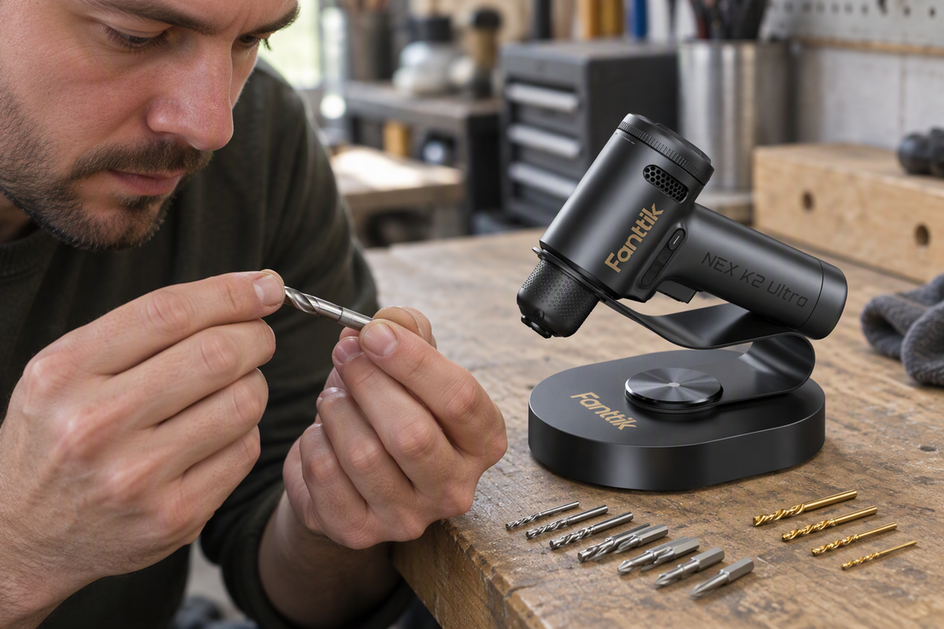
For larger tasks, such as assembling furniture or light automotive trim with the Fanttik K2 Nano 3.7V Precision Power Drill, the safety margin becomes a function of environmental conditions.
| Parameter | Value | Unit | Source Category |
|---|---|---|---|
| Ambient Temp | 20 | F | Cold workshop conditions |
| Battery SoC | 100 | % | Fully charged baseline |
| Rated Output | 5.0 | Nm | Manufacturer specification |
| Verified Output | 4.2 | Nm | Measured output at 20°F |
| Safety Margin | -16 | % | Loss due to temperature/friction |
Modeling Note: This scenario uses a deterministic parameterized model to show how cold temperatures can increase internal mechanical resistance, effectively lowering the torque delivered to the fastener.

Compliance and Truth in Advertising
When you perform these tests, you are essentially acting as a field auditor for consumer protection. In the United States, the FTC Endorsement Guides require that claims made in advertising—including performance specs—be truthful and substantiated. Similarly, the EU General Product Safety Regulation (EU) 2023/988 places the onus on manufacturers to ensure products perform safely as described.
By verifying your tools, you are holding brands accountable to these standards. If a tool consistently fails to hit its marks under the "Three-Test Heuristic," it may indicate a defect or a misleading marketing claim. For more on the importance of factory-level validation, see our deep dive on Professional Calibration: Why Factory Testing Matters.
Avoiding Common Pitfalls in Verification
Through our review of customer support tickets and workshop feedback, we have identified several "gotchas" that can ruin your data:
- Using the Wrong Coupler: Using a female-to-female coupler that isn't rated for the torque can introduce "wind-up" or mechanical spring, absorbing some of the torque before it reaches the meter. Always use high-stiffness adapters.
- Ignoring the "Click": On drivers with mechanical clutches, the "click" happens at a specific impulse. If you pull the trigger too slowly, the clutch might engage early; too fast, and inertia might carry the fastener past the set point. Consistency in trigger pull is vital.
- Neglecting Internal Fatigue: Tools are not immortal. We recommend reading our guide on Mechanical Fatigue: Spotting Internal Wear in Precision Tools to understand how worn gears can cause torque "jitter" that an external meter will pick up as inconsistent readings.
Summary Checklist for Reliable Verification
To ensure your workshop operates at a benchmark level of excellence, keep this checklist near your calibration station:
- Check the Meter: Is it ISO 6789 certified? Is the calibration sticker current?
- Check the Tool: Is the battery at >90%? Has the tool reached room temperature?
- Execute the Test: Perform the three-pull sequence. Discard the first; average the next two.
- Analyze the Delta: Compare the verified output to the advertised spec.
- Derate for Safety: Subtract 10% from your verified number for your "Safe Working Torque."
By treating your tools as precision instruments rather than simple appliances, you join the ranks of prosumers who value "boring excellence"—the peace of mind that comes from knowing every fastener is exactly as tight as it needs to be.
Disclaimer: This article is for informational purposes only. Mechanical assembly and tool verification involve inherent risks. Always follow the specific safety instructions provided by the tool and meter manufacturers. If you are working on safety-critical systems (e.g., automotive braking, structural supports), consult a certified professional.
References
Continue reading
 Implementing Quality Control Stations in Home Garages
A guide for setting up a professional-grade quality control station in a home garage for precision DIY and...
Implementing Quality Control Stations in Home Garages
A guide for setting up a professional-grade quality control station in a home garage for precision DIY and...
 Selecting Calibration Reference Tools for Prosumer Kits
Covers NIST standards, environmental drift, lithium-ion cell balancing, and using Fanttik precision tools in a calibrated workshop ecosystem.
Selecting Calibration Reference Tools for Prosumer Kits
Covers NIST standards, environmental drift, lithium-ion cell balancing, and using Fanttik precision tools in a calibrated workshop ecosystem.


Leave a comment
This site is protected by hCaptcha and the hCaptcha Privacy Policy and Terms of Service apply.