






































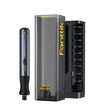




A compact emergency trunk kit built around five tools, a lithium jump starter, a digital tire inflator, an LED worklight, a tire plug kit, and a multi-bit screwdriver, covers most everyday roadside breakdowns without turning your trunk into a mechanic's shop. Each tool answers one specific problem: a dead battery, low tire pressure, poor visibility, a small puncture, or a loose fastener. None of them replace towing or professional repair when the situation is more serious than that.
The Five Tools to Pack in a Compact Emergency Trunk Kit
Five tools cover five distinct roadside scenarios, and each one has a clear job and a clear limit. The NHTSA roadside-kit guidance includes similar categories such as lighting, jumper cables, tire equipment, and basic tools in its recommended supplies, though the exact five-tool pairing below is an editorial approach rather than an official standard.
- Lithium jump starter — restarts a vehicle with a depleted battery.
- Digital tire inflator — restores a tire that has lost pressure but is otherwise sound.
- LED worklight — gives you usable light at the tire, battery, or trunk in low visibility.
- Tire plug kit — offers a temporary fix for a small tread puncture on the way to a shop.
- Multi-bit screwdriver — tightens loose trim, brackets, or minor accessory hardware.
This is a compact preparedness kit, not a full repair or survival kit. It is built to fit in a small bag or case, not to replace a mechanic's toolbox.
Before You Use Any Roadside Tool, Get Out of Traffic
The first decision at any breakdown is whether it is safe to work, not which tool to grab. Pull as far away from traffic as the road allows, onto a shoulder, exit ramp, or parking area, and turn on your hazard lights before opening the trunk.
If you cannot reach a safe spot, if you see smoke or fire, if the vehicle feels unstable, or if you are not sure what caused the problem, stop and call roadside assistance instead of troubleshooting on the shoulder. A worklight or reflective gear can help other drivers see your car, but it does not make an exposed roadside spot safe to work in. None of the five tools in this kit are a substitute for towing or a qualified repair shop when the situation calls for one.
Low Tire Pressure: Choose a Digital Tire Inflator by Target PSI
Start with your vehicle's recommended cold tire pressure, not the inflator's maximum PSI rating. That number lives on the vehicle tire door placard or in your owner's manual, and it is the pressure you are actually trying to reach.

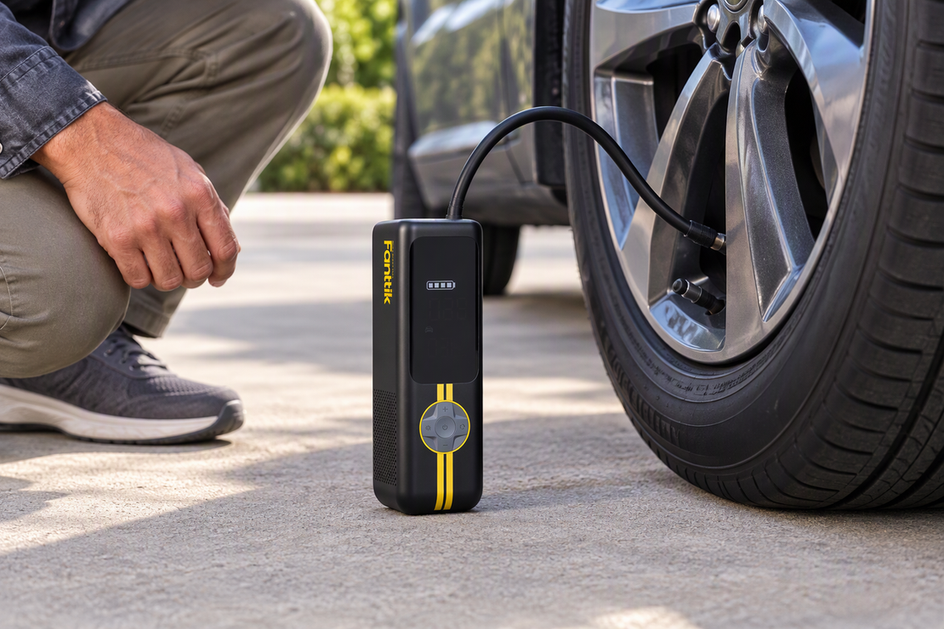
A high maximum PSI on an inflator tells you its ceiling, not how fast it fills your tire or whether it will stop at the right pressure. Look separately at inflation speed under a stated test condition, whether the unit has an adjustable preset with auto-stop, and how portable and battery-backed it is for trunk storage. Our Fanttik X9 APEX Portable Tire Inflator, for example, lists a 150 PSI maximum, an adjustable preset with automatic stop, and a manufacturer-reported 35-second fill from 28 to 33 PSI on a 25-inch tire, with enough battery capacity for 27 tires under that same test condition and a 1.87-pound weight. Those are useful reference points for comparing options, not proof that any inflator fits every vehicle; check your own tire size and target PSI before buying.
If a tire keeps losing pressure after you inflate it, or you see a nail, gash, or visible sidewall damage, inflating it again is not a repair. That points to a puncture or damage that needs inspection, which the next section covers.
Dead Battery: What a Lithium Jump Starter Can and Cannot Do
A lithium jump starter is built for one job: restarting a vehicle whose battery has run down but is otherwise fine. If the engine cranks weakly, the lights are dim, or accessories struggled before it died, a charged jump starter with the right connection to your battery terminals is likely to get you moving again.
It is not built to diagnose a no-start caused by something else, a fuel problem, ignition fault, failing alternator, or a mechanical issue. If the jump starter shows a healthy charge but the engine still will not start, or the same problem returns right after starting, the cause is probably not the battery alone, and continuing to try the same fix will not fix it. Exact voltage compatibility, clamp specifications, and connection steps vary by model, so follow the jump starter's own documentation rather than assuming any unit fits any vehicle. Before a trip, confirm the unit holds a charge and check that the clamps and cables show no fraying, corrosion, or damage.
Nighttime Work: Why an LED Worklight Belongs in the Kit
An LED worklight solves a narrow problem: letting you see the tire valve, battery terminal, or a dropped screw when it is dark. That local visibility is what lets you actually use the other four tools instead of working by phone flashlight.
A light you can prop up or clip in place, so your hands stay free, is more useful than one you have to hold the whole time. Check that it turns on and holds a charge as part of your pre-trip readiness check, the same way you would check the inflator or jump starter. A worklight does not fix poor weather, a busy shoulder, or a vehicle problem beyond a minor roadside task; it only helps you see what you are doing once you have already found a safe place to stop.
Small Tread Puncture: When a Tire Plug Kit Is Only a Temporary Step
A tire plug kit is worth carrying for one narrow case: a small puncture in the tread, not the sidewall. Industry USTMA tire repair guidelines limit repair consideration to tread-area punctures no larger than 1/4 inch (6 mm), and recommend professional inspection even for damage within that range.
A plug pushed in at the roadside gets you to a shop; it is not the finished repair. Proper repair calls for removing the tire from the wheel, inspecting the inside for hidden damage, and completing a patch-and-plug combination rather than relying on the plug alone. Sidewall damage, shoulder damage, anything larger than that tread limit, or an irregular cut means the tire needs professional service, not a plug. After using the kit, check what plugs or cement you used and plan to get the tire properly inspected soon.
Minor Loose Fasteners: What a Multi-Bit Screwdriver Can Handle
A compact multi-bit screwdriver handles small, low-stakes jobs: a loose license plate screw, a rattling interior trim panel, or a bracket that worked itself loose on a rough road. A useful kit screwdriver covers a few common bit types in a small handle, since the accessories you actually carry, roof racks, mounts, plates, are usually held by ordinary screws rather than specialty fasteners.
It is not the tool for lug nuts, seized bolts, or anything connected to steering, brakes, wheels, or suspension. Those jobs need proper torque tools and, often, a trained technician; forcing a small screwdriver on a stuck or structural fastener risks stripping it or making the problem worse. After use, wipe down the bits and return them to the case so a missing bit does not turn into a surprise next time you need it.
How to Organize, Charge, and Inspect the Five-Tool Kit
Keep all five tools in one compact, labeled case so you are not digging through the trunk at the roadside. Put the items you would reach for first, the worklight and inflator, where you can grab them without unpacking everything else.

Before a road trip, check that the jump starter and inflator hold a charge, and that the worklight turns on. Look over the cables, clamps, and hose for cracks or fraying, and confirm the screwdriver bits and plug-kit consumables are all present. After you use any tool, recharge or restore it according to its own instructions, and replace anything you used up, like plugs or cement, so the kit is complete again. A seasonal check before long trips, rather than a fixed schedule, is a reasonable habit for catching a tool that quietly went flat or missing since the last drive.
FAQs
What if the tire loses pressure again after I inflate it?
Repeated pressure loss means something is wrong with the tire, not that you need to inflate it again. Get to a safe location, avoid highway driving on a tire that keeps losing air, and have the tire inspected or repaired before your next long drive.
Can I leave lithium-powered emergency tools in a hot trunk all summer?
Don't assume a hot trunk is harmless for lithium-powered tools just because they're compact. Follow each device's own storage guidance, avoid using or charging anything that looks swollen, cracked, or damaged, and check that the jump starter and inflator still power on and hold a charge before you rely on them.
What should I replace after using part of the emergency kit?
Restock anything you used up: plugs and cement from the tire plug kit, any fuses if your jump starter includes them, and any missing or damaged screwdriver bits. Recharge the jump starter, inflator, and worklight fully, then put everything back in its spot in the case so the kit is ready again before your next trip.
Continue reading
 Cordless vs Gas Pressure Washers for Washing Cars: Safe PSI and GPM Ratings
A practical guide detailing safe PSI and GPM planning thresholds, nozzle angles, and power choices to protect clearcoat...
Cordless vs Gas Pressure Washers for Washing Cars: Safe PSI and GPM Ratings
A practical guide detailing safe PSI and GPM planning thresholds, nozzle angles, and power choices to protect clearcoat...
 Why Car Tire Pressure Increases During Highway Driving: Should You Bleed Hot Air?
A higher tire pressure reading after a highway drive comes from heat, not overinflation. Here is the safe...
Why Car Tire Pressure Increases During Highway Driving: Should You Bleed Hot Air?
A higher tire pressure reading after a highway drive comes from heat, not overinflation. Here is the safe...
Leave a comment
This site is protected by hCaptcha and the hCaptcha Privacy Policy and Terms of Service apply.