












































Match the inflator to the tire, not the headline PSI number. Before comparing any model, record the vehicle's specified cold tire pressure, the exact tire size, how many tires need air, and whether the job is a single top-off or a repeated session. Only an inflator with published evidence covering that exact workload deserves a spot on the shortlist.
A high maximum PSI rating tells you almost nothing about how fast a portable tire inflator for car, SUV, or truck duty fills a 33-inch tire or whether it can keep working through four low tires in a row. Airflow, tire volume, and duty cycle answer those questions instead, and each one changes the decision differently.
Record the Tire Size, Cold PSI, and Workload First
Every shortlist starts with five numbers pulled from the vehicle, not the inflator's spec sheet. Skipping this step is the most common reason buyers end up with a pump that's either overkill or undersized for the actual tires involved.
The five inputs that define the job
- Cold PSI: the pressure printed on the vehicle's tire information placard or certification label, not a number pulled from the tire's sidewall.
- Exact tire size: read from the same label or the owner's manual, since it defines how much air volume the job actually requires.
- Starting PSI: how low the tire currently reads, which sets the size of the pressure gap to close.
- Target PSI: the cold PSI value above, restated as the stopping point for the session.
- Number of tires and pattern: one emergency top-off versus a full four-tire or multi-vehicle session.
According to the NHTSA tire safety guidance, the manufacturer's recommended figure on the placard is the correct target, and a tire only counts as cold if it hasn't been driven on for at least three hours.
Why the input record comes before the product page
The same inflator can face very different workloads depending on tire volume and how far the pressure has to climb. A pump that comfortably tops off a small SUV tire from 28 to 32 PSI is doing a different job than one asked to bring a 33-inch truck tire back from 15 PSI. Writing down the five inputs first turns a manufacturer's published test condition into something you can actually compare against your own tires, instead of assuming any inflator will scale up automatically.
How Airflow, Tire Volume, and Maximum PSI Relate
Airflow, tire volume, and maximum PSI measure three different things, and treating any one of them as a stand-in for the others is where most shortlist mistakes happen. Keep them separate and each one earns its own place in the decision.
Airflow is not maximum PSI
Airflow describes how much air the pump can move under a stated condition, which is what actually drives inflation speed. Maximum PSI only describes the pressure ceiling the pump can reach; a unit rated to 150 PSI is not automatically faster than one rated to 100 PSI, because pressure ceiling and delivery rate are independent specifications.

Tire volume and pressure change set the workload
A larger tire holds more air than a smaller one at the same pressure, so a truck tire simply takes longer to fill than a compact SUV tire at an identical PSI target. A tire that starts farther below its target also needs more total air delivered before the job is finished, which means the same inflator can feel "fast" on a routine top-off and noticeably slower on a bigger recovery.
What to do when airflow is not published
- If a brand doesn't publish an airflow figure, don't assume a number from a similar-looking model; treat the gap as unresolved rather than filling it with a guess.
- Use a manufacturer's own inflation-time example only when your tire size and pressure span are materially similar to the one tested.
- Treat results from different tire sizes or different pressure spans as separate, non-comparable tests rather than averaging them into one expectation.
Duty Cycle Is the Limit for Repeated Inflation
Duty cycle, not maximum PSI or battery capacity, decides whether an inflator can handle more than one large tire without stopping. Accept a model for repeated work only when its documented continuous-run or rest-cycle limit actually covers your planned session.
One tire is not the same as a full session
A single low tire on the shoulder of the road may finish well inside a short operating window. Several large SUV or truck tires in one sitting accumulate both runtime and heat, so the total session length matters even if each individual tire would have been fine on its own.
What a useful duty-cycle specification includes
- A stated continuous operating time, such as a number of minutes the pump can run without stopping.
- The pressure or workload condition attached to that time, since a duty-cycle figure for a 0–35 PSI job doesn't automatically apply to a higher-pressure task.
- A rest or recovery instruction, when the manufacturer supplies one, for what to do once the limit is reached.
- Whether the claim covers one tire or an entire multi-tire session, since these are different measurements.
Fanttik publishes a 20-minute continuous-work condition for the X9 Ultra at 0–35 PSI. That figure describes the tested condition, not a guarantee that thermal shutdown won't occur outside it, and it doesn't transfer to other models or other pressure ranges. Readers whose X8 APEX has tripped its thermal protection during a multi-tire session can see the recovery steps in our X8 APEX overheating troubleshooting guide, which walks through the cause and the rest period needed before resuming.
Choose the Inflator by SUV or Truck Workload
The right inflator changes with the session, not with a single spec on the box. Match the scenario below to your recorded inputs, and only advance to a specific model once the required evidence for that row is actually documented.
| Workload scenario | Evidence that must match | Selection outcome | Not-fit condition |
|---|---|---|---|
| Routine SUV top-off | Target-pressure accuracy, correct tire-size coverage, easy vehicle usability | Choose based on gauge precision and usability, not maximum PSI | Maximum PSI far exceeds your target with no accuracy or usability evidence |
| One low truck tire | Comparable large-tire size and pressure-span example | Choose only if the published example is materially similar to your tire and pressure gap | No comparable large-tire example is published |
| Repeated multi-tire session | Documented continuous-work and rest-cycle limit covering the full session | Choose only when the stated limit covers your tire count and pressure recovery | No duty-cycle boundary is published for that workload |
For the one-low-truck-tire scenario, our X9 Ultra product page documents a 33-inch tire example reaching 30–35 PSI in 58 seconds with stated ±1 PSI accuracy. That's a useful reference only if your tire size and pressure gap are similar; a smaller SUV tire or a much larger pressure recovery is a different test. If you're weighing several current Fanttik inflators against each other for a truck-heavy household, our inflator model comparison lays out the official spec differences side by side.

Power, Hose, Gauge, and Connector Checks Decide Usability
A technically capable pump is still useless at the vehicle if its power source, hose, connector, or gauge can't complete the job in front of you. Run these checks after the workload match, not instead of it.
Power must match the place and session
- Confirm whether the unit is battery-powered, vehicle-powered through a 12V outlet, or dependent on another power source, and whether that source will last the planned session.
- If the session involves several tires or a large pressure recovery, check that the available charge or power arrangement can cover the full job, not just one tire.
Hose, connector, and gauge are completion checks
- Confirm the hose physically reaches the valve on the farthest tire without forcing you to reposition the unit awkwardly mid-job.
- Confirm the connector attaches securely to your vehicle's valve type; a loose or leaking connection undermines any airflow or duty-cycle advantage.
- Confirm the gauge lets you set and verify the target PSI you recorded earlier; if a model's gauge accuracy isn't documented, treat that as an open question rather than an assumed pass.
When Fanttik Evidence Is Strong Enough to Name a Model
A Fanttik inflator earns a place in your shortlist only when official evidence positively matches your recorded tire size, pressure span, workload, power situation, hose reach, and duty-cycle requirement. Belonging to the tire-inflator category or carrying a high maximum PSI rating isn't sufficient fit evidence on its own.
The evidence gate for a named model
Positive fit requires documentation for the reader's actual tire size and pressure span, and repeated service additionally requires a stated operating boundary that covers the session. A product that only lists a high maximum PSI, with no comparable tire-size example and no duty-cycle figure, doesn't clear that bar for a large or repeated job.
What the X9 Ultra evidence does and does not show
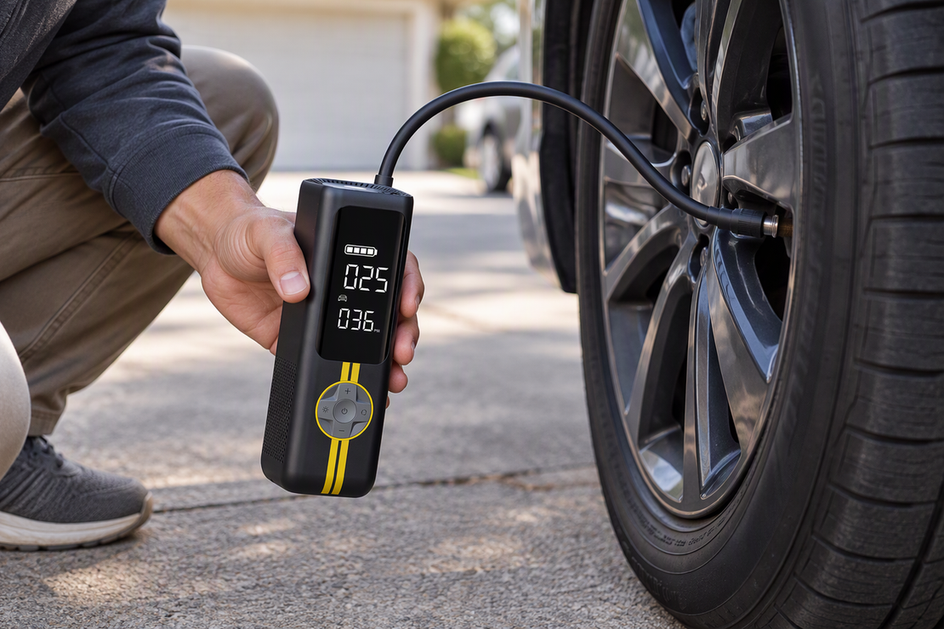
The X9 Ultra's published example covers a 33-inch truck tire reaching 30–35 PSI in 58 seconds with stated ±1 PSI accuracy, an 18.5V cordless design, and a 45.66-inch hose intended for pickup-truck tires up to 33 inches. It also carries the 20-minute continuous-work condition at 0–35 PSI noted earlier. That evidence supports the X9 Ultra as a fit for tasks resembling that exact example; it doesn't establish a universal airflow figure, cover every truck-tire size or pressure range, or promise that thermal shutdown can't occur outside the tested condition. If your workload sits outside those documented conditions, treat the product decision as unresolved rather than assuming fit.
When Inflation Is Not the Next Step
Inflation only solves the problem when the tire itself is sound. Know the line between a routine top-off and a tire that needs service before you keep adding air.
Use the specified cold pressure
Routine inflation should always target the vehicle manufacturer's specified cold PSI, not a generic SUV or truck range. If a TPMS warning light comes on, inspect the tire and check pressure as soon as possible rather than treating the warning light itself as the fix.
Stop when the tire itself is not a routine inflation job
Visible cuts, cracks, or bulges change the task from inflation to tire service, and a tire showing that kind of damage shouldn't stay in use. Persistent pressure loss that keeps returning after a proper top-off is another sign the tire needs a technician's inspection instead of another round of air.
FAQs
Can I compare two inflators' published inflation times directly?
Only when the tire size, starting PSI, target PSI, and material operating conditions are genuinely comparable. A manufacturer's 58-second result on a 33-inch truck tire reaching 30–35 PSI, for example, doesn't tell you anything about performance on a smaller SUV tire or a larger pressure recovery. Treat non-matching test conditions as separate, unrelated results rather than picking whichever number looks smaller.
How does duty cycle affect filling all four tires?
Duty cycle sets the maximum continuous running time before the inflator requires a mandatory cooling rest. If a multi-tire top-off or heavy pressure recovery exceeds that thermal boundary, the unit can trip its automatic thermal shutdown mid-session. Always verify that the published continuous-run limit covers the combined runtime needed for all planned tires.
Does a higher maximum PSI mean faster truck tire inflation?
No. Maximum PSI only indicates the peak pressure boundary the internal pump mechanism can withstand, not the volume of air it moves per minute. Airflow and tire displacement determine inflation speed, meaning a 150 PSI unit is not inherently faster at filling a large truck tire than a 100 PSI model.
Continue reading
 How to Jump Start a Car with an AGM Battery: Grounding Rules and Sensor Protection
This guide shows how to confirm your vehicle's approved AGM jump-start terminals, follow a sourced example, and know...
Complete Car Interior Detailing Guide: Step-by-Step Clean and Protect Workflow
A practical order of operations for detailing a car interior, from dry debris removal through material-specific cleaning to...
Leave a comment
This site is protected by hCaptcha and the hCaptcha Privacy Policy and Terms of Service apply.