









































To choose a laser distance meter, start with your projects, not the box. A meter fits when three things line up: its documented range covers your longest routine measurement, its stated accuracy is tight enough for the work, and its memory or calculation functions save you a step you would otherwise do by hand.
No single range or accuracy number suits every renovation or DIY job. If a candidate misses any of those three checks, or its documentation doesn't cover the conditions you'll work in, narrow the job it has to do or choose a different way to measure.

Start With the Measurements You Actually Need
Write down the jobs first. The spec sheet only matters once you know what it has to cover. Work through these three decisions in order:
- Name the measurement jobs and the longest routine distance. List what you'll actually measure: room lengths for flooring, wall heights for paint, window openings for blinds, or a garage for shelving. Circle the longest distance you'll measure again and again. That number is your range target, not the longest distance you might someday try.
- Set how much error the project can accept. A rough paint estimate can tolerate more error than a cut list for trim or cabinets. Decide your acceptable deviation before you look at any accuracy spec, and keep it separate from the range target.
- Pick only the functions you'll use. If you'll record a dozen room dimensions or need square footage, write that down. If you only check one distance at a time, extra modes shouldn't sway the choice.

Each item becomes one check: distance coverage, acceptable deviation, and useful documented functions. The sections below cover each check.
How to Compare a Meter's Range
Range answers one question: can the meter return a reading over the distance you need? Hold your longest routine distance up against the manufacturer's stated range. Then read the conditions attached to that figure. A maximum range is measured under specific conditions. When your targets or setting differ from them, the headline number doesn't prove the meter will reach that far on your job.
Here's an illustrative example, not a product test. Say you're planning flooring for a long living room and a basement. If the longest wall you'll measure regularly sits well inside a candidate's stated range under conditions similar to yours, range is settled and you can move on. If your routine distance sits near the stated maximum, or the documented conditions don't match your space, don't count that range as confirmed. Look for a model whose documentation clearly covers the job, or split long runs into shorter measurements.
A long range also says nothing about how close each reading will be to the true distance. That's a separate spec.
How to Compare Accuracy Specifications
Accuracy tells you how far a reading may stray from the true distance. It's the spec that matters when parts have to fit. Compare the stated tolerance with the deviation you set for your project. Keep a candidate only when its tolerance is equal to or tighter than what the work can accept.
Read the full accuracy line, not just the number. Manufacturers may attach a distance, a target type, or operating conditions to the figure. A tolerance stated under one set of conditions shouldn't be assumed for others. Also check the units before you compare two models. A spec in millimeters and one in fractions of an inch aren't comparable until you convert them carefully, and a figure tied to a specific distance may not describe readings farther out.
Don't let one model's accuracy figure become your requirement, either. Your trim cuts, tile layout, or furniture fit set the requirement. The spec sheet only tells you whether a candidate meets it.
When the Target or Conditions Change the Choice
Where and what you measure can matter as much as the numbers. A laser distance meter works by bouncing its beam off a target and reading the return. So the surface you aim at, how well you can see the laser dot, and the room's temperature and lighting all belong in the fit decision. Treat each as a question for the candidate's documentation: which targets, lighting, and operating temperatures does the stated range and accuracy cover?
Target material does affect results in related instruments. In a study of reflectorless distance measurement using a total station, a survey instrument rather than a handheld DIY meter, errors varied with the target material and the test distance. The authors also found larger errors on lower-density materials. Those figures don't carry over to consumer meters. They do show why a headline spec shouldn't be read as independent of the target.
The practical result is a simple split. If your job's targets and conditions fall within what the documentation covers, rely on the stated specs. If they don't, like aiming at an unusual surface or working somewhere the dot is hard to see, choose a model documented for those conditions, place a solid, flat target at the endpoint, or measure that part of the job with a tape.
Choose Smart Functions That Remove a Step
A smart function is worth paying for only when it replaces work you would otherwise do by hand. Stored readings help when you measure several rooms or openings and need the numbers later, for example when you're building a flooring estimate or a window-treatment order away from the site. If you already write every reading down right away, memory is a convenience, not a requirement.
Calculation modes work the same way. Area or volume calculations help when square footage or cubic footage is the actual output, such as paint coverage or room layout planning. They add little if you only need a single wall length. Keep in mind that measuring a distance and calculating an area are different tasks, so confirm the meter performs the specific calculation your job needs.
Feature sets and storage capacity vary by model, so don't assume every meter has the same modes. When a function you need is clearly documented for a candidate, make it a requirement. When you won't use a function, leave it out of the decision, even if it appears high on the feature list.
When a Laser Level Is the Better Fit
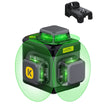
A laser distance meter answers "how far is it from here to there?" If your job instead needs a visible straight or level reference across a surface, a laser level is the tool category that fits. Examples include lining up a row of picture frames, setting a tile layout line, or keeping cabinets on a common height. The two tools solve different problems. Choose the one that produces the output your job needs, not just any tool that happens to use a laser.
Some projects need both: a distance reading to plan the layout and a reference line to install it. If you already own a level and the line is hard to see or seems off, our guide to troubleshooting laser level problems covers visibility and calibration issues.
FAQs
Is a digital laser tape measure the same as a laser distance meter?
The two names are often used for the same kind of handheld laser measuring tool. The label doesn't tell you much about fit. Judge any digital laser tape measure by its documented range, stated accuracy, conditions, and functions against your own project list.
How can I sanity-check a new meter before starting a project?
Measure a short, known distance with a steel tape, then measure it with the laser from the same reference point. If the readings differ by more than your project can accept, check which edge of the meter the reading is taken from. If your meter has a reference-point setting, confirm it's set to the edge you're measuring from before you repeat the test.
Do I need Bluetooth or an app connection?
You only need it if you regularly move readings into a phone, tablet, or planning file and want to skip retyping them. Before you pay for it, confirm in the candidate's documentation that the app supports your device and exports readings in a form you can use. If you record measurements by hand or with built-in memory, a connected feature shouldn't decide the purchase.
Continue reading
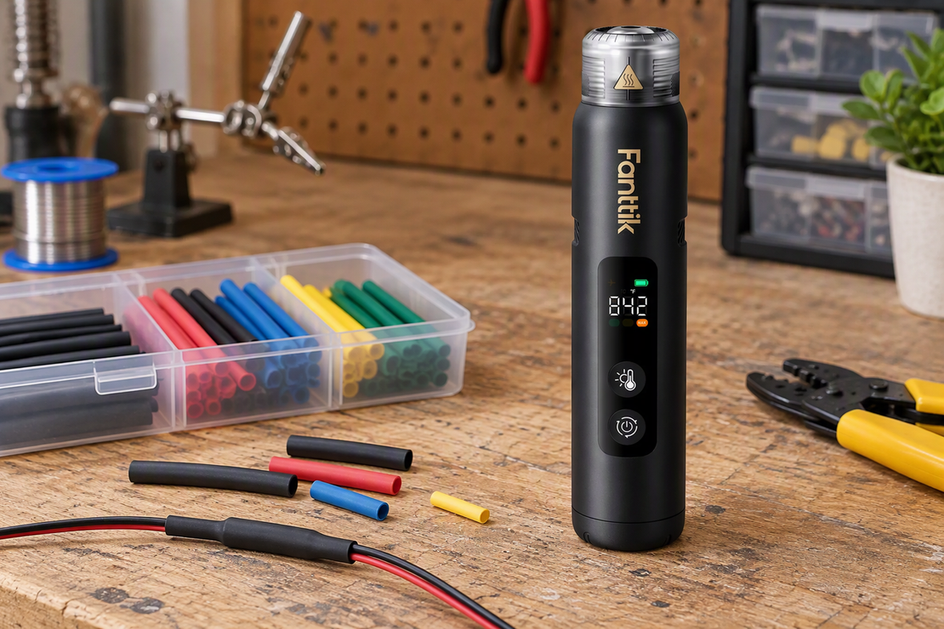 Heat Gun Buying Guide: Temperature Control, Airflow, and Essential DIY Uses
Match a heat gun to your project by checking temperature and airflow controls separately, confirming nozzle fit for...
Heat Gun Buying Guide: Temperature Control, Airflow, and Essential DIY Uses
Match a heat gun to your project by checking temperature and airflow controls separately, confirming nozzle fit for...
 How to Clean a Mechanical Keyboard and PC Fans with an Electric Air Duster
A practical keyboard and PC fan cleaning plan that separates canned-air advice from electric duster use and shows...
How to Clean a Mechanical Keyboard and PC Fans with an Electric Air Duster
A practical keyboard and PC fan cleaning plan that separates canned-air advice from electric duster use and shows...
Leave a comment
This site is protected by hCaptcha and the hCaptcha Privacy Policy and Terms of Service apply.