








































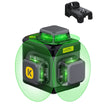

If your laser measure gives a jumpy or odd number on glass, a mirror, or a glossy finish, don't use it yet. Don't cut or install anything from that reading. First give the beam a better surface to hit, and if the number still won't settle, measure with a tape.
Refraction (light bending as it passes through glass) is one possible reason, but it's not the only one. A clear pane and an opaque mirror also raise different questions, so the check you run depends on which one you're aiming at.

What to Do When a Glass or Glossy-Surface Reading Seems Wrong
Stop and treat the reading as unconfirmed if repeated shots at the same spot disagree, or if the number clearly doesn't fit the space in front of you. This is a cautious working rule, not a manufacturer threshold. It keeps a bad number off your cut list, your shower-door order, or your mirror-mount layout.
Start with the simplest check. Take the same shot two or three more times without moving your reference edge. If the readings match each other and roughly match a quick tape check, you probably have a usable number. If they scatter, or they agree with each other but not with the tape, the surface is the next thing to deal with.

Next, give the beam something better to hit. A Leica Disto Pro 4 guide hosted by the University of Oregon warns that wet, reflective, transparent, or rough surfaces may not give good readings. It suggests having a partner hold a target plate, such as a notebook, in front of the surface. It also suggests a sticky note to reduce reflectivity. That advice was written for one model, but it gives you a concrete fix to try.
Once you add a target, the meter measures to the target's face, not to the glass. Think about where that face sits compared with the point you actually need:
- Held notebook: It sits in front of the surface, so the reading ends wherever the notebook is. Hold it flat against the glass or frame if the glass face is your endpoint.
- Sticky note: It sits right on the surface, so the endpoint stays at the glass, mirror, or glossy panel itself.
- Your real endpoint: Decide whether the job needs the glass face, the frame edge, or the rough opening. Then aim at that exact plane.
Your own meter may have its own rules. Look in its manual for the section on target surfaces and error messages. If that section limits certain surfaces or lists an error code for this situation, follow the manual over any general tip.
Very short distances are a separate limit. The same guide says the Disto Pro 4 can't read lengths shorter than 0.3 meters (about 1 foot) and recommends a tape measure for those. Other meters have their own minimum distance, so a short gap to a glass shelf or cabinet door may simply be out of range.
Switch methods when the fix doesn't hold. Use a tape measure for the final number if any of these happen:
- Readings with a target still scatter.
- The numbers with and without a target differ, and you can't explain the difference.
- The distance is too short for your meter.
Also try the meter on a matte painted wall. If the readings drift there too, the glass isn't the only issue, and it's worth learning how factory calibration limits error before you trust the tool on any surface.
Why Glass, Mirrors, and Glossy Finishes Need Separate Guidance
A clear pane can give you the distance to the wrong object. A mirror or glossy finish is just a hard surface to read. That difference changes what you check when a laser measure on glass or on a mirror gives a number that looks off.
A peer-reviewed study on reflectorless distance measurement lists several target properties that can change accuracy. These include material, transparency, surface roughness, color, and angle, which can scatter, refract, or reflect the beam. The study notes that partly transparent materials reflect only part of the beam. With very clear materials, the beam can come back from whatever is behind them, which throws off the result. That research used a surveying instrument on construction materials, not a handheld meter. Treat it as a reason to be suspicious, not as a spec for your tool.
For transparent glass, the useful question is: does this number match something behind the pane? Think of the back wall behind a glass railing, the far side of a window, or a shelf behind a cabinet door. If the reading lands closer to that object than to the glass, the beam likely didn't stop where you wanted. Put a target on the glass and shoot again.
Mirrors and glossy opaque finishes, like polished tile, lacquered cabinets, or high-gloss paint, don't have a "behind" to check. The beam can't pass through them. The Disto guide still groups reflective surfaces with difficult targets, and it describes the sticky note as a way to reduce reflectivity. For these surfaces, the fix is a less reflective spot at your endpoint, not a question about what's behind it.
About the "refraction error" label: refraction is one of the effects listed in that research, alongside scattering and reflection. A strange reading doesn't tell you which one happened. The good news is that you don't need to know the cause to act. The target and tape-check path works the same way whatever the cause turns out to be.
Box specs don't settle this either. Maximum laser range tells you how far a meter can reach. Accuracy tells you how close the reading should be under the maker's stated conditions. Neither one tells you how the meter handles clear glass or a mirror.
FAQs
Is a mirror error the same as a window-glass error?
Don't assume so. With clear glass, the reading may come from an object behind the pane. A mirror is opaque, so that isn't possible, and the problem is getting a clean return from a shiny surface. If the mirror sits in a frame or flush with a wall, you can often aim at the matte frame or wall in the same plane instead.
How much variation between readings is too much?
There's no universal number. Compare the spread between your readings to the tolerance your job needs. A spread you can live with for a rough estimate before shopping may be too much for a snug frameless mirror or a glass panel ordered to size. If the spread is larger than your fit tolerance, take the final number with a tape.
Should I use a laser to order a replacement glass pane?
A laser measure glass reading is fine for early planning. For the order itself, measure the opening or frame with a tape, where you can see and feel both endpoints. Glass is usually cut to size, so a wrong number means paying for a pane that doesn't fit.
Does the notebook-target trick work on every laser measure?
That tip comes from a guide written for the Leica Disto Pro 4, so it isn't a rule for every model. Try it on your own meter, then confirm that the readings repeat and roughly match a tape. If your manual lists its own surface limits or error codes, those take priority.
Continue reading
 Using Electric Air Dusters on Camera Gear: Is High-Velocity Air Safe for Lenses and Sensors?
Manufacturer guidance separates gentle blower cleaning from powered air. Here is how to judge an electric duster for...
Using Electric Air Dusters on Camera Gear: Is High-Velocity Air Safe for Lenses and Sensors?
Manufacturer guidance separates gentle blower cleaning from powered air. Here is how to judge an electric duster for...
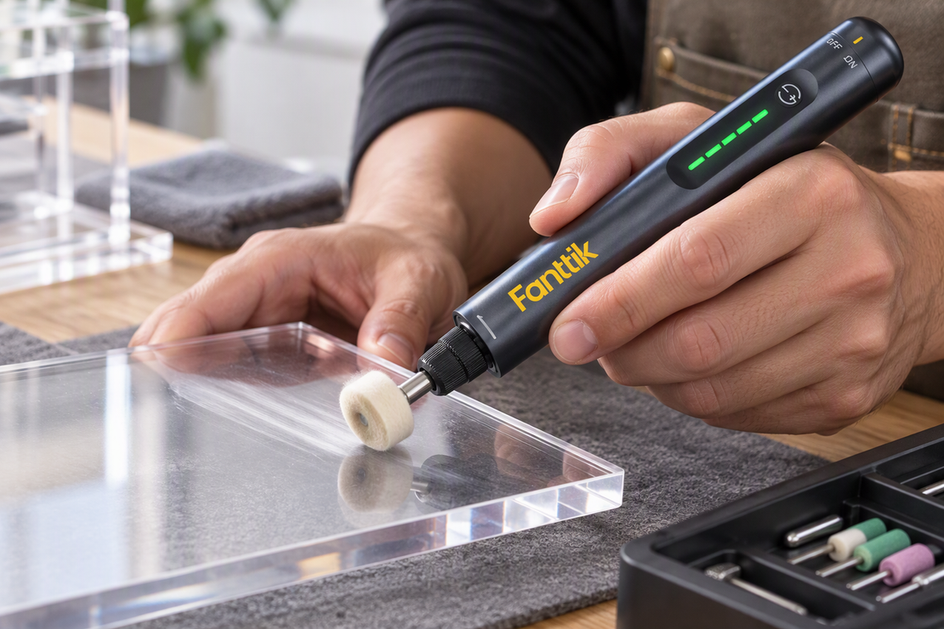 Polishing Plastic and Acrylic with a Rotary Tool: How to Avoid Melting and Swirls
A practical plan for buffing acrylic with a rotary tool: confirm the plastic, pick compound and speed, run...
Polishing Plastic and Acrylic with a Rotary Tool: How to Avoid Melting and Swirls
A practical plan for buffing acrylic with a rotary tool: confirm the plastic, pick compound and speed, run...
Leave a comment
This site is protected by hCaptcha and the hCaptcha Privacy Policy and Terms of Service apply.