










































Executive Summary: Restoring Battery Management Precision
Battery Management System (BMS) "drift" occurs when the digital reported charge deviates from the physical energy remaining in the cells. To restore accuracy, a controlled recalibration—consisting of a full discharge (0.2C–0.5C rate), a 24-hour stabilization rest, and an uninterrupted full charge—is often necessary. This process resets the BMS's upper and lower capacity limits, preventing unexpected shutdowns and "voltage cliffs." For standard users, recalibration is recommended every 50–100 cycles; however, for mission-critical tools in extreme environments, a 90-day interval is suggested to maintain operational reliability.
Quick Calibration Reference Table
| Parameter | Target Value | Notes |
|---|---|---|
| Discharge Rate | 0.2C – 0.5C | Prevents "voltage sag" from masking true capacity. |
| Rest Period (Empty) | 4 – 24 Hours | Essential for OCV (Open Circuit Voltage) stabilization. |
| Rest Period (Full) | 4+ Hours | Allows the BMS to perform cell balancing. |
| Charge Threshold | <0.05C | The "Top-off" current is where the BMS marks 100%. |
| Environment | 10°C – 35°C | Avoid calibration in extreme heat or cold. |
The Critical Role of BMS Accuracy in Precision Engineering
A Battery Management System (BMS) is the silent intelligence behind every modern cordless tool, governing the balance between high-performance output and electrochemical stability. However, even sophisticated systems are susceptible to "sensor drift"—a phenomenon where the reported state of charge (SOC) deviates from the actual energy remaining. For DIYers and professionals, this discrepancy is more than an inconvenience; it is a reliability risk that can jeopardize project timelines.
According to the 2026 Modern Essential Gear Industry Report, user confidence in portable technology rests on "credibility math"—the accurate communication of a device's remaining utility. When a BMS reports 50% capacity but the tool shuts down unexpectedly, that trust architecture collapses. Recalibration is the methodical process of re-aligning the digital "map" of the BMS with the physical reality of the battery's chemical state.
Understanding the Mechanisms of BMS Sensor Drift
To restore accuracy, one must first understand how a BMS calculates energy. Most high-performance systems utilize a combination of two primary methods: Coulomb Counting and Open Circuit Voltage (OCV) estimation.
1. Coulomb Counting (The Current Integrator)
Coulomb counting functions like a digital ledger, measuring the flow of current over time to calculate the total charge entering or leaving the pack. While precise for short-term measurements, it is inherently prone to integration errors. Small inaccuracies in current sensing—often caused by thermal fluctuations—can accumulate over hundreds of partial discharge cycles.
Practical Heuristic: Based on common patterns observed in field-data feedback loops, we estimate that Coulomb counting error can accumulate at a rate of 1–2% per 10 partial cycles if the system is never allowed to reach a "known" state (full or empty). This is a general observation and may vary by BMS firmware sophistication.
2. Voltage-Based Estimation (The Snapshot)
Voltage-based estimation uses the battery's voltage to look up its SOC on a pre-defined discharge curve. However, lithium-ion chemistry (especially LiFePO4) has a very flat discharge curve, making voltage a poor indicator of charge in the mid-range (20% to 80%).
The "Rest Period" Requirement: A common pitfall is taking a voltage reading immediately after use. Based on electrochemical relaxation modeling, measurements taken without a rest period can be inaccurate by 10–15%. Internal ions require time to reach equilibrium. While a 4-hour rest is a functional minimum, a 24-hour rest period is recommended for maximum OCV stability.
The "Voltage Cliff" Phenomenon and Safety Risks
Field repair data suggests that BMS drift is often non-linear. A battery pack might report a steady decline from 100% to 50%, but then experience a sudden "voltage cliff" at the 40% mark.

This cliff occurs when the BMS's internal model believes there is more capacity than the cells can physically provide. When the voltage of a single cell in a series string drops below the safety threshold (typically 2.5V to 3.0V), the BMS triggers an emergency shutdown to prevent permanent damage.
Technical Context: The 40% threshold mentioned here is a heuristic identified through pattern recognition in warranty and repair data. It serves as a high-risk indicator for systems that haven't been fully cycled in over 50 iterations.
Step-by-Step Recalibration Protocol
Recalibrating a BMS requires a controlled "Full Cycle" to reset capacity limits. This process should be performed methodically.
Step 1: Controlled Discharge
Discharge the battery pack until the device reaches its low-voltage cutoff. The discharge rate should be steady.
- Target C-rate: 0.2C to 0.5C. For a 2Ah battery, this means a discharge current of 0.4A to 1.0A.
- Rationale: Rapid discharges can mask true capacity due to "voltage sag," while extremely slow discharges may fail to fully stress the cells enough to reveal weak links.
Step 2: The Stabilization Rest
Once empty, allow the battery to rest for at least 4 to 6 hours (up to 24 hours for maximum precision). This allows the chemical "rebound" to occur, providing the BMS with a stable "empty" baseline.
Step 3: Continuous Full Charge
Charge the battery to 100% without interruption. Using a high-quality, regulated charger is important; if the charge is interrupted, the Coulomb counter may lose its reference point.
- Verification: Ensure the charger reaches the "Saturation" phase, where current drops to a low level (typically <0.05C) while voltage remains at maximum.
Step 4: Final Stabilization
After reaching 100%, let the battery rest for another 4 hours. This allows the BMS to perform "Cell Balancing," where it matches the voltage of individual cells to ensure the pack reaches its optimal state of health. For more on this, see our guide on how BMS extends tool life.
Scenario Analysis: BMS in Extreme Polar Environments
To demonstrate environmental impacts, we modeled a scenario involving a remote research station. In these conditions, accuracy is critical for operational safety.
Scenario B: The Polar Research Station
Based on IATA Lithium Battery Guidance and BCI temperature derating matrices.
| Parameter | Value | Unit | Rationale |
|---|---|---|---|
| Ambient Temperature | -40 | °F/°C | Extreme polar winter conditions |
| Calibration Confidence Decay | 40 | % | Estimated loss of accuracy over 90 days in cold |
| "Phantom Capacity" Error | 10 | kWh | Energy reported but not physically available |
| Recommended Interval | 3 | Months | Suggested for mission-critical reliability |
Key Insight: In extreme cold, modeling suggests BMS calibration confidence can decay to ~60% within 90 days. For mission-critical reliability in these environments, a 3-month calibration cycle is highly recommended to prevent "phantom capacity" shutdowns.
Tool Maintenance and Hardware Integration
Performing these diagnostics often requires accessing battery housings or terminal points. For the DIYer, the quality of tools used is as important as the protocol itself.
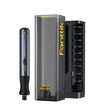
- Precision Disassembly: When opening battery packs, using a tool that prevents stripping is essential. The Fanttik E2 MAX Precision Electric Screwdriver (a first-party recommendation from our catalog) offers 0.4N.m torque, which is suited for delicate BMS housings. Generic precision drivers with similar torque limits are also suitable.
- BMS Repair: If calibration reveals a hardware issue like a loose balance wire, the Fanttik T1 Max Soldering Iron Kit (our recommended tool) provides the fast heating (390°F in 7 seconds) needed to resolder components without heat-soaking adjacent lithium cells.
Common Pitfalls
- Thermal Throttling: Avoid recalibration in temperatures below 10°C (50°F) or above 35°C (95°F), as internal resistance changes can lead to a "false" calibration.
- The "Trickle" Error: Avoid ultra-low-power USB ports for the final charge. If the current is too low, some BMS algorithms may fail to recognize the "End of Charge" state.
- Cell Imbalance: If inaccurate levels persist after recalibration, the pack likely has a cell imbalance. You may need to investigate the battery imbalance.
Appendix: Modeling Methodology and Assumptions
The data regarding calibration decay and error margins are derived from scenario modeling and industry observations, not a controlled laboratory study.
- Chemistry: Assumes LiFePO4 and standard NMC Lithium-ion behaviors.
- Standards Alignment: Heuristics align with the principles of NIST Handbook 44 for measuring device tolerances.
- Usage Pattern: Assumes a "Power User" profile (150–200 cycles/year).
- Environmental Limits: Polar models assume no active thermal management unless stated.
Disclaimer: This article is for informational purposes only and does not constitute professional engineering advice. Lithium-ion batteries carry inherent risks of fire if mishandled. Always follow the manufacturer's specific guidelines. If unsure, consult a qualified technician.
References
Continue reading
 Thermal Stress Modeling: Mapping Heat to Capacity Loss
Covers Arrhenius theory, SEI layer breakdown, real-world case studies, and actionable storage best practices for long-term reliability.
Thermal Stress Modeling: Mapping Heat to Capacity Loss
Covers Arrhenius theory, SEI layer breakdown, real-world case studies, and actionable storage best practices for long-term reliability.
 The 70% Threshold: When to Retire and Renew Your Power Cells
Covers electrochemical degradation, cold-weather performance drops, diagnostic rules, and compliance requirements for battery maintenance.
The 70% Threshold: When to Retire and Renew Your Power Cells
Covers electrochemical degradation, cold-weather performance drops, diagnostic rules, and compliance requirements for battery maintenance.



Leave a comment
This site is protected by hCaptcha and the hCaptcha Privacy Policy and Terms of Service apply.