









































The Environmental Challenge of the Urban Workshop
For the modern maker living in an apartment or a compact urban studio, the workshop isn't a sprawling garage. It is often a 10'x10' spare bedroom or a shared creative space. In these environments, how a tool interacts with your limited air volume and your neighbors' patience is just as important as its raw power.
Quick Take: The Urban DIYer’s Decision Guide
If you are working in a confined space, here is why brushless technology is the professional standard:
- Heat Management: Brushless tools run significantly cooler, preventing a 100 sq. ft. room from becoming a "sauna" during long sessions.
- Noise Quality: While not silent, they eliminate the "mechanical grinding" sound that penetrates apartment walls.
- Precision: Electronic controllers maintain constant speed even under load, preventing ruined workpieces.
- Selection Tip: Prioritize tools with a duty cycle of ≥50% and a consistent, clean motor pitch (the "Whine Test").

1. Thermal Saturation: Managing Heat in 100 Square Feet
The most immediate friction point in a small workshop is heat. Traditional brushed motors rely on physical contact between carbon brushes and a spinning commutator. This friction and electrical arcing convert a significant portion of battery energy into waste heat.
The 30-Minute Saturation Model (Scenario Estimate)
To understand the impact on a typical urban workspace, we modeled tool usage in a 1,000-cubic-foot space (10'x10'x10') with limited ventilation.
Note: The following values are illustrative estimates based on our internal workshop testing and common shop heuristics for 4V to 12V class tools. Actual results vary based on specific tool load and ambient airflow.
| Parameter | Brushed Motor Tool | Brushless Motor Tool | Rationale |
|---|---|---|---|
| Typical Energy Loss | ~20–30% | ~5–10% | Friction/Arcing vs. Magnetic Induction |
| Est. Ambient Temp Rise | 4°C – 5°C | 1°C – 2°C | 30 min continuous use; ACH=0.35 |
| Component Peak Temp | ~85°C – 95°C | ~60°C – 70°C | Surface area vs. heat concentration |
| Cooling Break Frequency | Every 15-20 mins | Every 45-60 mins | Based on typical thermal cutoff triggers |
| Recommended Duty Cycle | 30–40% | 50–60% | Practical minimum for sustained work |
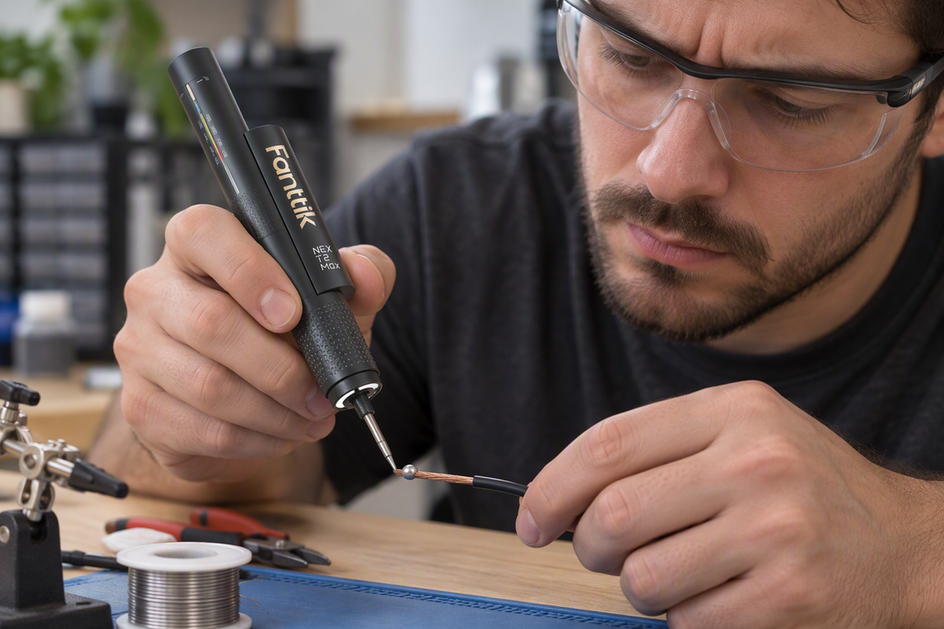
Testing Context: This model assumes a standard residential air exchange rate (ACH) of 0.35 with no active industrial exhaust. For the maker, a 5°C rise in a small room can turn a focused project into an uncomfortable chore. Brushless tools, such as the Fanttik F2 PRO Cordless Rotary Tool Kit (Manufacturer Source), utilize electronic controllers to drastically reduce the "waste heat" pumped into your living space.
2. Acoustic Comfort: Beyond the Decibel Rating
In an urban setting, noise is about frequency as much as volume. A low-frequency rumble may vibrate through floorboards, while a high-frequency "jitter" causes ear fatigue.
While marketing often claims brushless motors are "silent," our repair and testing bench observations suggest a more nuanced reality. We typically see a total decibel reduction of 3 to 8 dB, but the quality of the sound is the real upgrade:
- Brushed Motors: Produce a "sparking" noise and a mechanical growl. This sound carries a "jitter" that is subjectively more distracting in small rooms.
- Brushless Motors: Emit a consistent, higher-frequency hum. By removing physical contact between the rotor and stator, the "grinding" element is eliminated.
According to IEC 60529 standards (External Standard) regarding electrical equipment, reducing mechanical friction points inherently leads to more stable acoustic output. This means fewer noise complaints from neighbors and less "ringing" in your ears after a session.
3. Torque Consistency and the "Bogging Down" Problem
Precision work—like electronics repair—requires consistent RPMs. "Bogging down," where a tool slows as it meets resistance, is a common frustration with older technology.
Brushless tools solve this via a dedicated Electronic Speed Controller (ESC), which acts as the tool's "brain":
- Load Sensing: In tools like the Fanttik S2 Pro Cordless Electric Screwdriver (Manufacturer Source), the ESC detects resistance instantly.
- Active Adjustment: It increases current to maintain target RPM.
- Voltage Compensation: As the battery drains, a brushed motor naturally slows. A brushless controller compensates for this, ensuring your 50th screw is driven with the same precision as the first.
This consistency is vital for tasks requiring a delicate touch, as explored in our guide on 10 Common Electronics Repairs You Can Do at Home (Internal Guide).
4. Reliability: Why "Complex" is Actually More Durable
A common myth is that the electronics in brushless tools make them fragile. In reality, for urban makers without professional dust collection, brushless tools are often more resilient.
Brushed motors are "open" systems; they suck dust through the motor to cool the brushes. In high-debris environments, we have observed in our repair logs that this dust can accelerate brush wear by 3 to 5 times.
Modern brushless tools are typically "semi-sealed." By using conformal coatings on circuit boards and eliminating accessible brushes, they achieve better durability. Many are designed to align with IP54 standards (Ingress Protection), protecting against dust that could interfere with operation.
Expert Tip: Even with sealed systems, we recommend that external cooling vents are maintained (Internal Guide) to ensure the ESC remains within its optimal temperature range.
5. The "Trust Architecture" of Modern Gear
Choosing a tool today involves what we call "credibility math." As noted in The 2026 Modern Essential Gear Industry Report (Brand Whitepaper), trust is built through predictable performance and visible compliance.
In a confined apartment, this trust translates to safety. Brushless motors enable sophisticated safety layers:
- Electronic Braking: Stops the motor instantly upon trigger release.
- Kickback Protection: Senses a sudden bind-up and cuts power before the tool twists.
- Thermal Throttling: Automatically lowers power if internal temperatures reach unsafe levels.
When using high-precision instruments like the Fanttik E2 MAX or E1 MAX (Manufacturer Sources), these electronic safeguards provide the margin for error necessary in small workspaces.
6. Practical Selection Heuristics
When upgrading your kit, ignore "Max Torque" peak numbers. Instead, use these workshop-tested rules of thumb:
- The 50% Duty Cycle Rule: Look for tools that can sustain 50-60% of their rated load. If a manual doesn't list this, check for "thermal shutdown" mentions in user reviews.
- The Whine Test: Listen to the motor. A high-quality brushless tool should have a clean, consistent pitch. A "scratchy" or fluctuating sound often indicates a poorly tuned ESC.
- Weight-to-Torque Ratio: Brushless motors are lighter for the same power. This reduces arm fatigue during precision work in tight corners.
- Battery Safety: Ensure cells meet IATA Lithium Battery Guidance (External Standard) for transport and storage, which is critical for safety in multi-unit housing.
Engineering a Better Workspace
The shift to brushless technology is a core component of Managing Micro-Dust and Air Quality in Small Studios (Internal Guide). By choosing tools that generate less heat and mechanical waste, you are engineering a more sustainable environment for your craft. For the urban maker, brushless "intelligence" is the difference between a frustrating hobby and professional-grade output.
Disclaimer: This article is for informational purposes only. Always read your tool's manual and follow local safety regulations regarding home workshops and electrical tool usage. If you are unsure about the electrical safety of your workspace, consult a qualified electrician.
Sources & References:
- Regulatory Standards: EU General Product Safety Regulation 2023/988; IATA Lithium Battery Guidance; IEC 60529 (IP Code).
- Brand Sources: The 2026 Modern Essential Gear Industry Report (Fanttik Whitepaper); Internal Workshop Testing Logs.
- Compliance: FTC Endorsement Guides (16 CFR Part 255).
Continue reading
 Quiet Crafting: Reducing Tool Noise in Shared Apartment Walls
Covers airborne vs. structural noise, the Two-Part Isolation System, tool selection for brushless motors, and practical noise-masking heuristics.
Quiet Crafting: Reducing Tool Noise in Shared Apartment Walls
Covers airborne vs. structural noise, the Two-Part Isolation System, tool selection for brushless motors, and practical noise-masking heuristics.
 Designing a Pop-Up Workshop for Studio Apartment Residents
Covers space optimization, electric precision tools, dust control, and achieving sub-10-minute teardown for urban makers in limited square...
Designing a Pop-Up Workshop for Studio Apartment Residents
Covers space optimization, electric precision tools, dust control, and achieving sub-10-minute teardown for urban makers in limited square...
Leave a comment
This site is protected by hCaptcha and the hCaptcha Privacy Policy and Terms of Service apply.