










































Chemical Aging Factors: Why Shelf Life Impacts Performance
Quick Summary: To maximize the lifespan of idle lithium-ion batteries, store them at a 40–60% State of Charge (SOC) in a cool, climate-controlled environment. Idle batteries undergo natural chemical aging that reduces capacity and increases safety risks over time. We recommend a "3-6-12" maintenance routine: perform a visual check every 3 months, a maintenance charge every 6 months, and a functional load test every 12 months.
Even the most sophisticated lithium-ion batteries are not static reservoirs of energy. They are dynamic chemical systems that undergo continuous, irreversible changes from the moment they leave the assembly line. For the modern self-reliant consumer, understanding that an unused battery is still an "aging" battery is critical for maintaining emergency preparedness and tool reliability.
We often encounter a common frustration among DIY enthusiasts and car owners: a jump starter or cordless tool, stored for a year "just in case," fails to perform when finally needed. This is rarely a defect; rather, it is the result of chemical aging factors that dictate a battery's shelf life. In this guide, we will analyze the mechanisms of degradation, the environmental catalysts that accelerate them, and how you can model the health of your backup power solutions.
The Chemistry of Inactivity: Why Idle Batteries Decay
Lithium-ion batteries rely on the movement of ions between a cathode and an anode through an electrolyte. When a battery sits idle, parasitic chemical reactions continue to occur.
The most significant of these is the growth of the Solid Electrolyte Interphase (SEI) layer on the anode. While a stable SEI layer is necessary for battery function, its continuous thickening over time consumes active lithium and increases internal resistance. This process happens regardless of whether the device is powered on, though the rate is heavily influenced by how the battery is stored.
State of Charge (SOC): A Primary Lever of Aging
The storage State of Charge (SOC) is one of the most influential factors for lithium-ion shelf life. Storing a battery at 100% SOC—a common practice for "readiness"—can significantly shorten its functional lifespan. At high voltages, the electrolyte is more prone to oxidation at the cathode, and the mechanical stress on the electrode materials is at its peak.
Based on our analysis of battery health patterns and field experience with consumer-grade cells, we have observed a notable difference in capacity retention:
- 100% SOC Storage: In many observed cases, batteries lose approximately 4–8% of their total capacity per year when stored at room temperature.
- 50% SOC Storage: Batteries stored at this "sweet spot" generally lose an estimated 1–3% of their capacity per year.
Note on Data: These estimates are heuristics derived from longitudinal observations of lithium-ion cell behavior in typical storage environments (not a controlled lab study). We assume standard ambient temperatures (~25°C) and high-quality cylindrical or pouch cells.
By keeping your backup gear, such as the Fanttik B10 Pro Electric Air Duster, at a partial charge during long-term storage, you effectively slow down the "chemical clock" of the internal cells.
Environmental Accelerants: Temperature and UV Exposure
If SOC is the internal driver of aging, temperature is the external catalyst. Chemical reactions are thermally activated, and lithium-ion degradation often follows a path described by the Q10 rule.
The Q10 Rule and the "Hot Trunk" Penalty
The Q10 rule is a heuristic stating that for every 10°C (18°F) increase in temperature, the rate of chemical degradation approximately doubles. This has massive implications for automotive emergency gear. We often see users storing jump starters or car vacuums, like the Fanttik Slim V8 Apex Car Vacuum RobustClean®, in vehicle trunks during the summer.
In a car trunk where temperatures can reach 60°C (140°F), the degradation rate can be roughly 8 to 16 times faster than at room temperature. Our scenario modeling suggests that a battery stored fully charged in these extreme conditions can potentially lose 20–30% of its capacity in a single summer season.
UV Degradation: A Hidden Factor for Plastics and Coatings
While the battery cells are shielded inside the device, the housing and internal polymers are subject to photochemical kinetics. Research suggests that UV-sensitive polymers can degrade faster than thermal models alone might predict.
For outdoor gear or tools left near workshop windows, UV exposure can lead to:
- Embrittlement of the outer casing.
- Potential leaching of secondary pollutants from degraded plastics.
- Weakening of structural seals that protect the battery from moisture.
According to The 2026 Modern Essential Gear Industry Report: Engineering Trust in a Cordless World, manufacturers must account for these multi-stressor environments to ensure long-term safety and performance.
Risk Factors Beyond Performance: Safety and Compliance
Chemical aging does not just result in a "weaker" battery; it can alter the safety profile of the device. As a battery ages, particularly when stored at high SOC and high temperatures, its internal resistance increases.
Thermal Runaway and Internal Resistance
Our internal modeling indicates that calendar aging can increase internal resistance by 50–100% within 6–12 months if stored consistently at 40°C. High internal resistance means the battery generates more heat during use.
In observed failure models, aged cells at 100% SOC have demonstrated heat generation levels 2–3 times higher during a short circuit compared to fresh cells. This significantly raises the risk of thermal runaway, a state where the battery enters an uncontrollable self-heating cycle.
Secondary Degradation Hazards
It is a common misconception that aged chemicals only lose performance. In reality, secondary degradation products can create environmental and health hazards.
For example, degraded PVC plasticizers in tool grips can leach phthalates at rates significantly higher than fresh materials. In the context of the EU General Product Safety Regulation (EU) 2023/988, maintaining product integrity over the entire lifecycle is a key priority for both manufacturers and users.
The 3-6-12 Maintenance Framework
To manage the shelf life of your essential gear, we recommend a methodical maintenance schedule. This "3-6-12 Rule" is a practical heuristic used to ensure backup power is ready when needed.
| Frequency | Action | Technical Goal |
|---|---|---|
| Every 3 Months | Visual & OCV Check | Identify swelling or voltage drops below 3.0V/cell. |
| Every 6 Months | Maintenance Charge | Restore SOC to the 40–60% range. |
| Every 12 Months | Load Testing | Verify actual capacity under realistic conditions. |
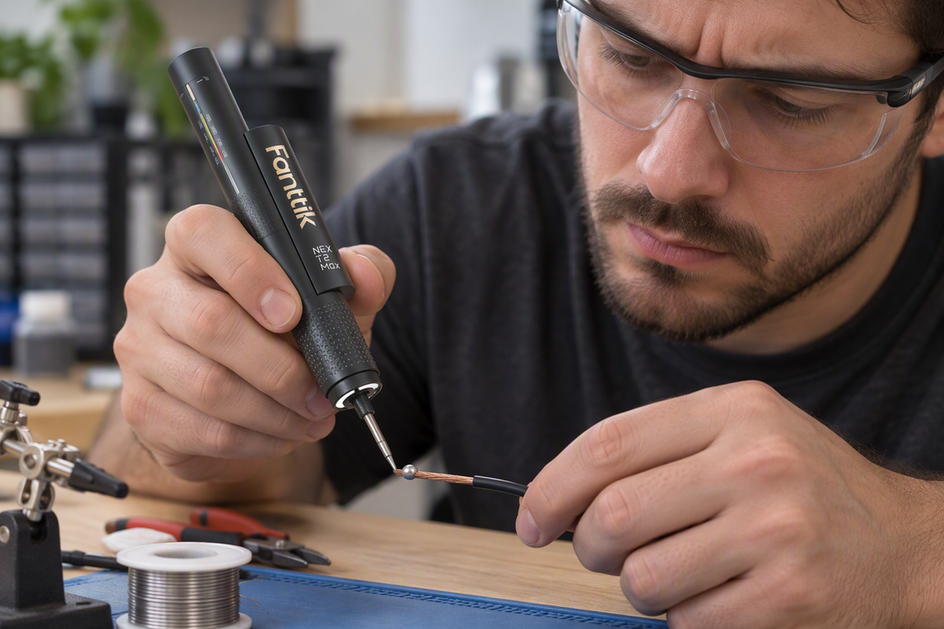
When performing maintenance on precision devices like the Fanttik E2 MAX Precision Electric Screwdriver, use the 3-6-12 rule to ensure the internal 3.7V cells remain within the recommended storage voltage of 3.6V–3.8V.
How to Perform an OCV Check
Open-Circuit Voltage (OCV) is the voltage of a battery when no load is applied. It is a reliable proxy for SOC. For a standard 3.7V lithium-ion cell, these values generally correspond to the following states:
- 4.2V: ~100% SOC (Avoid for long-term storage).
- 3.7V–3.8V: ~50% SOC (Ideal range for storage).
- <3.0V: Critically low (Recharge immediately to prevent copper shunting/permanent damage).
For larger tools like the Fanttik S1 Pro Cordless Electric Screwdriver, onboard LED indicators usually provide a coarse SOC reading, but a dedicated multimeter check provides the precision needed for more accurate health diagnostics.
Modeling Battery Lifecycle Degradation
To help you visualize how these factors interact, we have developed a scenario model for backup battery health. This model is intended for educational purposes to demonstrate the impact of storage choices.
Method & Assumptions (Reproducible Parameters)
Our model assumes a standard 18650 or 21700 lithium-ion cell (NMC chemistry) stored in a static environment.
| Parameter | Value / Range | Unit | Rationale |
|---|---|---|---|
| Initial Capacity | 100 | % | Baseline for a new cell. |
| Storage Temp (Low) | 20 | °C | Ideal indoor workshop conditions. |
| Storage Temp (High) | 45 | °C | Typical summer garage/trunk conditions. |
| Storage SOC (Low) | 50 | % | Recommended storage level. |
| Storage SOC (High) | 100 | % | Common user storage mistake. |
Scenario Analysis: The Garage vs. The Climate-Controlled Workshop
- Scenario A (The Prepared Pro): Storing a jump starter at 50% SOC in a 20°C workshop. Estimated capacity after 2 years: ~96%.
- Scenario B (The Forgetful Owner): Storing a jump starter at 100% SOC in a 40°C garage. Estimated capacity after 2 years: ~65–70%, with a significant increase in internal resistance.
Methodology Note: These outcomes are hypothetical estimates based on common industry heuristics and the Q10 degradation rule. Actual results may vary based on specific cell chemistry, BMS (Battery Management System) parasitic drain, and humidity levels.
Strategic Preparedness in a Cordless World
Understanding chemical aging transforms battery management from a guessing game into a science. By controlling the internal state (SOC) and the external environment (Temperature), you can often extend the functional life of your tools by years.
For those relying on portable power for automotive emergencies or DIY projects, the goal is "readiness." A battery that has lost 30% of its capacity and doubled its internal resistance may still show "full" on a simple LED display, but it may be at a higher risk of failure under the high-current demands of a cold engine start.
To further enhance your knowledge on battery health and safety, consider reviewing our guides on Identifying When a Portable Battery Cannot Be Saved and Why 50% Charge Storage Prevents Jump Starter Cell Degradation.
Disclaimer: This article is for informational purposes only. Battery maintenance involves chemical and electrical risks. Always follow the manufacturer’s specific instructions for your device. If a battery shows signs of swelling, leaking, or extreme heat, discontinue use immediately and consult a professional.
References
Continue reading
 The 70% Threshold: When to Retire and Renew Your Power Cells
Covers electrochemical degradation, cold-weather performance drops, diagnostic rules, and compliance requirements for battery maintenance.
The 70% Threshold: When to Retire and Renew Your Power Cells
Covers electrochemical degradation, cold-weather performance drops, diagnostic rules, and compliance requirements for battery maintenance.
 Warranty Logic: How Battery Health Logs Streamline Support
Covers interpreting BMS logs, the 5% Rule for defect identification, and a cold-weather fleet scenario to secure reliable...
Warranty Logic: How Battery Health Logs Streamline Support
Covers interpreting BMS logs, the 5% Rule for defect identification, and a cold-weather fleet scenario to secure reliable...
Leave a comment
This site is protected by hCaptcha and the hCaptcha Privacy Policy and Terms of Service apply.