










































The Mechanics of Precision: Why Gear Cleanliness Dictates Torque Accuracy
In the world of high-stakes electronics repair and precision mechanical assembly, a tool is only as reliable as its last calibration. For serious DIYers and makers, we often focus on the external specs—the Newton-meters (N.m) listed on the box or the RPM of the motor. However, based on our observations at the repair bench and patterns identified in professional maintenance cycles, the true bottleneck for accuracy isn't the motor's power; it is the state of the internal planetary gearset.
Fine dust, metallic micro-shards, and carbonized lubricant can settle into these precision gearboxes. This debris creates parasitic friction that alters torque delivery, often leading to over-tightening or under-torquing before the tool’s internal sensors or mechanical clutches can react. This article provides a methodical deep dive into the safe cleaning procedures required to restore tool accuracy and extend the operational life of your precision equipment.
Logic Summary: Our maintenance protocols assume that torque accuracy is a function of mechanical efficiency. We model the "restoration of accuracy" as the removal of non-linear friction variables (contaminants) from the driveline. This approach is aligned with the principles outlined in The 2026 Modern Essential Gear Industry Report: Engineering Trust in a Cordless World, which emphasizes that trust is engineered through visible maintenance and technical transparency.
The "Lapping Compound" Trap: Why Surface Cleaning Fails
A common mistake we see among hobbyists is the "blow-and-go" method. When a tool feels "gritty," the instinct is to grab a high-velocity duster. While a tool like the Fanttik B10 Pro Electric Air Duster is exceptional for clearing external vents and keyboards, using compressed air on a partially disassembled gearbox can be counterproductive.
Simply blasting components with air often redistributes abrasive particles deeper into the existing lubricant. This creates what technicians call a "lapping compound"—a mixture of grease and grit that acts like liquid sandpaper. Instead of cleaning the gears, you are effectively machining them down from the inside, accelerating mechanical fatigue and internal wear.
The Grease Color Heuristic
Before you begin a full degrease, we recommend a visual inspection of the original lubricant. This serves as a primary diagnostic tool:
- Translucent/White/Amber: The gearbox is likely healthy; cleaning is preventative.
- Dark Gray or Black: This indicates that significant metallic wear has already occurred. The dark pigment is actually suspended microscopic metal flakes.
- Expert Insight: If the grease is black, cleaning will restore smooth operation, but it cannot recover lost material. In these cases, torque consistency may remain slightly compromised due to increased gear backlash.

Phase 1: Diagnostic Inspection and Safe Disassembly
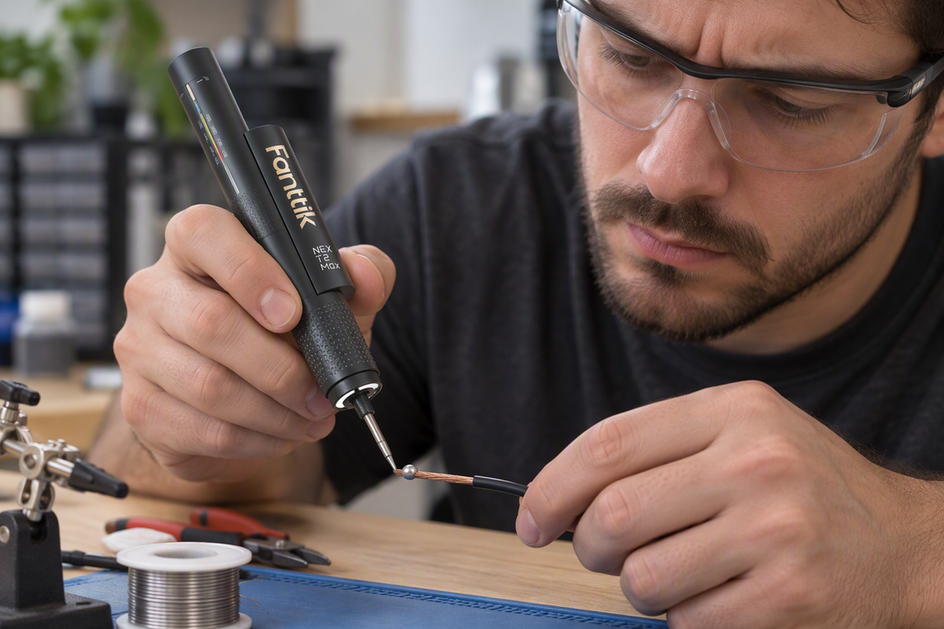
Precision tools, such as the Fanttik E2 MAX Precision Electric Screwdriver, utilize incredibly small tolerances. To maintain these, disassembly must be surgical.
1. Visual Access
In many modern tools, you can perform a preliminary check without a full teardown. Using a flexible borescope with a diameter of ~3mm (based on standard industrial inspection specs) allows you to peer through existing ports to identify grease carbonization or metal flakes. This preserves the factory gear meshing and preload until you are certain a deep clean is necessary.
2. Controlled Teardown
When disassembly is required, use a dedicated precision driver. We often observe that the most damage occurs not during use, but during poorly executed repairs.
- Organize: Use a magnetic mat to track screws.
- Avoid Prying: If the housing doesn't separate easily, check for hidden screws under rubber grips or labels.
- Material Guardrail: For tools with plastic gear housings, never use aggressive solvents like acetone or brake cleaner. These can craze or weaken the polymer, leading to structural failure under torque load.
Phase 2: The Degreasing and Cleaning Protocol
To restore the gears to a "zero-baseline," you must remove every trace of old, contaminated lubricant.
The Solvent Choice
We recommend 99% isopropyl alcohol (IPA) or a dedicated electronics-safe contact cleaner. IPA is preferred because it evaporates quickly and leaves zero residue.
- Submerge and Agitate: Place the gear components in a small glass container with IPA. Use a soft-bristled brush to remove stubborn debris from the gear teeth.
- Ultrasonic Cleaning (Optional): For ultra-high precision gears, an ultrasonic bath can be highly effective. However, ensure the components are fully dried immediately afterward to prevent flash rusting on steel gears.
Inspection After Cleaning
Once the gears are "naked," inspect the teeth under magnification. You are looking for:
- Pitting: Small craters on the gear face.
- Scuffing: Vertical lines indicating where grit was dragged across the surface.
- Deformation: Rounded teeth edges, which suggest the tool was used beyond its rated torque capacity.
Method & Assumptions (Modeling Note): Our cleaning effectiveness model is based on a "Zero-Residue" assumption. This is a scenario model, not a controlled lab study.
Parameter Value or Range Unit Rationale Solvent Purity 99 % Prevents moisture-induced oxidation Immersion Time 5–10 Minutes Typical time for grease breakdown Inspection Magnification 10x–20x Power Required to see micro-scuffing Drying Temperature 20–25 °C Ambient drying to avoid thermal stress Housing Material Glass/Metal N/A Solvent-resistant cleaning vessel
Phase 3: Re-Lubrication and Precision Reassembly
Cleaning is only half the battle; the choice of new lubricant determines the tool's future accuracy.
Selecting the Right Grease
For precision tools like the Fanttik K2 Nano 3.7V Precision Power Drill, a light synthetic grease with PTFE (Teflon) is often the standard approach.
- Viscosity Matters: Grease that is too thick will increase the "no-load" current draw and fool the tool's electronics into thinking it has reached the torque limit prematurely.
- Quantity: More is not better. Over-packing a gearbox creates "churning" friction, which generates heat and can lead to seal failure. A light, even coat on the gear teeth is sufficient.
The Reassembly Heuristic
When putting the tool back together, the most common pitfall is over-tightening the motor or gearbox mounting screws. This can warp the housing, introducing gear binding and ruining metrology accuracy.
- The Quarter-Turn Rule: Tighten screws until they are finger-tight, then add exactly a quarter-turn with a precision driver. This provides sufficient clamping force without distorting the polymer or metal chassis.
Phase 4: Verification via the "First Movement" Test
How do you know the torque accuracy is actually restored? While industrial labs use dynamic torque transducers, you can perform a "First Movement" or static torque test as a valid, cost-effective proxy.
Conducting the Test
- Baseline Setup: Use a digital torque tester or a high-accuracy digital torque wrench (accuracy <±2% based on standard digital sensor specs).
- The Breakaway Measurement: Measure the amount of torque required to initiate movement (breakaway torque) on a known fastener.
- The Logic: Contamination increases internal friction, which raises the breakaway torque. By comparing the "before" and "after" cleaning measurements, you can quantitatively verify the reduction in system resistance.
Measuring the decrease in current draw (amperage) during a no-load run is another reliable indicator. If the tool draws less power to spin the gears after cleaning, you have successfully reduced parasitic friction, thereby protecting internal sensors from false readings.
Engineering Trust Through Maintenance
Precision is not a permanent state; it is a perishable one. As outlined in the Fanttik 2026 Whitepaper, the transition from "consumer tool" to "professional instrument" happens when the user takes responsibility for the tool's internal health.
Whether you are using a Fanttik F2 PRO Cordless Rotary Tool Kit for delicate carving or an electric driver for smartphone repair, the principles of gear hygiene remain the same. By moving beyond generic cleaning and adopting a data-driven maintenance routine, you ensure that your tools remain as precise on their thousandth screw as they were on their first.
Trust & Safety Disclaimer
This article is for informational purposes only. Disassembling power tools may void your warranty. Always ensure the tool is powered off and the battery is removed before beginning maintenance. If you are uncomfortable performing these steps, consult a professional service center. Proper maintenance should always align with local safety regulations, such as the EU General Product Safety Regulation (EU) 2023/988.
Sources & References
- Mountz Torque: Method for Conducting a First Movement Torque Test
- Tyto Robotics: How to Calculate Electric Motor Torque
- EUR-Lex: EU General Product Safety Regulation (EU) 2023/988
- ISO Standards: ISO Standards Catalogue for Quality Management
- NIST: Handbook 44 - Weights and Measures
- Fanttik Whitepaper: Engineering Trust in a Cordless World (2026)
Continue reading
 Diagnosing Torque Sensor Failure in Cordless Power Drivers
A guide to diagnosing torque sensor failure in cordless power drivers. Learn to identify calibration drift and electronic...
Diagnosing Torque Sensor Failure in Cordless Power Drivers
A guide to diagnosing torque sensor failure in cordless power drivers. Learn to identify calibration drift and electronic...
 The Structural Risks of Overtorquing in Home DIY Projects
A guide to preventing structural damage from fastener overtorquing, covering material failure, precise tool use, and repair cost...
The Structural Risks of Overtorquing in Home DIY Projects
A guide to preventing structural damage from fastener overtorquing, covering material failure, precise tool use, and repair cost...
Leave a comment
This site is protected by hCaptcha and the hCaptcha Privacy Policy and Terms of Service apply.