









































Cordless Cleaning: Evaluating Portability for Exterior Care
The transition from gasoline-powered and corded-electric tools to cordless, lithium-ion alternatives represents a fundamental shift in how homeowners approach property maintenance. In the realm of exterior restoration and high-pressure cleaning, this shift is often marketed as a compromise-free evolution. However, for the DIY practitioner aiming for professional-grade results, the decision to "cut the cord" requires a methodical evaluation of energy density, sustained performance, and logistical overhead.
As highlighted in the The 2026 Modern Essential Gear Industry Report: Engineering Trust in a Cordless World, the maturity of the "modern essential gear" market has moved beyond aesthetic appeal. True value now lies in "credibility math"—the transparent communication of what a tool can realistically achieve under load. For exterior care, this means looking past peak "marketing PSI" and understanding the thermal and electrical constraints of battery-powered systems.
The Energy Density Gap: PSI vs. GPM Reality
The most common misconception in cordless pressure cleaning is that a high PSI (Pounds per Square Inch) rating is the sole indicator of cleaning power. In reality, effective cleaning is a product of pressure and flow rate (Gallons per Minute), often referred to as "Cleaning Units" (CU).
While a high-end cordless unit may boast a peak pressure of 1100–1500 PSI, its flow rate is frequently limited to 1.2–1.5 GPM to preserve battery life. By comparison, a entry-level corded or gas unit might deliver 2.0–2.5 GPM at the same pressure. This creates a significant "Cleaning Units" deficit. For tasks like stripping mildew from porous siding or cleaning deeply weathered concrete, the volume of water (GPM) is often more critical than the impact pressure (PSI) for flushing away dislodged debris.
Furthermore, practitioners consistently observe that advertised "max PSI" is rarely sustainable in cordless units. On our technical repair benches, we have noted that the sustained pressure at the nozzle often drops by 20–30% after the first 60 seconds of continuous load. This is primarily due to voltage sag as the battery encounters high current draw and thermal management systems begin to throttle the motor to prevent overheating.
Logic Summary: Performance Modeling
- Observation: Pressure drop of 20–30% occurs during continuous discharge.
- Mechanism: Voltage sag under high-current draw (~15–25A) and thermal throttling.
- Implication: Users should plan for an "effective PSI" that is significantly lower than the box-label peak.
Runtime Modeling: The 1.5-Minute Heuristic
For a homeowner, the most pressing question is not "how strong is it?" but "how much can I finish before the battery dies?" To answer this, we utilize a practical heuristic derived from field observations and energy consumption patterns.
A reliable baseline for planning is to budget 1 to 1.5 minutes of effective cleaning time per 1000 mAh of battery capacity when using a standard 15-degree nozzle at medium pressure.
| Parameter | Value/Range | Unit | Rationale |
|---|---|---|---|
| Battery Capacity | 2000 | mAh | Standard 20V/2Ah pack |
| Effective Runtime | 2.5–3.0 | Minutes | Based on the 1.5min/1000mAh heuristic |
| Surface Area Coverage | ~100 | sq ft | Moderate soil on composite decking |
| Flow Rate (Avg) | 1.2 | GPM | Typical cordless pump output |
| Recharge Time | 60–90 | Minutes | Standard fast-charger rate |
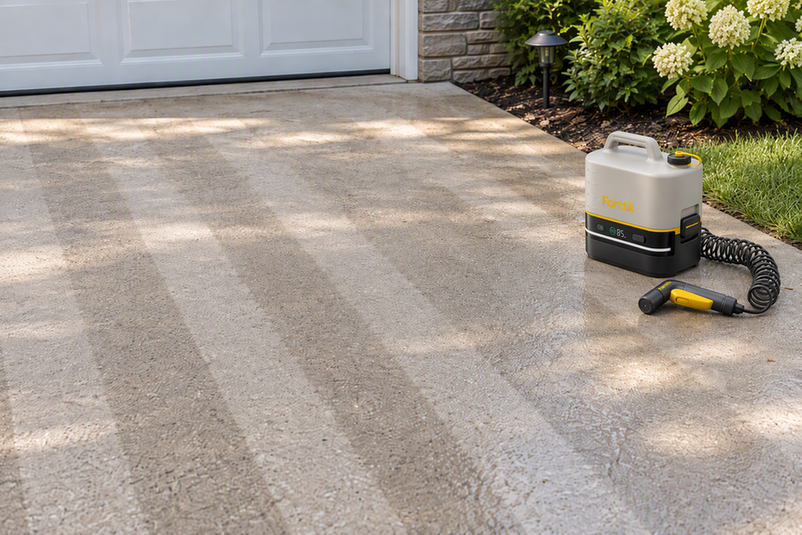
Under this model, a standard 20V/2Ah battery is typically capable of cleaning a 10' x 10' (100 sq ft) section of moderately soiled composite decking. If you are cleaning a standard two-car driveway (~400–600 sq ft), a single battery will be woefully insufficient. This is where the "portability" argument meets the "logistics" reality.
Scenario A: The Quick-Response Detailer
For cleaning a mountain bike after a muddy trail ride or rinsing salt off a vehicle's undercarriage, the cordless unit is unmatched. The setup time is near zero, and the 5–8 minutes of runtime provided by a small battery is more than enough. In these cases, Maximizing Battery Life for Deep Undercarriage Residue Removal becomes a matter of technique rather than raw capacity.
Scenario B: The Property Restorationist
For cleaning 1,500 square feet of vinyl siding, a cordless unit becomes a logistical burden. To match the 1–2 hours of continuous runtime offered by a corded unit, a user would require 4 to 8 high-capacity batteries. With professional-grade batteries often costing between $100 and $200 each, the upfront investment can quickly exceed $800, negating the cost-effectiveness of the tool itself.
The Paradox of "Untethered" Cleaning
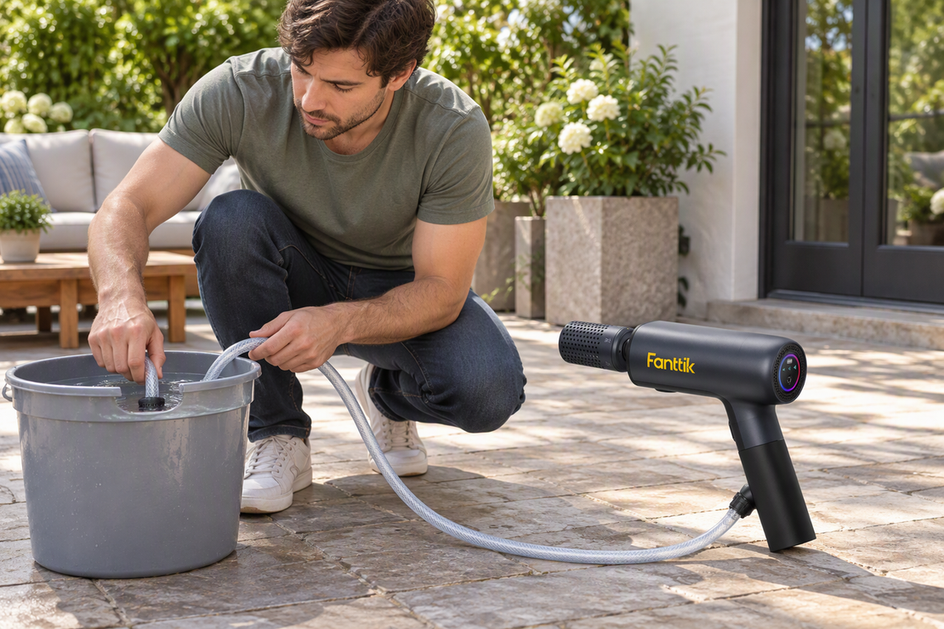
The primary marketing appeal of cordless tools is the freedom from being "tethered" to an outlet. However, for pressure washers, this freedom is often illusory. Unless you are drawing water from a static source like a bucket or a lake—which further reduces pressure and limits runtime—you are still tethered to a garden hose.
The true cordless advantage is not total mobility around the property, but rather:
- Rapid Deployment: The ability to start cleaning in under 60 seconds without untangling extension cords.
- Electrical Safety: Eliminating the risk of mixing high-voltage extension cords with standing water, a critical concern in Bathroom Safety: Managing Battery Integrity in Humid Zones.
- Remote Access: Cleaning items far from the house, such as a dock, a remote fence line, or a trailhead vehicle.
If the job requires more energy (water moved under pressure) than the battery can store, the "cordless" benefit collapses. You end up spending more time managing battery swaps and charging cycles than actually cleaning.
Professional Efficiency Multipliers
To overcome the inherent energy limitations of lithium-ion power, experienced practitioners use specific techniques to "stretch" their battery life. These are not just tips; they are essential protocols for cordless exterior care.
1. The Pre-Soak Protocol
Applying a dedicated cleaning solution or "soap foam" and allowing it to dwell for 5–10 minutes can reduce active spray time by up to 40%. By letting chemistry do the heavy lifting of breaking down organic growth (mold, algae) or road grime, the pressure washer is only needed for the final rinse. This significantly extends the effective square footage you can cover on a single charge.
2. Vertical Surface Optimization
A frequently observed mistake is attempting to clean large vertical surfaces, such as siding or second-story windows, from ground level using only the standard spray gun. This wastes immense amounts of battery life due to the inefficient angle and the loss of pressure over distance. Using an extension wand is non-negotiable for efficiency; it allows the nozzle to remain inches from the surface, ensuring every drop of pressurized water performs work.
3. Thermal Management and Storage
Lithium-ion batteries are sensitive to thermal stress. Continuous high-drain usage generates significant internal heat. If a battery is "hot to the touch" after use, it should never be placed immediately on a charger, as this can accelerate capacity degradation. Similarly, storing tools in a high-humidity garage can lead to terminal oxidation. We recommend reviewing Protecting Portable Power Tools from Garage Dust and Humidity to ensure your investment lasts beyond a single season.
Longevity and the Environmental Footprint
When evaluating cordless portability, one must consider the lifecycle of the product. Corded electric motors are remarkably simple and can last for decades with minimal maintenance. In contrast, the cordless ecosystem is often a high-turnover cycle.
Lithium-ion batteries used in outdoor power tools face extreme thermal stress—ranging from direct sunlight during summer use to freezing temperatures in winter storage. According to general industry observations, these batteries often see significant capacity degradation within 2–3 years of heavy use. This leads to a recurring replacement cost and a substantial e-waste footprint. As noted in the ISO Standards Catalogue, maintaining quality management and environmental standards in battery production is a global priority, but the most sustainable tool is often the one that doesn't require a proprietary battery replacement every few years.
Decision Framework: Cordless vs. Corded
To determine if a cordless unit is right for your exterior care projects, use the following decision matrix based on your specific maintenance profile.
| Feature | Choose Cordless If... | Choose Corded/Gas If... |
|---|---|---|
| Primary Task | Spot cleaning, vehicles, patio furniture. | Driveways, full house siding, large decks. |
| Project Size | Under 200 square feet per session. | Over 500 square feet per session. |
| Frequency | Weekly light rinses. | Seasonal deep restoration. |
| Location | Remote areas, docks, trailheads. | Always within 50-100ft of an outlet. |
| Budget | High (considering battery costs). | Moderate (lower cost per Cleaning Unit). |
Trust and Safety Sidebar
When dealing with high-pressure water and high-capacity lithium batteries, safety is paramount.
- Battery Handling: Always follow IATA Lithium Battery Guidance regarding the State of Charge (SoC) for transport and long-term storage (typically 30–50%).
- Electrical Hazards: Ensure all battery terminals are free of oxidation to prevent arcing. See Connector Oxidation: Cleaning Outdoor Appliance Terminals for Spring for detailed maintenance steps.
- Material Safety: High pressure can easily damage wood grain or etch soft stone. Always test a 15-degree or 25-degree nozzle on an inconspicuous area first.
Methodology Appendix: Modeling Assumptions
The data and heuristics presented in this article are based on a deterministic scenario model designed to reflect typical DIY usage. These are estimates for planning purposes and are not a substitute for controlled laboratory testing.
Modeling Parameters:
- Ambient Temperature: 20°C (68°F). Performance may decrease in temperatures below 10°C or above 35°C.
- Battery Chemistry: Lithium-ion (LiNiMnCoO2), standard 18650 or 21700 cell configuration.
- Pump Type: Wobble plate or axial cam pump with a brushless DC motor (approx. 85% efficiency).
- Water Source: Standard residential spigot (approx. 40–60 PSI inlet pressure).
- Nozzle Orifice: 1.0mm to 1.2mm.
Boundary Conditions:
- Water Temperature: Model assumes inlet water below 40°C. Using hot water can damage pump seals and alter pressure readings.
- Duty Cycle: Model assumes a 75% duty cycle (45 seconds of spraying per minute). Continuous 100% trigger-on time will result in faster thermal throttling.
- Battery Age: Estimates are based on "New" batteries (< 50 cycles). Expect a 10–15% reduction in runtime after 100 cycles.
Disclaimer: This article is for informational purposes only. High-pressure cleaning equipment can cause serious injury or property damage if used incorrectly. Always read the manufacturer's manual and wear appropriate personal protective equipment (PPE), including safety goggles and closed-toe shoes. For complex restoration projects involving hazardous materials like lead paint or heavy mold, consult a licensed professional.
Sources
Continue reading
 Clearing the Storm: Optimizing Your Robot for Heavy Leaf Debris
Covers the Sensor Paradox, ISO/IEC standards integration, and step-by-step mechanical recovery for post-storm robotic pool cleaner optimization.
Clearing the Storm: Optimizing Your Robot for Heavy Leaf Debris
Covers the Sensor Paradox, ISO/IEC standards integration, and step-by-step mechanical recovery for post-storm robotic pool cleaner optimization.
 Defeating Sun Damage: Preserving Your Pool Robot’s Outer Shell
Covers material science of ASA/ABS polymers, sun-belt case studies, and practical maintenance protocols for long-term shell integrity.
Defeating Sun Damage: Preserving Your Pool Robot’s Outer Shell
Covers material science of ASA/ABS polymers, sun-belt case studies, and practical maintenance protocols for long-term shell integrity.
Leave a comment
This site is protected by hCaptcha and the hCaptcha Privacy Policy and Terms of Service apply.