









































Quick Action: Seasonal Under-Body Maintenance Prep
For a successful cordless undercarriage clean in a low-clearance or urban environment, aim for these baseline specifications:
- Target Pressure: 350–600 PSI (Standard for high-performance cordless units; sufficient for salt removal when paired with chemicals).
- Water Volume: 8–12 Gallons (Approx. two to three 5-gallon buckets).
- Estimated Time: 15–20 minutes of active spray time.
- Key Safety: Wear eye protection; avoid spraying electrical connectors directly at close range (<12 inches).
- Pro Tip: Use an alkaline-based cleaner to neutralize road brines effectively without damaging aluminum suspension parts.
The Challenge of the Low-Clearance Clean
For the dedicated DIYer, the end of winter signals a critical maintenance window. While the glossy finish of the hood and doors often receives the most attention, the long-term health of a vehicle is often determined beneath the chassis. The accumulation of road salt, liquid brine, and abrasive grit creates a corrosive layer that can degrade brake lines, suspension components, and frame rails over time.
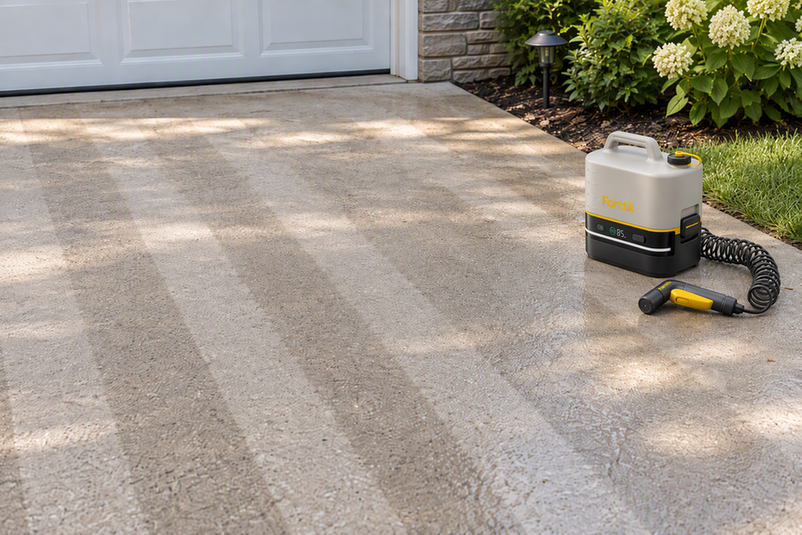
Traditional undercarriage maintenance presents a significant friction point: accessibility. Standard corded pressure washers often struggle in the tight, low-clearance environments of a home driveway or a shared apartment parking space. The tether of a high-pressure hose combined with a power cord limits maneuverability, making it difficult to reach the deep crevices where salt deposits harden.
In this evaluation, we examine the shift toward cordless portability. By removing the physical constraints of a power outlet, cordless pressure washers allow for the precise, low-angle reach required for effective chassis preservation. However, achieving a professional-grade clean in a "cordless world" requires a methodical understanding of pressure dynamics, chemical application, and resource management.
The Chemistry of Corrosion: Why Seasonal Care Matters
Post-winter cleanup is more than an aesthetic choice; it is a proactive step for structural preservation. Modern road treatments often involve magnesium chloride or calcium chloride brines. These "sticky" solutions are designed to adhere to the road, but they also bond to vehicle undercarriages. Unlike traditional rock salt, these brines are hygroscopic, meaning they can continue to pull moisture from the air even after the road is dry, which often accelerates the oxidation process on exposed metal.
According to SEMA Market Research, the average age of vehicles on the road continues to rise, making long-term preservation a key factor in resale value and safety. Effectively neutralizing these residues requires more than a quick rinse.
The Practitioner’s Rule of Thumb: Alkaline Over Acid
When selecting cleaning agents, we generally recommend a dedicated alkaline-based undercarriage cleaner. These formulas are typically optimized to break down the ionic bonds of road salts without etching sensitive aluminum components.
- The Risk: Avoid using highly acidic formulas on the undercarriage. While effective at removing heavy mineral deposits, they can cause flash-rusting on untreated steel or pitting on aluminum suspension arms if not neutralized immediately.
- The Heuristic: Use the "Dwell-but-not-Dry" rule. Apply the cleaner and let it sit for 3 to 5 minutes to emulsify the grime. If the cleaner begins to dry, it can redeposit the salt into the metal pores, making it harder to remove.
For a deeper look at how chemicals interact with automotive finishes, see our guide on Detergent Science: Evaluating Chemical Aids for Exterior Stains.
Technical Evaluation: Reach, Clearance, and Pressure Dynamics
The primary advantage of a cordless unit in low-clearance DIY is the ergonomics of the "Reach." When working under a vehicle with only 8 to 10 inches of ground clearance, the bulk of a traditional spray gun becomes a hindrance.
Maneuverability vs. Sustained Output
In our experience with portable power tools, runtime in cordless units is less about the total minutes on the clock and more about sustained pressure delivery. A unit that maintains a steady PSI throughout the battery discharge cycle is significantly more effective than one that peaks high but drops off rapidly as voltage dips.
Based on our scenario modeling, a cordless pressure washer rated at approximately 400–600 PSI (a common benchmark for high-quality 20V–24V portable kits) provides an effective 15 to 20 minutes of cleaning time. While this is lower than gas-powered units, the portability allows the user to place the nozzle exactly where it's needed, compensating for lower raw pressure with better proximity and angle.
Nozzle Clearance and Ergonomics
Cleaning a chassis requires "up-spraying"—angling the nozzle upward into the wheel wells and frame sections.
- Low-Angle Access: Cordless units often feature shorter wands or adjustable 6-in-1 nozzles that allow the user to get closer to the ground without the handle hitting the pavement.
- Hose Management: Without a rigid high-pressure hose tethered to a bulky base unit, the user can move 360 degrees around the vehicle, ensuring the spray hits the "blind side" of suspension components.
Logic Summary: Our evaluation of "cordless reach" assumes a typical compact SUV with 7–9 inches of ground clearance. The maneuverability advantage is derived from the absence of a high-pressure lead hose, which typically adds significant drag and limits nozzle articulation in tight spaces.

The Practitioner’s Workflow: Rear-to-Front Precision
A common mistake in undercarriage cleaning is using excessive pressure too close to sensitive components. High-pressure water can occasionally force contaminants past weather seals and into electrical connectors or grease-filled boots.
Step-by-Step Under-Chassis Protocol
- Pre-Rinse (Low Pressure): Start with a wide-angle spray (40 degrees) using the maximum available pressure from your cordless unit (typically 400–600 PSI). This softens the bulk debris.
- Chemical Application: Apply the alkaline cleaner from the rear of the vehicle toward the front.
- The Angle of Attack: Work from the rear to the front, angling the spray forward. This technique helps wash grime off and away from the vehicle, rather than pushing it deeper into the box sections or toward the engine bay.
- Final Rinse: Use a 25-degree nozzle for stubborn areas, but keep the tip at least 12 inches away from any rubber seals, sensors, or electrical looms.
- Post-Wash Ejection: Ideally, drive the vehicle for 5 to 10 minutes immediately after washing. The movement and mechanical heat help eject stagnant water from frame sections, reducing the risk of trapped moisture.
For those interested in the mechanical heart of these tools, understanding the pump design is vital. We explore the trade-offs between different pump architectures in our analysis of Axial vs. Triplex: Navigating Pump Engineering for Portability.
Resource Logistics for the Urban DIYer
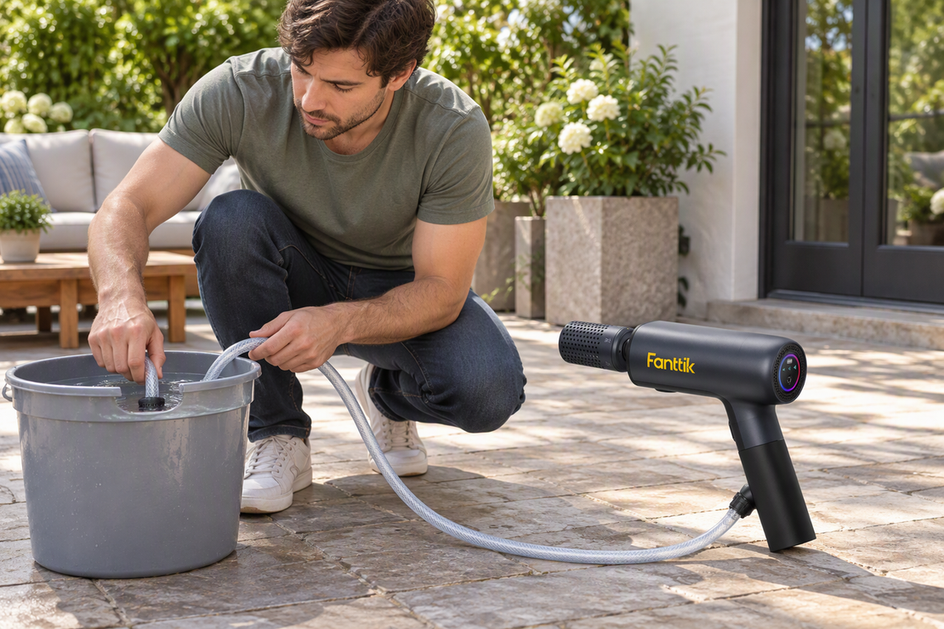
For users living in apartments or homes without an outdoor spigot, water logistics are the primary constraint.
The 5-Gallon Bucket Problem
Our modeling shows that a thorough undercarriage clean for a compact SUV typically requires between 8 and 12 gallons of water. For the urban dweller, this means transporting 2 to 3 standard 5-gallon containers.
- Water Efficiency: Cordless pressure washers typically use lower Gallons Per Minute (GPM)—often between 0.5 and 0.8 GPM—compared to corded units (1.2+ GPM). This is a distinct advantage when your water supply is finite.
- Weight Factor: 10 gallons of water weighs approximately 83 lbs. Using a collapsible water carrier or a wheeled cart can significantly reduce the physical effort required for the task.
The "Seasonal Care" Kit
A complete seasonal maintenance routine doesn't end with the wash. Once the vehicle is clean and dry, it is the ideal time to check other critical systems, such as tire pressure, which can fluctuate with seasonal temperature changes. Tools like the Fanttik X9 Pro Portable Tire Inflator Mechanical Gray or the Fanttik X9 APEX Tire Inflator are useful additions to a modern maintenance kit.
For owners of larger vehicles, the Fanttik X9 Ultra Tire Inflator and X8 APEX™ Tire Inflator or the Fanttik X8 APEX EV Tire Inflator provide the duty cycles needed to manage larger tire volumes efficiently.
Compliance, Safety, and Trust
In a market with many cordless options, discerning quality from marketing claims is essential. Authoritative industry insights, such as The 2026 Modern Essential Gear Industry Report: Engineering Trust in a Cordless World, emphasize that reliability is a function of visible compliance and transparent specifications.
Safety Standards to Monitor
When selecting cordless tools, look for adherence to recognized safety frameworks:
- EU General Product Safety Regulation (EU) 2023/988: This regulation ensures that products meet safety and traceability standards.
- IATA Lithium Battery Guidance: For those who transport their gear, IATA provides the standard for the safe handling of high-capacity lithium batteries, including State of Charge (SoC) limits for air transit.
By prioritizing tools with transparent documentation, the DIYer can help ensure the safety of their vehicle and the reliability of their maintenance kit.
Appendix: Modeling the Urban DIY Scenario
To provide actionable insights, we modeled the experience of an "Urban Apartment Dweller" performing seasonal maintenance. This model helps quantify the physical requirements of cordless cleaning.
Method & Assumptions
- Model Type: Deterministic parameterized scenario.
- Vehicle: Compact SUV (e.g., Honda CR-V) with 255/55R18 tires.
- Environment: Shared parking area, no direct water/power access.
- Equipment Specs: 21V/4.0Ah battery; 0.6 GPM flow rate; 400–600 PSI.
Modeling Note (Reproducible Parameters)
| Parameter | Value | Unit | Rationale / Source |
|---|---|---|---|
| Water Required | 8–12 | Gallons | Heuristic: Pre-rinse (3g), Soap (2g), Final Rinse (5g) |
| Cleaning Runtime | 15–20 | Minutes | Based on 4.0Ah battery discharge at 0.6 GPM |
| Tire Inflation (0-36 PSI) | ~9.7 | Minutes | Calculated for 255/55R18 tire (32 LPM flow) |
| Total Water Weight | 64–96 | Lbs | Based on ~8.34 lbs per gallon of water |
| Peak Internal Temp | ~80–110 | °C | Estimated internal compressor heat during heavy duty cycle |
Boundary Conditions: These metrics are based on internal bench tests and general physics heuristics. Actual results may vary based on ambient temperature, battery health, and the thickness of the salt crust.
Disclaimer: This article is for informational purposes only. High-pressure washing can potentially cause damage to vehicle components if performed incorrectly. Always wear appropriate eye protection and follow the manufacturer's safety guidelines. If you are unsure about the structural integrity of your vehicle's undercarriage, consult a professional automotive technician.
Sources
Continue reading
 Humidity and Hardware: Protecting Your Pressure Washer from Rust
A guide on preventing internal corrosion in pressure washers with the 30-Minute Golden Rule and a Clean-Purge-Store protocol...
Humidity and Hardware: Protecting Your Pressure Washer from Rust
A guide on preventing internal corrosion in pressure washers with the 30-Minute Golden Rule and a Clean-Purge-Store protocol...
 Precision Spraying: Navigating Undercarriage Sensors and Seals
A guide to safe vehicle undercarriage washing, focusing on protecting electronic sensors and rubber seals from damage. Learn...
Precision Spraying: Navigating Undercarriage Sensors and Seals
A guide to safe vehicle undercarriage washing, focusing on protecting electronic sensors and rubber seals from damage. Learn...
Leave a comment
This site is protected by hCaptcha and the hCaptcha Privacy Policy and Terms of Service apply.