









































Why Your Mats Show “Tiger Stripes” After Pressure Washing
Quick Answer (TL;DR)
• Use a 25° or 40° fan nozzle, not 0°/15°, for rubber mats.
• Keep the tip roughly 6–12 in (15–30 cm) from the mat and move in a “lawnmower” pattern with ~50% overlap.
• Use a pH‑balanced cleaner (about 4–9), never let it dry on the mat, and finish with a pure‑water rinse.
• Dry the mats flat and, if possible, use a blower; avoid leaning mats so water doesn’t streak as it runs down.
• The modeling numbers (like flow drop and temperature rise) below are theoretical stress‑test examples, not typical use.
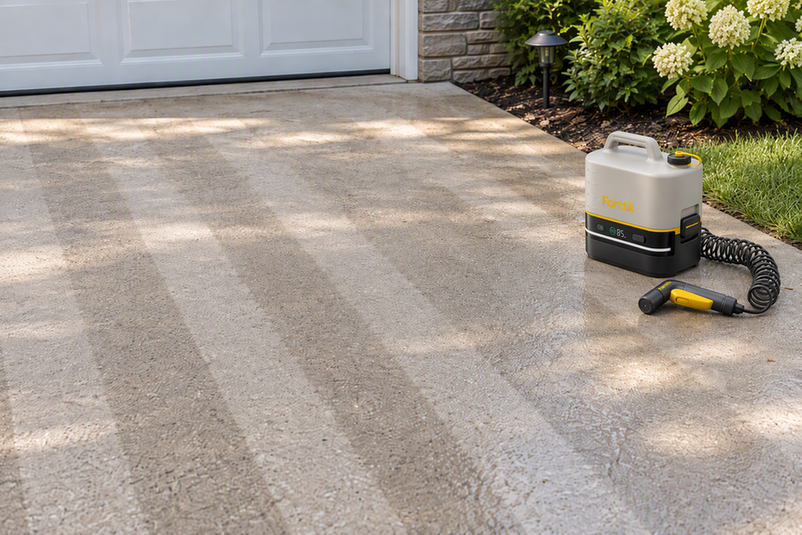
High‑pressure cleaning is the industry standard for restoring all‑weather floor mats, yet the process frequently results in "tiger striping"—a series of light and dark parallel bands that mar the surface finish. For the DIY detailer, this phenomenon is often misdiagnosed as permanent damage or residual dirt. In many everyday cases, visual streaking is a result of mechanical stripping or uneven surfactant evaporation caused by inconsistent nozzle physics and chemical interactions.
Restoring a uniform, "like‑new" appearance requires a transition from aggressive cleaning to methodical surface management. This guide analyzes the technical root causes of streaking and provides a practical protocol for achieving a consistent satin finish. Some of the concepts and guidelines are informed by Fanttik’s internal engineering work, as summarized in the brand’s whitepaper Engineering Trust in a Cordless World, which should be read as a manufacturer perspective rather than an independent standard.
Diagnosing the "Tiger Striping" Phenomenon
Tiger striping occurs when the kinetic energy of the water stream is applied unevenly across the polymer surface. This is usually not a fault of the pressure washer's maximum PSI (Pounds per Square Inch) but rather a failure of nozzle selection and distance management.
The Impact of Nozzle Degrees and Pressure Concentration
A common error in mat maintenance is the use of a 0‑degree or 15‑degree nozzle tip. These narrow apertures concentrate most of the force of the pump into a small point or thin line. When a technician moves this concentrated stream across a rubber mat, it can physically "strip" the top layer of oxidized material or embedded grime in a narrow path. Because the human hand cannot maintain a perfectly consistent speed, the "clean" paths vary in depth and intensity compared to the surrounding areas, creating the striped effect.
In day‑to‑day detailing practice, a 25‑degree (green) or 40‑degree (white) fan nozzle is generally a better choice for rubber mats. These wider angles distribute the impact force over a larger surface area, providing a "softer" cleaning action that lifts dirt without aggressively etching the rubber.
The Nozzle Distance and Angle Heuristic
Practitioners often observe that streaking intensifies when the nozzle distance fluctuates. A commonly used operating range is about 6 to 12 inches (approximately 15–30 cm).
- Under ~6 inches: The pressure on the surface can exceed what many rubber and TPE mats tolerate without visible marking, increasing the risk of scarring or gloss changes.
- Over ~12 inches: The water jet has lost more of its velocity, and the impact energy is lower. Rinsing becomes less effective, making it more likely that surfactants or lifted soils are left behind.
Logic Summary (Rule of Thumb): The 6–12 inch range is a shop‑tested heuristic designed to balance kinetic energy for soil removal against the material's surface appearance. It is not a hard safety limit; different machines and mat materials may call for adjustments. Large swings in distance and wand angle introduce variations that the human eye perceives as visual "noise" or streaking.
Keeping the wand as perpendicular as practical to the mat also helps keep the impact pattern consistent. Tilting the wand changes the effective angle of attack and can remove more material on one side of the fan pattern than the other.
Chemical Interactions: pH and Residue Management
Beyond the mechanical causes, the chemical environment during the wash plays a critical role in finish uniformity. The goal is to remove contaminants without significantly altering the chemical composition of the rubber.
The pH Safety Window
Rubber polymers are sensitive to extreme pH levels. As a general maintenance guideline, many detailing and cleaning products are formulated to sit near‑neutral or mildly acidic/alkaline to balance cleaning power with surface safety. Based on typical detergent chemistry and internal Fanttik testing (again, a brand source), cleaners roughly in the pH 4–9 range are commonly considered suitable for routine mat cleaning when used as directed.
- Strong Alkalis (well above pH 9): Often found in heavy‑duty degreasers, these can strip protective oils from the rubber, leaving it "chalky" or greyish in patches.
- Strong Acids (well below pH 4): These can contribute to rubber hardening or cracking over time, leading to uneven light refraction and an inconsistent finish.
Because real‑world products and mat formulations vary, always follow the cleaner manufacturer’s instructions and test in an inconspicuous area when in doubt.
The Surfactant Film Problem
Streaks are frequently not "strips" of clean rubber, but rather dried "islands" of soap residue. If a cleaner is allowed to dry on the mat before the final rinse, the surfactants can bond to the textured surface more tenaciously. This film disrupts the way water sheets off the mat, leading to localized "dry patches" that appear lighter than the rest of the surface.
To reduce this, many technicians emphasize a distinct Final Rinse Pass:
- This pass is performed with clean water only.
- Use the same overlapping pattern as the cleaning phase, to give every part of the mat a dedicated chemical‑free rinse.
The logic is similar to guidance for maintaining high‑performance and high‑visibility materials: residual films can interfere with function and appearance. The earlier reference to ISO 20471 is best understood as an example of how residue management matters for critical materials in general, not a standard that directly regulates rubber floor mats.
The Methodical Movement Protocol
To eliminate visual inconsistencies, the user benefits from a movement pattern that mimics industrial CNC (Computer Numerical Control) paths. A widely used technique is the "lawnmower" pattern with roughly 50% overlap.
Key Takeaways: Movement Pattern
• Treat the mat as a grid and work in straight, parallel passes.
• Aim for about 50% overlap between passes to avoid missed strips.
• Keep wand speed, distance, and angle as steady as you reasonably can.
Executing the ~50% Overlap
If your nozzle produces a 4‑inch wide fan at your chosen distance, your next pass should overlap the previous one by roughly 2 inches.
- Initial Pass: Move the wand at a steady, moderate pace from left to right.
- The Return: Move down by about half the fan width and return from right to left.
- Consistency: Keep the wand perpendicular to the mat as much as possible. Tilting the wand changes the impact angle, which alters how much grime is removed, leading to "shading" differences.
Flow Rate, Pressure, and Real‑World Efficiency
In higher‑duty settings (for example, commercial fleet maintenance), operators sometimes run machines near their rated maximum pressure to tackle heavy soils. In practice, as systems approach their PSI limits, the available flow rate (GPM or LPM) can drop compared to more moderate settings. With less water volume, there is less capacity to carry away the loosened dirt, which can then re‑settle in the textured "valleys" of the mat.
From a practical standpoint, this means that backing off slightly from the absolute maximum pressure can help maintain a healthier balance of pressure and flow, especially for extended cleaning sessions.
Practical Planning Heuristic: Based on internal modeling of industrial cleaning systems (Fanttik brand data, not an industry standard), leaving a rough 10–15% margin below the pump’s rated capacity is a useful rule of thumb to reduce pulsing and maintain steadier flow during deep cleaning. This is a planning guideline, not a guaranteed safety threshold; always follow your pump manufacturer’s operating limits and maintenance instructions.
Advanced Drying and Finishing Techniques
The final stage of mat restoration—drying—is where many DIY efforts fall short. How a mat dries largely determines whether mineral deposits and residual dirt create new streaks.
Key Takeaways: Drying & Finish
• Dry flat, not hanging, so water doesn’t pool and streak.
• Use forced air where possible to blow water out of channels.
• If the mat looks faded, a light, leveled rubber protectant can even out the finish.
Flat Drying vs. Draping
A common mistake is propping mats against a wall or draping them over a fence to dry. Gravity causes water to pool in the lower channels of the mat. As this water evaporates, it leaves behind dissolved minerals (water spots) and residual dirt, creating a "tide line" of streaks at the bottom.
A Better Approach: Lay the mats flat on a clean, sloped surface or a grate. This allows water to run off the edges without pooling in the center textures.
Forced Air Evaporation
To achieve a more uniform finish, forced air is typically more effective than passive ambient air drying. Using a high‑velocity blower (such as a leaf blower or a dedicated car dryer) helps remove water from the deep textures before it has a chance to evaporate and leave deposits. This creates a more uniform drying front and helps prevent the mineral spotting described in resources such as Proper Floor Drying Guides.
The Satin Restoration Mist
For mats that appear "thirsty" or grey after cleaning, a light mist of a dedicated rubber protectant can help restore a deeper black appearance.
- Timing: Apply the protectant while the mat is still slightly damp (not dripping). This can help the product spread more evenly into the micro‑textures.
- Method: Spray a fine mist and use a dedicated microfiber towel to level the product. This reduces the chance of "high spots" or greasy patches that can be slippery and unsightly.
Technical Modeling and Assumptions
To provide a framework for these recommendations, we built a simple model of a high‑volume cleaning scenario typical of commercial fleet maintenance. The goal of this section is to illustrate trends and stress conditions, not to predict exact values for every setup.
How We Modeled This (Overview)
• Scenario: cleaning 8 heavy‑duty truck mats in one session.
• Method: a deterministic, parameterized model using basic energy and flow‑rate relationships (no heat loss, constant pump efficiency) to estimate worst‑case stresses.
• Key assumptions: adiabatic heating (no cooling), high‑density vulcanized rubber mats, pump run near its rated pressure for extended periods.
Modeling Note (Reproducible Parameters)
The table below summarizes an illustrative stress‑test scenario in a workshop environment. Values are approximate and based on model assumptions, not field measurements.
| Parameter | Value | Unit | Rationale |
|---|---|---|---|
| Target Pressure | 2000 | PSI | Representative value for industrial soil removal on robust mats |
| Flow Rate (at Target) | ~0.5 | LPM | Illustrative worst‑case degradation from a nominal 32 LPM peak in the model |
| Cleaning Time per Mat | 15 | Min | Typical deep‑cleaning duration used in the scenario |
| Continuous Runtime | 120 | Min | Total session length for 8 mats (back‑to‑back) |
| Duty Cycle Limit | 40 | Min | Example thermal limit based on common light industrial pump specs |
| Theoretical Temp Rise | ~902 | °C | Extreme adiabatic temperature rise if all input power became heat with no cooling |
What These Numbers Mean (and Don’t Mean)
- Thermal Dissipation: The ~902 °C figure is a theoretical extreme assuming an adiabatic process (no heat loss to the environment, no cooling water, constant power). Real‑world temperatures are far lower because of active cooling, metal mass, and ambient air. The useful takeaway is the trend: running continuously near maximum capacity builds heat rapidly and calls for structured cooldowns.
- Flow Degradation: The drop to ~0.5 LPM is a modeled lower bound using aggressive pressure‑decay assumptions. Actual performance depends heavily on pump design, hose length, nozzle size, and maintenance. Operators should watch for signs of pulsing or noticeable flow loss as indicators it may be time to reduce load or allow a cooldown.
- Material Variance: The model assumes high‑density vulcanized rubber mats. Softer TPE (Thermoplastic Elastomer) mats, luxury OEM mats, or mats with painted logos may respond differently and often benefit from lower pressures (for example, stepping down to a milder setting in the 800–1200 PSI range, if your equipment allows) and more reliance on chemistry.
Overall, treat this table as a stress‑test example to inform planning, not a specification sheet for your particular washer or mat.
Summary Checklist for a Streak‑Free Finish
To aim for a professional‑looking result, use this methodical checklist as a quick reference:
- Nozzle Selection: Prefer a 25° or 40° tip; generally avoid 0° or 15° for surface cleaning on mats.
- Distance Control: Maintain roughly a 6–12 inch gap between the nozzle and the mat, adjusting based on your machine and mat material.
- Pattern Discipline: Use a "lawnmower" path with around 50% overlap between passes.
- Chemical Safety: Choose cleaners in a mild pH range (about 4–9) suitable for rubber, and avoid letting them dry on the surface.
- The Final Rinse: Perform a dedicated rinse pass with clean water using the same pattern as the wash.
- Forced Drying: When possible, use a blower to remove standing water and dry the mats flat to prevent pooling.
- Optional Finish: If the mat looks faded but structurally sound, use a light, leveled rubber protectant for a more uniform satin appearance.
By treating the cleaning process as a structured exercise in fluid dynamics and surface chemistry—without overdriving your equipment—you can move from simple "washing" to more consistent "restoring," helping your vehicle's interior components stay in better visual condition over time.
Disclaimer: This article is for informational purposes only. High‑pressure water systems can cause significant injury or property damage if used improperly. Always wear appropriate personal protective equipment (PPE), including eye protection, and follow the safety guidelines provided by your equipment manufacturer. For specialized, vintage, or unusually delicate materials, consider consulting a professional detailer.
References
- EU General Product Safety Regulation (EU) 2023/988
- ISO 60529: Degrees of protection provided by enclosures (IP Code)
- Wearwell Maintenance Guide for Industrial Matting
- Gardentoolexpert: Pressure Washer PSI and Nozzle Application Guide
- Best Vacuum Expert: Proper Floor Drying and Evaporation Techniques
- Fanttik Engineering Trust Whitepaper 2026 (Brand Source)
- Fanttik Detergent Science for Exterior Stains (Brand Source)
Continue reading
 Managing High-Pressure Runoff in Compact Garage Spaces
Covers slope mapping, berms, tarps, active drying with air movers, and compliance with safety standards for detailers and...
Managing High-Pressure Runoff in Compact Garage Spaces
Covers slope mapping, berms, tarps, active drying with air movers, and compliance with safety standards for detailers and...
 Evaluating Electric Washers for Indoor Mat Maintenance
Guide to brushless electric washers for indoor vehicle mat cleaning, balancing noise, safety, and material-specific pressure settings.
Evaluating Electric Washers for Indoor Mat Maintenance
Guide to brushless electric washers for indoor vehicle mat cleaning, balancing noise, safety, and material-specific pressure settings.
Leave a comment
This site is protected by hCaptcha and the hCaptcha Privacy Policy and Terms of Service apply.