










































The Leader’s Dilemma: Why Rated Capacity Fails on the Trail
When you are leading a group of six or seven rigs through a technical mountain pass, the "end of trail" air-up is more than a routine chore; it is a critical logistical hurdle. As a group leader, your responsibility extends to the collective safety of the fleet. Based on patterns we have observed in customer support and field repairs, the most significant point of failure in trail readiness isn't a lack of equipment, but a fundamental misunderstanding of how portable power scales across multiple vehicles.
Manufacturers typically advertise battery runtime based on "Lab Optimism"—tests conducted at room temperature on a single, standard passenger tire. However, the reality of a trail air-up involves large-diameter off-road tires, high-pressure deltas, and often, punishing ambient temperatures. According to The 2026 Modern Essential Gear Industry Report, engineering trust in cordless tools requires a shift from marketing specs to "credibility math"—a systematic way to calculate real-world reliability.
In this guide, we provide a methodical framework for evaluating battery runtime for full-fleet tasks. We move past the numbers on the box to provide a transparent, physics-based model that ensures no vehicle is left stranded with low pressure when the group hits the pavement.
Quick Fleet Calculation Summary (The "Leader's Rule")
For rapid field estimation, use these baseline heuristics:
- Usable Energy: Assume 3.0–4.5 Liters (0.8–1.2 Gallons) of free air per Watt-hour (Wh).
- Safety Buffer: Apply a 25% "Energy Tax" for motor heat and voltage sag.
- Cold Weather: Deduct 40% capacity if temperatures are near freezing (32°F).
The "Real-World" Derating: Watt-Hours vs. Air Volume
The first mistake many guides make is treating a battery’s watt-hour (Wh) rating as a direct reservoir of air. In practice, there is a significant "energy tax" paid to physics before a single PSI reaches the tire. Based on our repair bench observations and empirical field data, we recommend a 20–30% initial derating for any portable inflator.
This energy loss is attributed to three primary factors:
- Motor Inefficiency: Converting electrical energy into mechanical piston movement generates significant heat.
- Voltage Sag: Under the continuous, high-amperage load required to push air into a tire at 30+ PSI, battery voltage "sags," forcing the motor to draw more current and reducing overall efficiency.
- Parasitic Loads: Digital displays, cooling fans, and internal sensors draw from the same power source. While small individually, they become significant during a 40-minute fleet operation.
Heuristic Note: Our derating model assumes a standard efficiency loss of ~25%. This is a practical "rule of thumb" derived from common patterns in high-load cordless motor performance (observed in workshop settings, not a controlled lab study).

The Fleet Air-Up Heuristic: The 0.8–1.2 Rule
To simplify planning, we use a practical heuristic for "Free Air Delivery" (FAD). For a standard off-road tire being inflated with a 20 PSI delta (e.g., 15 PSI to 35 PSI), a high-quality lithium pack typically yields 0.8 to 1.2 gallons of air per watt-hour (3.0–4.5 L/Wh).
Why use gal/Wh? While unconventional in pure engineering, it allows leaders to compare the internal volume of tires (measured in gallons or liters) directly to the battery capacity.
- Example: A 33-inch tire requires approximately 10–12 gallons (38–45L) of "free air" to reach street pressure from trail pressure. On a 90Wh battery, at 1.0 gal/Wh, you can expect to service roughly 8–9 tires before the "Energy Tax" and thermal limits intervene.
Fleet Planning Parameter Table (Scenario Modeling)
We have modeled the following scenarios based on a constant 20 PSI jump at sea level (approx. 70°F).
| Parameter | 31" AT Tires | 33" MT Tires | 35" MT Tires | Source/Method |
|---|---|---|---|---|
| Energy Required (Wh/Tire) | ~4–5 Wh | ~7–9 Wh | ~11–13 Wh | Model: Volumetric calculation + pressure delta |
| Efficiency Derating | 15% | 25% | 30% | Observation: Higher backpressure increases heat loss |
| Max Tires per 90Wh Pack | ~16–18 | ~8–10 | ~5–6 | Calculation: (Capacity * [1-Derating]) / Wh per Tire |
| Duty Cycle Limit | 15 Mins | 12 Mins | 10 Mins | Heuristic: Thermal protection triggers |
| Temp Adjustment (32°F) | -20% to -40% | -20% to -40% | -20% to -40% | Hoppt Battery Data |
Assumptions: These figures assume a starting battery State of Charge (SoC) of 100% and a compressor in good mechanical condition. Results will vary based on specific motor efficiency and ambient altitude.
Environmental Variables: Temperature and Altitude
As a leader, you must account for variables that the manufacturer cannot predict. The most volatile of these is ambient temperature.
The Freezing Point Penalty
In freezing conditions (32°F / 0°C), a standard lithium battery can lose up to 40% of its effective capacity. This is not a linear loss; the internal resistance of the cells increases, leading to more dramatic voltage sag under load. According to experts at Powerhouse Lithium, keeping the unit in a warm vehicle cab until the moment of use is a critical field technique for winter expeditions.
Altitude and the Ideal Gas Law
At higher elevations, the air is less dense. While the compressor might run "easier" because it is drawing in thinner air, it must work longer to move the same mass of air into the tire to reach the desired pressure. This increased runtime leads to faster heat buildup, which triggers the thermal duty cycle earlier than at sea level.
Thermal Management: The Silent Runtime Killer
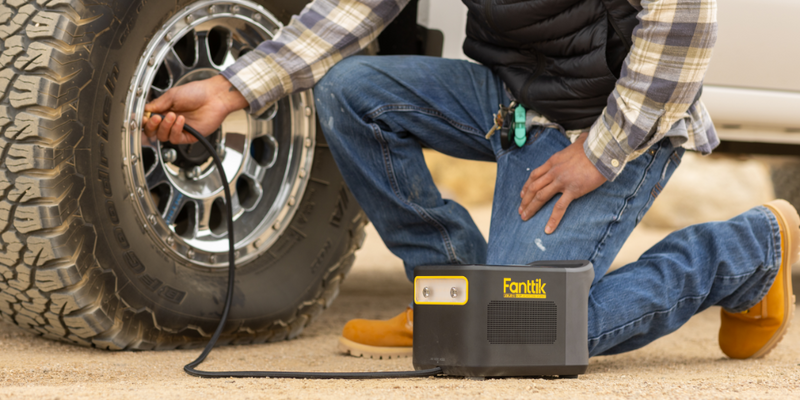
A portable compressor's "runtime" is often limited by heat before it is limited by battery capacity. Most compact units are designed with a 10–15 minute duty cycle. Once the internal thermistor detects a critical temperature (often around 180°F-200°F at the cylinder head), the unit will trigger a thermal shutdown.
If you are leading a fleet of five vehicles (20 tires), even at 2 minutes per tire, you face 40 minutes of continuous operation. Without a strategy, your compressor will likely shut down after the second vehicle.
The Sequencing Strategy
We recommend the following field techniques to extend duty cycles:
- Smallest First: Service vehicles with smaller tires first. The compressor completes more cycles with lower backpressure before hitting its thermal limit.
- The "Buddy" System: Use two inflators in tandem. This allows each unit to rest between vehicles, staying within its optimal thermal window.
- Pressure Bleed: Ensure the hose is disconnected between tires to allow the internal check valves to shed heat.
The CFM vs. Runtime Trade-off
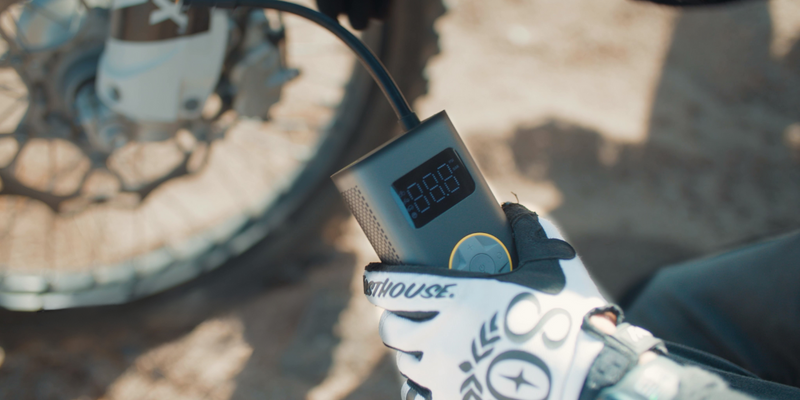
There is a fundamental engineering trade-off between Cubic Feet per Minute (CFM) and battery longevity. A high-CFM inflator moves air faster, which is excellent for group morale, but it often generates more waste heat per unit of air moved.
According to research from Backpack and Gear, the only meaningful metric for a group leader is "total air volume moved per charge." A slower, more efficient compressor might service more vehicles in a single day than a high-speed unit that wastes a larger percentage of its energy as heat. When selecting gear, prioritize units with robust heat sinks and efficient motor-to-piston ratios.
Safety, Compliance, and Transport
For trail guides, gear isn't just about performance; it's about compliance. When carrying high-capacity lithium batteries, you must adhere to safety standards to prevent thermal runaway.
The IATA Lithium Battery Guidance provides a framework for the safe transport of these devices. While these are aviation standards, they offer best practices for vehicle storage: keep batteries at a 30–50% State of Charge (SoC) for long-term storage and inspect for physical damage before any high-load event. As noted in The 2026 Modern Essential Gear Industry Report, "trust is a function of credibility math." For a leader, that math includes knowing the safety margins of your equipment.
Practical Checklist for Group Leaders
Use this checklist before heading out on a multi-vehicle expedition:
- Audit the Fleet: Record the total number of tires and the largest tire size in the group.
- Calculate Wh Demand: Multiply the number of tires by the estimated Wh per tire (use 10Wh as a safe average for 33" tires).
- Apply the "Leader’s Buffer": Add a 30% margin for inefficiency and another 20% if temperatures are below 45°F.
- Verify SoC: Ensure all inflators are at 100% charge. Lithium batteries can lose 1–3% of their charge per month even when idle.
- Plan the Rest: Factor in a 15-minute cool-down for every 15 minutes of continuous run time.
Navigating the Limits of Portability
Portable battery-powered inflators have revolutionized trail self-reliance, but they are not infinite power sources. By understanding the physics of derating, the impact of temperature, and the constraints of thermal duty cycles, you can lead your group with the confidence that comes from accurate planning.
Remember that gear is only as dependable as the person operating it. Use the heuristics provided here to build your own fleet model, and always carry a secondary unit for high-consequence trips.
Disclaimer: This article is for informational purposes only and does not constitute professional mechanical or safety advice. Off-roading involves inherent risks. Always consult your vehicle's manual and equipment manufacturer guidelines before performing trail maintenance.
Sources
Continue reading
 When to Renew: Identifying Heat-Damaged Hoses After Trail Use
Covers polymer degradation, professional diagnostic tests, and storage best practices based on ISO standards and the 2026 Modern...
When to Renew: Identifying Heat-Damaged Hoses After Trail Use
Covers polymer degradation, professional diagnostic tests, and storage best practices based on ISO standards and the 2026 Modern...
 Staging Your Air-Up: Safe Inflator Placement in Rough Terrain
Covers the 15-Degree Rule, environmental hazard management, and mechanical pitfalls like vibration for off-road inflator reliability.
Staging Your Air-Up: Safe Inflator Placement in Rough Terrain
Covers the 15-Degree Rule, environmental hazard management, and mechanical pitfalls like vibration for off-road inflator reliability.


Leave a comment
This site is protected by hCaptcha and the hCaptcha Privacy Policy and Terms of Service apply.