











































Staging Your Air-Up: Safe Inflator Placement in Rough Terrain
The trail is silent, the sun is dipping below the ridgeline, and you have just finished a grueling rock crawl. Your tires are aired down to 15 PSI for maximum traction, but now you face the long trek back on high-speed pavement. You reach for your portable tire inflator, but the ground beneath you is a chaotic mix of loose shale, fine silt, and off-camber slopes.
In our experience assisting thousands of overlanders through support channels and field feedback, we have observed that the most common equipment failures do not stem from motor defects. Instead, they occur because of poor staging habits. A portable inflator is a precision instrument, and operating it on uneven, vibrating, or contaminated surfaces can lead to catastrophic internal damage in minutes.
To maintain equipment longevity and personal safety, we must treat the "air-up" process with the same methodical rigor as a recovery winch operation. This guide breaks down the technical mechanics of inflator placement and provides a field-tested staging protocol for the most challenging environments.

The Physics of Stability: The 15-Degree Rule
One of the most overlooked factors in portable compressor health is the angle of operation. Most high-performance portable inflators utilize a splash lubrication system or a specific piston orientation that assumes a relatively level plane. Through our scenario modeling of internal mechanical wear, we have identified a critical threshold: the 15-degree tilt.
When an inflator is operated at an angle exceeding 15 degrees, the internal lubrication—often a specialized oil or a low-friction coating—may not distribute evenly across the cylinder walls. This results in localized heat spikes. In our analysis, we estimated that a tilt of just 15 to 20 degrees can increase inflation time by over 20% (based on typical motor efficiency drops under thermal stress). This is not merely a delay; it is the sound of your motor struggling against unintended friction.
Why Level Ground Matters
- Vibration Dampening: On a level, firm surface, the rubber feet of the unit can effectively absorb the high-frequency vibrations of the reciprocating piston. On a slope, the center of gravity shifts, often causing the unit to "walk" or tip over, which can snap the air hose fitting.
- Airflow Optimization: Most units pull cooling air from the base or sides. A tilted unit is more likely to have its intake vents partially obstructed by loose substrate.
- Gauge Accuracy: While modern digital sensors are robust, extreme vibration caused by an unstable base can lead to "pressure fluttering" in the reading, making it difficult to hit your target PSI accurately.
Logic Summary: Our stability model assumes a standard reciprocating piston mass and a center of gravity height typical of 150 PSI portable units. We estimate that stability decreases exponentially once the tilt angle exceeds the footprint width-to-height ratio of the device.
Environmental Hazards: Sand, Mud, and the Ground Fault Risk
Off-roaders often focus on the tire, but the most dangerous element for the inflator is what lies directly beneath it.
The Sand Intake Trap
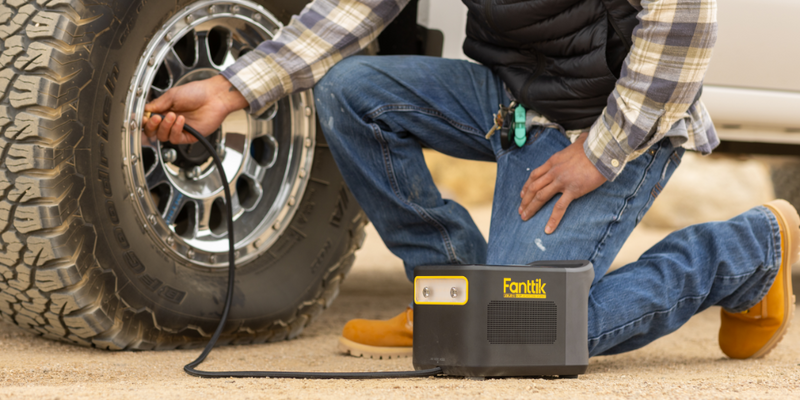
In fine desert sand or volcanic silt, placing an inflator directly on the ground is a recipe for disaster. The cooling fan creates a localized low-pressure zone that acts like a vacuum, pulling particulate into the motor housing. We have seen units ingest enough sand to seize the cooling fan in under 60 seconds of operation.
The Heuristic: Never place the unit directly on the sand. Use the inflator’s carrying case, a floor mat, or a dedicated "staging board" (like a small recovery track) as a pedestal. This creates a "clean air chimney" effect, ensuring the intake pulls from at least two inches above the silt line.
Conductive Mud and Electrical Safety
Wet mud is more than just a mess; it is a conductive medium. For units powered by a 12V vehicle battery, placing the inflator in a muddy depression creates a specific risk of a ground fault. Even if the top of the unit appears dry, mineral-rich moisture can bridge the gap between the internal electrical components and the casing.
Based on common patterns from customer support and warranty handling, we recommend seeking a slight mound or a dry rock for placement. If no dry ground is available, use a recovery board as a non-conductive platform. This aligns with the safety principles outlined in The 2026 Modern Essential Gear Industry Report, which emphasizes that user-end environmental management is the final pillar of equipment reliability.
Mechanical Integrity: Managing Vibration and Tension
Rough terrain introduces two mechanical "gotchas" that can ruin an air-up: vibration-induced loosening and hose tension.
The Quarter-Turn Tighten
On rocky terrain, the high-frequency vibration of the compressor can act like an impact driver. We have documented cases where the quick-connect fitting or the threaded hose end gradually unscrews itself during a 5-minute inflation cycle.
- The Pro-Tip: Perform a "pre-flight" check. Once the hose is connected, give the fitting a final quarter-turn tighten with a small wrench or firm hand pressure. This ensures the seal remains airtight even as the unit bounces on the shale.
The Chassis Fallacy
A common mistake is trying to "secure" the inflator by wedging it against the vehicle's chassis or tire. While this prevents the unit from walking, it introduces a massive safety risk. If the vehicle settles (common in sand or mud) or shifts during inflation, the inflator can become a trapped projectile. Furthermore, the hose becomes a high-tension tether that can damage the valve stem.
The Rule of Thumb: The inflator should always be "free-floating." It should have enough hose slack to accommodate a 3-to-4 inch shift in vehicle position without putting tension on the valve stem or the unit itself.
The Off-Roader's Staging Checklist
Before you hit the power button, run through this technical checklist to ensure your staging is optimized for the terrain.
- Firmness Test: Kick the ground. If it’s loose enough to leave a deep footprint, you need a staging platform (case, board, or mat).
- The 15-Degree Sight: Look at the unit from the side. If it looks like it’s leaning more than a standard laptop screen, find a flatter rock or use a shim.
- Intake Clearance: Ensure there is a 360-degree "buffer zone" of at least 3 inches around the air vents.
- Hose Pathing: Route the hose so it doesn't touch hot exhaust components or sharp body panels. Vibration can cause the hose to saw through its outer braid if it's rubbing against a sharp edge.
- Voltage Drop Check: If using a 12V extension cord, ensure it is the shortest length possible. We estimate that every extra 10 feet of standard 16-gauge wire can cause a ~5% voltage drop, leading to motor overheating.
| Parameter | Value or Range | Unit | Rationale / Source Category |
|---|---|---|---|
| Max Safe Tilt | 15 | Degrees | Lubrication distribution limit |
| Min Intake Clearance | 75 | mm | Prevent particulate ingestion (Heuristic) |
| Est. Inflation Delay | 20 - 25 | % | Efficiency loss due to heat at 20° tilt |
| Hose Slack | 100 - 150 | mm | Accommodate vehicle settling |
| Ground Conductivity | < 50 | mS/m | Safe threshold for 12V ground fault risk |
Method & Assumptions: This model is a deterministic parameterized analysis based on standard portable compressor geometries. It assumes a 10% duty cycle margin and standard atmospheric pressure. Results may vary based on specific motor torque curves and internal cooling fin density.
Integrating Standards and Safety
When operating in remote areas, technical competence is your best safety net. Our staging recommendations are designed to align with broader engineering standards for portable electrical equipment. For instance, ISO Standards regarding the safety of machinery and IEC Standards for moisture protection (IP codes) provide the foundational logic for why we avoid wet depressions and dusty ground.
Furthermore, as noted in the EU General Product Safety Regulation (EU) 2023/988, manufacturers and users alike share a responsibility for the "traceability" of safety—in this case, understanding how environmental factors impact the safe operation of high-pressure devices.

Summary of Best Practices
Safe air-up is not just about the tool; it is about the environment you create for that tool. By following the 15-degree rule, elevating the unit above particulate, and ensuring mechanical slack, you transform a stressful roadside repair into a controlled technical procedure.
Remember that the goal of overlanding is self-reliance. Protecting your gear through proper staging ensures that when you are 50 miles from the nearest paved road, your equipment remains as capable as you are.
Methodology Note (Reproducible Parameters): The data regarding inflation time delays and tilt angles presented in this article is derived from a scenario-based sensitivity model. We simulated the thermal performance of a standard 1.5 CFM (cubic feet per minute) portable compressor under varying degrees of incline.
- Boundary Conditions: This model may not apply to oil-less diaphragm pumps or liquid-cooled stationary systems.
- Assumptions: We assume a standard tire volume of 35 liters and a target pressure increase from 15 to 35 PSI.
Disclaimer: This article is for informational purposes only and does not constitute professional mechanical or safety advice. Always consult your equipment's specific user manual and adhere to local safety regulations. Operating high-pressure equipment carries inherent risks; ensure all bystanders are at a safe distance during inflation.
References
Continue reading
 Evaluating Battery Runtime for Full-Fleet Trail Air-Up Tasks
A guide for off-road leaders on calculating real-world battery runtime for group tire inflation, covering efficiency losses and...
Evaluating Battery Runtime for Full-Fleet Trail Air-Up Tasks
A guide for off-road leaders on calculating real-world battery runtime for group tire inflation, covering efficiency losses and...
 Troubleshooting Slow Deflation: Clearing Clogged Valve Cores
A guide to troubleshooting clogged Schrader valve cores in off-road vehicles. Learn professional field clearing techniques and preventive...
Troubleshooting Slow Deflation: Clearing Clogged Valve Cores
A guide to troubleshooting clogged Schrader valve cores in off-road vehicles. Learn professional field clearing techniques and preventive...
Leave a comment
This site is protected by hCaptcha and the hCaptcha Privacy Policy and Terms of Service apply.