
































The Criticality of PSI Precision in High-Performance Environments
For a performance driver, tire pressure is a primary tuning tool rather than a static setting. A variance of as little as 0.5 PSI can measurably alter the contact patch, potentially shifting a vehicle from a neutral balance into understeer or snap oversteer. In the high-consequence environment of a track day, where tires often reach temperatures exceeding 130°F (54°C), the equipment used to manage these pressures must offer more than consumer-grade convenience.
Paddock Quick-Start: 3 Essentials for Accuracy
- The 15-Second Warm-Up: Always run a portable inflator for 10–15 seconds before the first measurement to stabilize the sensor and internal electronics.
- The Verification Loop: Use the inflator for speed, but verify final "hot" pressures with a high-quality analog gauge to account for potential sensor drift.
- Thermal Awareness: Recognize that air exiting an inflator is significantly hotter than ambient air; allow 1–2 minutes for pressures to stabilize before making a "final" record.

The Physics of Accuracy: Beyond the Spec Sheet
When evaluating a portable inflator, enthusiasts often focus on the manufacturer's accuracy claim (typically ±0.5% or ±1 PSI). While these figures provide a baseline, they are often derived under ideal laboratory conditions. In a track environment, thermal dynamics create variances that can influence the sensor’s real-world precision.
Thermal Drift and Sensor Stability
According to Tire Terrain's engineering guide on temperature, tire pressure typically rises by 1 to 2 PSI for every 10°F increase in temperature. On a afternoon where track surface temperatures reach 130°F, a tire might see a total pressure swing of 8 to 15 PSI during a single session.
In professional settings, we often observe that an inflator's internal sensor is also subject to thermal drift. As the unit’s motor operates, it generates internal heat. Without proper isolation or temperature compensation, the digital readout may begin to fluctuate or "drift" as the unit's internal temperature rises.
Adiabatic Heating Effects
A factor often overlooked is the temperature of the air being pumped into the tire. The process of rapid compression generates heat—a phenomenon known as adiabatic heating.
Calculation Note (Theoretical Peak Gas Temperature): Using the adiabatic compression formula $T_2 = T_1 \times (P_2 / P_1)^{(k-1)/k}$, where $k$ (gamma) for air is 1.4:
- Inputs: Initial temp ($T_1$) of 35°C (308K), initial pressure 14.7 PSI, final pressure 36 PSI.
- Result: The theoretical peak gas temperature at the compression head can reach 131°C (268°F) to 166°C (330°F).
- Practical Context: This represents the transient temperature of the air at the point of compression, not the final stabilized temperature of the tire. However, this heat is the primary driver of sensor drift and tool wear.
Evaluating Professional-Grade Hardware Criteria
To meet the standards suggested in the 2026 Modern Essential Gear Industry Report, a track-ready inflator should demonstrate "credibility math"—the ability to provide repeatable results under stress.
- Flow Rate Under Load: Many consumer units boast high "Free Air" flow rates (e.g., 32L/min). However, performance at 30–40 PSI is what matters. A professional-grade unit should maintain a consistent flow that allows for rapid adjustments without hitting thermal shutdown.
- Pressure-Sensitive Auto-Stop: The ability to preset a pressure and have the unit stop within a 0.2 PSI margin can help reduce the risk of human error when managing multiple paddock tasks.
- Vibration Dampening: According to NIST Handbook 44, measuring devices must maintain accuracy despite environmental interference. Paddock vibrations from generators or heavy traffic can cause lower-quality digital gauges to fluctuate. Professional units typically use higher-quality transducers and internal dampening to filter this electronic "noise."
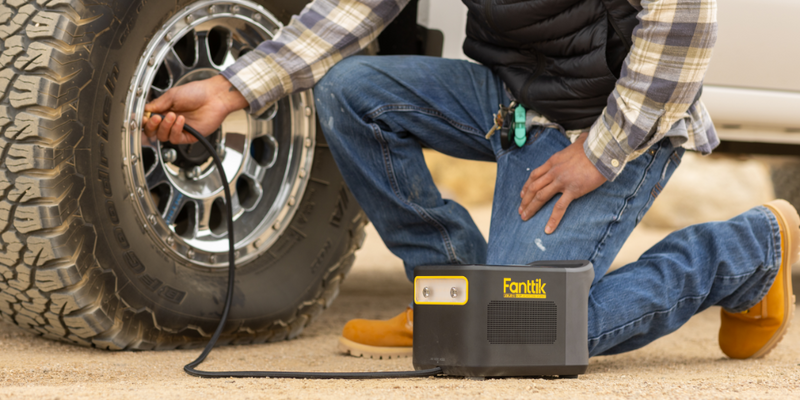
Scenario Analysis: The Competitive Two-Car Team
To demonstrate the demands placed on this equipment, we modeled a scenario involving a team managing two high-performance vehicles (e.g., a BMW M3 and a Porsche 911) during a summer event.
Modeling Assumptions & Inputs:
- Ambient Temperature: 35°C (95°F).
- Flow Rate Assumption: 32 LPM (Free Air), with a modeled 15% decay in efficiency as backpressure reaches 36 PSI.
- Valve Restriction: Standard Schrader valve (assumed non-restricted for this model).
| Parameter | Value | Rationale |
|---|---|---|
| Tire Size | 275/35R19 | Standard high-performance fitment |
| Delta Pressure | 10 PSI | Typical post-cooldown adjustment (26 to 36 PSI) |
| Total Tires | 8 | Two-car team requirement |
| Estimated Runtime | ~27 Minutes | Total cumulative time for 8 tires |
| Time Per Tire | ~3.3 Minutes | Includes flow decay and connection time |
Key Findings from the Model:
- Duty Cycle: A total runtime of 27 minutes is within the 40-minute continuous limit of top-tier units, but it approaches the thermal threshold of the housing.
- Accuracy Risk: Because of the extreme thermal rise at the compression head (reaching ~166°C theoretically), taking a "final" reading immediately after inflation may be inaccurate. The air inside the tire is temporarily hotter than the tire carcass.
The Professional Paddock Protocol: Ensuring Consistency
Even a highly accurate inflator can yield inconsistent results if the methodology is flawed. We recommend the following protocol for critical track-side measurements.
1. The "Sensor Warm-Up" Technique
The first inflation after a period of inactivity is often the most prone to variance. Run the inflator for 10–15 seconds before connecting it to the tire. This ensures the internal electronics have reached a stable operating state.
2. The Verification Loop
Treat the inflator’s digital display as a high-speed monitor, but not necessarily the absolute source of truth. Professionals often use a separate, certified analog gauge for final verification. If you consistently see a variance of more than 2 PSI, it may indicate sensor drift or the need for professional calibration.
3. Dynamic Management
As noted by SEMA Market Research, the performance aftermarket is increasingly data-driven. In racing, there is rarely a single "correct" pressure. Factors like braking generate front-to-rear pressure differentials (often 2–3 PSI). Manage pressures dynamically based on handling characteristics rather than strictly following a door placard.
Compliance, Safety, and Battery Integrity
The reliability of the lithium-ion battery inside a cordless inflator is a significant safety consideration in hot paddocks.
Transport and Storage
According to IATA Lithium Battery Guidance, lithium batteries should be handled with specific State of Charge (SoC) considerations for safety. For longevity, we recommend storing your inflator at approximately 50% charge. Avoid leaving the unit in a hot car trunk, as extreme heat can accelerate battery degradation.
Regulatory Standards
When selecting gear, look for evidence of compliance with international safety standards:
- ISO 9001: For quality management.
- IEC 60529 (IP Ratings): Protection against dust and moisture found in outdoor paddocks.
- EU General Product Safety Regulation (2023/988): Providing a framework for traceability and safety.
Economic Impact and Performance ROI
While lap times are the priority, the economic impact of pressure accuracy is measurable. We modeled a heuristic ROI for a driver covering 8,000 miles per year (80% track, 20% street).
Under-inflation by just 1.5 PSI—a common variance in low-quality gauges—can increase fuel consumption by 0.3% to 0.45% (based on US Dept. of Energy coefficients). More importantly, for a $1,800 set of track tires, consistent under-inflation can accelerate shoulder wear, potentially reducing the tire's effective lifespan by 10–15%.
ROI Heuristic: For this specific persona, the "payback period" of a $110 professional-grade inflator is approximately 52 to 59 months based on fuel and tire savings. However, the primary value is found in the consistency of handling and the mitigation of tire failure risks.
Building a Trustworthy Tool Kit
As the Auto Care Factbook highlights, enthusiasts are increasingly taking maintenance into their own hands. In this landscape, the tools you choose define your capability.
Evaluating an inflator’s accuracy requires looking past marketing claims and into the engineering realities of thermal management and sensor stability. By adopting a methodical approach—including sensor warm-ups, verification loops, and adherence to safety standards—you can help ensure your equipment remains an asset to your performance.
Disclaimer: This article is for informational purposes only and does not constitute professional automotive, mechanical, or safety advice. Always consult your vehicle's manufacturer guidelines and professional racing technicians for specific tire pressure recommendations. Tire inflation involves high-pressure gases and electrical components; exercise caution and follow all safety warnings provided by equipment manufacturers.
Sources
- The 2026 Modern Essential Gear Industry Report (Fanttik)
- NIST Handbook 44: Specifications, Tolerances, and Other Technical Requirements for Weighing and Measuring Devices
- IATA Lithium Battery Guidance Document
- Tire Terrain: How Temperature Affects Tire Pressure
- US Dept. of Energy: Proper Tire Pressure Saves Fuel
- EU General Product Safety Regulation (2023/988)
Continue reading
 Why Internal Valve Engineering Dictates Prosumer Precision
Covers valve crack pressure, flow decay, material science, and compliance with ISO/SAE standards for repeatable performance.
Why Internal Valve Engineering Dictates Prosumer Precision
Covers valve crack pressure, flow decay, material science, and compliance with ISO/SAE standards for repeatable performance.
 Troubleshooting Pressure Sensor Lag in High-Speed Inflators
End tire pressure errors! Uncover why your inflator sensor lags and use our simple tricks to get precise...
Troubleshooting Pressure Sensor Lag in High-Speed Inflators
End tire pressure errors! Uncover why your inflator sensor lags and use our simple tricks to get precise...
Leave a comment
This site is protected by hCaptcha and the hCaptcha Privacy Policy and Terms of Service apply.