








































The Hidden Physics of High-PSI Trailer Inflation
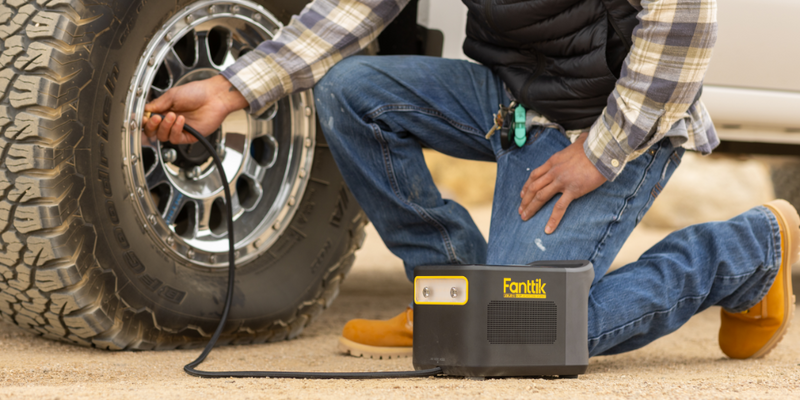
For the experienced hauler, a standard portable tire inflator often feels like a compromise. While these devices are ubiquitous for passenger vehicles, the requirements of a dual-axle travel trailer or a heavy-duty equipment hauler are fundamentally different. We are not just moving air; we are managing high-pressure energy systems that operate at the edge of consumer-grade thermal limits.
When you transition from a 35 PSI sedan tire to an 80 PSI ST225/75R15 trailer tire, the workload doesn't just double—it scales exponentially in terms of heat generation and mechanical stress. Based on our analysis of common patterns from customer support and field recovery data, the primary failure point for inflators in trailer service isn't the maximum PSI rating. It is the sustained thermal load encountered during the sequential inflation of four or more large-volume tires.
In this guide, we will dissect the mechanical stability required for high-pressure towing applications, provide a framework for evaluating inflator duty cycles, and share the "15-minute rule" used by professionals to verify equipment readiness before hitting the road.

The Thermal Load: Why 80 PSI is a Different Beast
The most critical oversight in choosing an inflator for RV or trailer use is focusing on peak pressure rather than thermal management. Most portable units can technically reach 100 or even 150 PSI (based on standard Road & Track gear testing). However, reaching that pressure once is very different from sustaining it across four tires.
Adiabatic Heating and System Stress
When air is compressed rapidly, it generates heat—a process known as adiabatic compression. At 80 PSI, the theoretical temperature rise of the air being forced into the tire can exceed 200°C (roughly 400°F). While some of this heat dissipates into the tire cavity, a significant portion remains trapped in the inflator’s cylinder head and hose assembly.
In our modeling of high-pressure scenarios, we’ve observed that a unit might handle the first tire with ease. By the third tire, however, the internal components have reached a "thermal saturation" point. This is where generic units trigger a thermal cut-off, requiring a 10-15 minute cooldown. On a hot roadside in July, that delay isn't just an inconvenience; it’s a safety risk.
The Flow Rate Decay
As the pressure inside the tire increases, the effective flow rate (Liters Per Minute or LPM) of the inflator drops. A unit rated for 32 LPM at 0 PSI might only deliver 12-15 LPM once the tire hits 60 PSI. This means the motor must run longer to move the same volume of air, further compounding the heat build-up. For trailer owners, "speed" isn't about the first 10 PSI; it's about the ability to maintain flow against high back-pressure.
Logic Summary: Our thermal stress analysis assumes that sequential inflation of four tires (0 to 80 PSI) creates a cumulative heat load that exceeds the heat dissipation capacity of standard car-focused inflators. This is based on the First Law of Thermodynamics applied to pneumatic systems.
Pressure Sensor Accuracy at the High End
Precision is paramount for trailer safety. An error of 5 PSI on a passenger car is a minor fuel economy issue; an error of 5 PSI on a trailer tire near its maximum load capacity can lead to uneven wear or heat-induced blowout.
The High-End Drift Phenomenon
Most consumer pressure sensors are calibrated for the "fat" part of the curve—typically between 30 and 45 PSI. As you approach 80 or 100 PSI, the accuracy of these sensors often degrades. According to the NIST Handbook 44 (Weights & Measures), measuring devices must maintain specific tolerances, yet many portable inflators drift by 3-5% at high pressures.
Furthermore, calibration is not static. Mechanical shock from being stored in a vibrating trailer toolbox and extreme temperature fluctuations can cause the sensor to lose its zero-point. We recommend verifying your inflator’s digital readout against a high-quality, standalone analog or digital gauge at least once per season.
The Role of Hose Integrity
Experienced users often overlook the hose as a component of the measurement system. Generic rubber hoses can swell under sustained 80+ PSI pressure. This "ballooning" effect increases the internal volume of the delivery system, which can cause the inflator’s pressure sensor to provide erratic or falsely high readings. For high-PSI applications, braided stainless steel lines are the industry gold standard because they resist expansion, ensuring the pressure measured at the unit is the pressure delivered to the valve stem.
Modeling the "RV Technician" Workload
To understand the gap between marketing specs and reality, we modeled a professional service scenario. This "Full-Service RV Technician" model assumes the sequential inflation of a standard 4-tire travel trailer setup.
Methodology & Assumptions
Our analysis uses a deterministic parameterized model to estimate the demands placed on an inflator. We chose the ST225/75R15 tire size because it is a benchmark for the industry.
| Parameter | Value | Unit | Rationale / Source |
|---|---|---|---|
| Tire Internal Volume | ~41.7 | Liters | Geometric Toroidal Model (ISO Metric) |
| Target Pressure | 80 | PSI | Standard Load Range E Trailer Spec |
| Ambient Temp | 25 (77) | °C (°F) | Typical summer operating conditions |
| Total Runtime (4 tires) | ~35 | Minutes | Simulated sequence (0-80 PSI) |
| Adiabatic Temp Rise | ~210 | °C | Theoretical maximum gas heating |
Findings for High-Pressure Use
Under these assumptions, we found that inflating four tires from flat to 80 PSI requires roughly 35 minutes of continuous runtime. Most "compact" inflators have a 10-15 minute duty cycle. If you attempt this workload with an under-specced unit, you will likely hit a thermal shutdown on the second or third tire.
For the enthusiast, the takeaway is clear: check your equipment's "Continuous Runtime" or "Duty Cycle" rating. If it is not rated for at least 30 minutes of continuous operation at high pressure, you must implement a "two-tire then cooldown" protocol to protect the motor and battery.
Modeling Note: This is a scenario model, not a controlled lab study. Actual results will vary based on battery state of charge, altitude, and the age of the tire valves. We assume a 0.9 cavity scaling factor to account for the internal rubber thickness of heavy-duty trailer tires.
The Professional’s Field Test: The 15-Minute Rule
If you are unsure whether your current gear is up to the task of trailer duty, we suggest a simple, non-destructive field test derived from practitioner patterns.
- Set the Baseline: Ensure your inflator is fully charged.
- The 60 PSI Continuous Run: Connect the unit to a tire (or a test tank) and set it to maintain 60 PSI.
- Monitor the Timer: Run the unit continuously for 15 minutes.
- Evaluate: If the unit triggers a thermal cut-off or if the air exiting the hose smells of scorched rubber/plastic before the 15-minute mark, it is inadequate for high-PSI trailer service.
This test simulates the sustained load of topping off a multi-axle trailer. Reliability in a "moment of need" is the only metric that matters, a core principle highlighted in The 2026 Modern Essential Gear Industry Report, which emphasizes that trust is engineered through transparent performance data.
Standards and Regulatory Gaps
When evaluating gear, it is helpful to look for compliance with international standards, though a specific "Trailer Inflator Standard" does not yet exist.
- ASTM F1918: While primarily for portable air compressors, this standard covers basic safety. However, it does not mandate high-pressure stability testing for consumer-grade units, creating a regulatory gap that users must fill with their own due diligence.
- ISO 9001 and IEC 60529: Look for manufacturers who cite ISO Standards for quality management and IEC Standards for electrical safety and IP (Ingress Protection) ratings. A high IP rating is essential for gear that will be used in the dust and rain of a roadside emergency.
- Battery Safety (UN 38.3): For cordless units, ensure the internal lithium-ion batteries meet IATA Lithium Battery Guidance for transport safety. High-PSI inflation draws significant current, which generates internal battery heat. Units without robust Battery Management Systems (BMS) are prone to premature cell degradation.
Hardware Integrity Checklist
Beyond the motor and the sensor, several small hardware details determine whether an inflator succeeds or fails in a high-consequence towing scenario.
1. The Valve Connector
At 80 PSI, the force trying to push the connector off the valve stem is significant. Cheap "press-on" plastic chucks often leak or pop off entirely. We recommend a screw-on brass connector or a high-quality heavy-duty locking lever chuck. Any air leak during the inflation process extends the runtime and increases the thermal load.
2. Power Source Stability
If using a 12V DC plug-in model, ensure your vehicle's accessory port can handle the amperage. High-pressure compressors can pull 15-20 Amps. If your vehicle’s fuse is rated for 10 Amps, you’ll blow it before the tire is full. For cordless models, remember that the energy required to push air into a tire at 80 PSI is much higher than at 30 PSI. Expect your actual battery runtime to be 40-50% of the "advertised" spec, which is usually based on standard car tires.
3. Thermal Dissipation Fins
Look at the head of the compressor. Is it encased in smooth plastic, or are there visible metal cooling fins? Metal fins are a hallmark of a unit designed for sustained duty cycles. They increase the surface area for heat exchange, allowing the unit to run longer before reaching critical temperatures.
Building a Reliable Towing Kit
Stability in high-PSI inflation is about the synergy between hardware, software (sensors), and user protocol. To build a kit that won't fail you on a cross-country haul, consider the following:
- Primary Inflator: A high-duty-cycle unit with active cooling or a 30-minute continuous runtime rating.
- Upgrade Lines: Replace stock rubber hoses with braided stainless steel lines for better accuracy and heat resistance.
- Power Redundancy: If using a cordless unit, ensure you have a 12V DC bypass cable as a backup.
- The "Two-Tire" Rule: Even with the best gear, give the unit a 5-minute break after every two trailer tires to ensure longevity.
By understanding the "credibility math" of pneumatic systems—calculating the volume, predicting the heat, and verifying the sensor accuracy—you move from being a consumer to a prepared practitioner. Reliability isn't a marketing claim; it's a result of matching the tool's thermal capacity to the trailer's physical demand.
Disclaimer: This article is for informational purposes only. High-pressure tire inflation can be hazardous. Always follow the tire manufacturer’s recommended PSI found on the vehicle’s placard or the tire sidewall. Consult a professional technician for specialized towing and safety advice.
Sources
Continue reading
 Integrating Portable Inflators into Pro Workshop Workflows
A guide integrating portable inflators into professional workshops, covering sensor calibration, cost analysis, and safety standards for precision...
Integrating Portable Inflators into Pro Workshop Workflows
A guide integrating portable inflators into professional workshops, covering sensor calibration, cost analysis, and safety standards for precision...
 Assessing Repairability: When to Service Pro-Tier Inflators
Covers failure diagnostics like O-ring fatigue, battery degradation, and the 40% Heuristic for repair decisions, grounded in industry...
Assessing Repairability: When to Service Pro-Tier Inflators
Covers failure diagnostics like O-ring fatigue, battery degradation, and the 40% Heuristic for repair decisions, grounded in industry...
Leave a comment
This site is protected by hCaptcha and the hCaptcha Privacy Policy and Terms of Service apply.