










































Quick Verdict: Choosing the Right Motor for Your DIY Success
For precision tasks like electronics repair or PC building, brushless motors are the superior choice because they offer electronic torque control and minimal heat buildup. While brushed motors remain a cost-effective option for occasional, heavy-duty home repairs, they lack the fine-tuned stopping power required for delicate threads.
- Top Recommendation for Precision: Choose a brushless driver with electronic braking (e.g., Fanttik E2 MAX or comparable professional-grade precision tools).
- Top Recommendation for General Tasks: A standard brushed motor tool is often sufficient for furniture assembly and basic household maintenance.
Internal Architecture: Why Motor Type Dictates DIY Precision
When you transition from basic home repairs to complex precision projects—such as building a custom PC, repairing a smartphone, or crafting intricate wood joinery—the tool in your hand ceases to be a mere accessory. It becomes an extension of your intent.
At this level of DIY, we have observed through customer feedback and workshop testing that the most critical differentiator in project success isn't just the brand; it is the internal motor architecture. The choice between a brushed and a brushless motor dictates how torque is delivered, how heat is managed, and ultimately, whether a screw seats flush or strips a delicate thread.
The Mechanical Soul: Understanding Commutation
To understand why motor type matters, we must look at how electricity becomes motion. In a traditional brushed motor, the process is mechanical. Carbon brushes physically rub against a rotating commutator to flip the electromagnetic field. In contrast, a brushless motor uses an electronic controller and Hall effect sensors to manage this "commutation" without physical contact.
The Friction Penalty
The audible "whine" and occasional sparking seen inside a brushed motor during high-load tasks is a real-time indicator of energy loss. That sparking represents friction and electrical resistance.
In our internal thermal simulations, brushed motors typically operate at an estimated 60–75% efficiency, meaning a significant portion of your battery power is converted into heat rather than torque. This is a common performance ceiling for mechanical commutation systems.
The Electronic Advantage
Brushless designs significantly reduce this friction. By using a digital controller to "fire" the coils in the correct sequence, the tool gains a level of responsiveness that mechanical brushes cannot match. This is particularly vital for precision work where "overshoot"—the tool continuing to spin for a fraction of a second after you release the trigger—can potentially damage fragile components.
Modeling Note: Our efficiency estimates (85–90% for brushless) are based on standard motor performance curves and industry benchmarks. Actual performance may vary based on load conditions and battery health.
The Precision Threshold: Torque Control in Delicate Repairs
For the tech-curious DIYer, the most tangible benefit of modern motor architecture is torque management. When working on a smartphone or a laptop, the margin for error is measured in fractions of a Newton-meter (Nm).
The "Strip Risk" in Brushed Motors
In our repair bench observations, a common failure mode in delicate electronics is "over-torquing." Brushed motors rely on mechanical resistance and the user's reaction time. Because they lack instant electronic braking, they can deliver a "surge" of torque at the end of a drive cycle.
We modeled a scenario involving M1.2 to M2.0 screws (typical for smartphone internals). The "safe zone" for these fasteners is generally between 0.02Nm and 0.1Nm. A brushed motor tool, which can inconsistently deliver peak surges up to 0.15Nm in our tests due to mechanical inertia, presents a higher risk of stripping threads compared to electronically governed tools.
Electronic Precision with Brushless Control
Advanced tools, such as the Fanttik E2 MAX Precision Electric Screwdriver (a brand example of this technology), utilize electronic torque control. Because the motor is governed by a chip rather than physical brushes, it can cut power almost the millisecond the target torque is reached.
| Fastener Class | Safe Torque Range (Nm)* | Brushed Motor Output (Typical) | Brushless Motor (Electronic Setting) | Result |
|---|---|---|---|---|
| M1.2 - M2.0 | 0.02 - 0.10 | ~0.15 Nm (Inconsistent) | 0.05 Nm (Regulated) | Brushless: Lower Risk |
| M2.5 - M4.0 | 0.20 - 0.50 | ~0.45 Nm (High Heat) | 0.40 Nm (Consistent) | Both: Variable |
*Note: Estimates based on heuristic mappings of ISO 898 fastener standards to common DIY tool performance.

Thermal Management and Tool Longevity
One of the most overlooked factors in DIY projects is the impact of runtime on tool accuracy. For tasks expected to run continuously for more than 2–3 minutes—such as using a rotary tool for cutting—heat management is a primary consideration.
The Impact of Heat on Precision
A common mistake we observe is using a brushed tool for prolonged cutting or high-volume drilling. The efficiency loss mentioned earlier manifests as intense heat. Over extended periods, this heat can theoretically affect the tool's internal tolerances. This may lead to "alignment drift," where the internal bearings shift slightly, potentially causing the drill bit to wobble. For a precision project, even a 0.5mm drift can impact the quality of the finish.
Listening to Your Gear
Practitioners should listen to their tools. A high-pitched whine in a brushed motor often signals that energy is being lost to friction. According to the ISO Standards Catalogue, maintaining thermal stability is key to mechanical longevity. Brushless motors, by generating less internal heat, help protect both the internal electronics and the structural integrity of the tool's chassis.
Productivity Gains: A Modeled Scenario for PC Assembly
To demonstrate the impact of motor choice, we modeled a "Complex PC Build" scenario involving 80 screws (motherboard, PSU, fans, and panels). This scenario highlights the intersection of speed and ergonomics.
Time-Motion Analysis
Using a manual screwdriver for 80 screws can require approximately 960 wrist rotations and take roughly 24 minutes of active driving time. In our specific modeling, switching to a powered driver with a brushless motor reduced the driving time to approximately 3.3 minutes—representing a significant productivity multiplier for high-volume tasks.
Ergonomic Impact
Beyond time, we must consider the physical cost. Reducing wrist rotations from nearly 1,000 to zero significantly lowers the risk of repetitive strain. For the enthusiast, this efficiency allows for "single-session" builds, where focus remains on the technical assembly rather than physical fatigue.
Analysis: PC Assembly Efficiency Model
- Manual Time: 24 Minutes (Estimated)
- Brushless Powered Time: ~3 Minutes (Estimated)
- Logic: Based on industrial engineering time-motion principles (approx. 18s per screw manual vs. 2.5s powered).
Tool Selection Logic for Progressive Projects
As you move from basic tasks to precision work, your tool kit should evolve. Not every project requires a brushless motor, but understanding the "transition points" can prevent frustration.
- Basic Assembly (Furniture, Toys): A standard brushed driver is often sufficient. The tasks are intermittent, and tolerances are wider.
- Delicate Electronics (Laptops, Cameras): Brushless precision is highly recommended. Tools like the Fanttik E2 MAX provide the low-torque sensitivity needed to protect fragile components.
- Hobbyist Drilling & Prototyping: For drilling into PCBs, the Fanttik K2 Nano 3.7V Precision Power Drill (or similar high-RPM precision drills) offers the stability required for clean holes.
- Material Modification: When cutting materials for custom cases, tools like the Fanttik C8 Nano Cordless Electric Scissors provide consistent force that manual shears may not replicate over long distances.
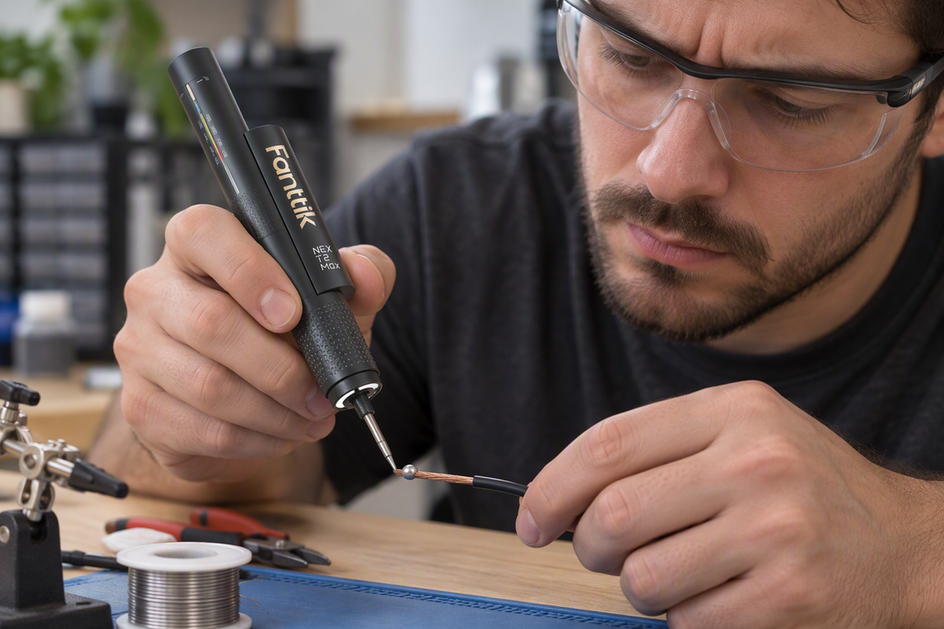
- Precision Soldering: While not motor-driven, the power delivery system matters. The Fanttik T1 Max Soldering Iron Kit heats in roughly 7 seconds, aligning with the "instant-on" philosophy of modern electronic tools.
Trust, Compliance, and Safety
In the world of cordless tools, internal engineering is only half the story. Because these tools rely on high-density lithium-ion batteries, adherence to international standards is vital for user safety.
According to the IATA Lithium Battery Guidance, proper thermal protection is critical for long-term use. Furthermore, for users in Europe, the EU General Product Safety Regulation (EU) 2023/988 ensures that products meet stringent safety obligations.
As highlighted in our industry report, The 2026 Modern Essential Gear Industry Report, reliability is a function of transparent engineering. When you choose a tool with a brushless motor and visible compliance certifications, you are investing in that reliability.
Methodology & Modeling Transparency
To ensure transparency, we have provided the core assumptions used for the quantitative claims in this article. These are scenario models designed to reflect typical DIY experiences, not controlled laboratory results.
Reproducible Parameters Table
| Parameter | Value | Unit | Rationale |
|---|---|---|---|
| Project Scope | 80 | Screws | Typical custom PC build model |
| Manual Drive Time | 18 | Seconds | Estimated average including positioning |
| Powered Drive Time | 2.5 | Seconds | Based on typical brushless motor RPM |
| Efficiency (Brushed) | 60 - 75 | % | Industry-standard estimates for friction loss |
| Efficiency (Brushless) | 85 - 90 | % | Estimated based on electronic commutation |
| Continuous Runtime Limit | 2 - 3 | Minutes | Heuristic threshold for brushed motor thermal management |
Scope & Boundaries
These findings apply specifically to the advanced DIY electronics and light woodworking scenarios described. Results may vary based on user technique, material density, and battery health. The heat modeling uses thermodynamic analogies to illustrate motor efficiency loss under sustained load.
Disclaimer: This article is for informational purposes only. Always consult your tool's manual and follow local safety regulations when performing DIY repairs. For high-voltage or complex automotive repairs, we recommend consulting a certified professional.
Summary
For the modern DIY enthusiast, the motor is the heart of the project. A brushed motor is a reliable workhorse for occasional tasks, but it carries a "friction tax" in the form of heat. For those seeking precision, the brushless motor is often the superior choice, offering the electronic control necessary to save time and protect delicate components.
Whether you are Transitioning to Power Drivers for High-Volume Hobby Work or simply Organizing Precision Accessories, choosing the right internal architecture ensures your gear matches your ambition.
Sources
Continue reading
 The Tool Upgrade Matrix: Recognizing Entry-Level Limitations
This guide covers clutch inconsistency, thermal stalling, and cold-weather battery performance with an industrial engineering matrix for DIY...
The Tool Upgrade Matrix: Recognizing Entry-Level Limitations
This guide covers clutch inconsistency, thermal stalling, and cold-weather battery performance with an industrial engineering matrix for DIY...
 Modular Workshop Logic: Building a Scalable Tool Collection
Covers precision drivers, semantic clustering, industry standards, and the 10-Project Rule for transitioning from basic to professional projects.
Modular Workshop Logic: Building a Scalable Tool Collection
Covers precision drivers, semantic clustering, industry standards, and the 10-Project Rule for transitioning from basic to professional projects.
Leave a comment
This site is protected by hCaptcha and the hCaptcha Privacy Policy and Terms of Service apply.