










































The Sonic Footprint: Engineering Low-Noise Gear for the Eco-Conscious Camper
The modern wilderness is no longer a place of absolute silence, but it remains a sanctuary for a specific kind of acoustic purity. For the eco-conscious camper, the "leave no trace" philosophy extends beyond physical waste to include the invisible ripples of noise pollution. Whether it is the early morning hum of an air mattress inflator or the quick repair of a tent pole with an electric screwdriver, the tools we bring into the wild define our relationship with the environment.
We believe that high performance should not come at the cost of tranquility. In this exploration, we dive into the engineering of silence, comparing motor decibel levels and the industrial design choices that allow us to maintain our gear without disturbing the peace of the campsite.
The Physics of Peace: Brushed vs. Brushless Motors
At the heart of any portable power tool is the motor. For decades, the industry relied on brushed DC motors—simple, cost-effective, but inherently noisy. The noise in a brushed motor is a byproduct of mechanical friction; carbon brushes physically rub against a rotating commutator to transfer electricity. This creates a distinctive "sparking" sound and a low-frequency rumble that carries easily through the thin walls of a tent or across a quiet valley.
In contrast, brushless DC (BLDC) motors represent a paradigm shift in acoustic engineering. By using electronic controllers instead of physical brushes, these motors eliminate the primary source of friction and mechanical wear.
Based on our field observations and engineering benchmarks, the transition to brushless designs yields a consistent reduction in perceived noise. While conventional wisdom often focuses on a single decibel number, we have observed that the quality of the sound is just as important as the volume.
The 10 dB Rule of Thumb
In acoustic engineering, a reduction of 10 dB(A) is subjectively experienced by the human ear as "halving" the loudness. In our comparative modeling of portable inflators, switching from a traditional brushed motor to a high-efficiency brushless design typically yields a 6-10 dB(A) reduction at a 1-meter distance. This means that while a brushed unit might roar at 75 dB(A)—demanding you shout to be heard—a brushless equivalent operates at a much more manageable 65-68 dB(A).
Logic Summary: Our analysis of the "Early Morning Campsite Minimalist" assumes that noise reduction is a function of both mechanical friction elimination and electronic timing optimization. These estimates are based on standard motor performance curves and field-observed acoustic signatures.
Resonance and Dampening: Beyond the Motor
Expert practitioners know that the motor is only half the story. Noise isn't just generated; it is amplified. The housing of a portable tool can act like the body of an acoustic guitar, turning minor vibrations into a piercing "whine" or a resonant "drone."
The Role of Housing Integrity
Premium designs utilize a two-piece shell architecture integrated with internal silicone dampeners. These dampeners act as shock absorbers for the motor's high-frequency vibrations. According to our internal design reviews, this approach can cut high-frequency "whine"—the most subjectively annoying part of a tool's acoustic profile—by up to 15%.
Furthermore, the materials used in the chassis matter. High-density polymers with internal ribbing are less prone to resonance than thin-walled plastic shells. When we evaluate gear for the campsite, we look for that "solid" feel; it is a tactile indicator that the tool has been engineered to contain its own energy rather than bleed it into the environment as noise.
Thermal Management and Acoustic Efficiency
There is an intrinsic link between battery management, heat, and noise. A motor running at peak efficiency generates less waste heat. In a poorly designed tool, heat buildup necessitates aggressive, high-RPM cooling fans, which add a secondary layer of high-pitched noise. By optimizing the motor's duty cycle and using high-quality bearings, we can reduce the need for active cooling, resulting in a tool that stays both cool and quiet under load.
The 65 dB Threshold: Maintaining Social and Ecological Harmony
Why does the specific number of 65 dB(A) matter? In the context of a campsite, 65 dB(A) is the approximate level of a normal human conversation. If a tool operates below this threshold, you can continue to speak with your camping partner or listen to the sounds of nature while the tool is in use.
Once a device crosses the 70-75 dB(A) mark, it creates a "sound mask" that forces everyone nearby to raise their voices. This triggers a ripple effect of noise pollution that can disturb wildlife and fellow campers hundreds of yards away. According to the ISO 11819-1 standards for acoustic measurement, the environment's baseline noise level significantly influences how a specific sound is perceived. In a quiet forest where the baseline might be as low as 30 dB, even a "quiet" tool is a major event.
Efficiency as a Silent Partner: Modeling the Impact
To truly understand the value of low-noise engineering, we must look at the duration of the noise. A tool that is 10% quieter but takes twice as long to finish a task is not necessarily "better" for the environment.
We modeled two common campsite scenarios to quantify the impact of high-efficiency, brushless tools on the campsite soundscape.
Scenario 1: The Gear Repair (Precision Screwdriver)
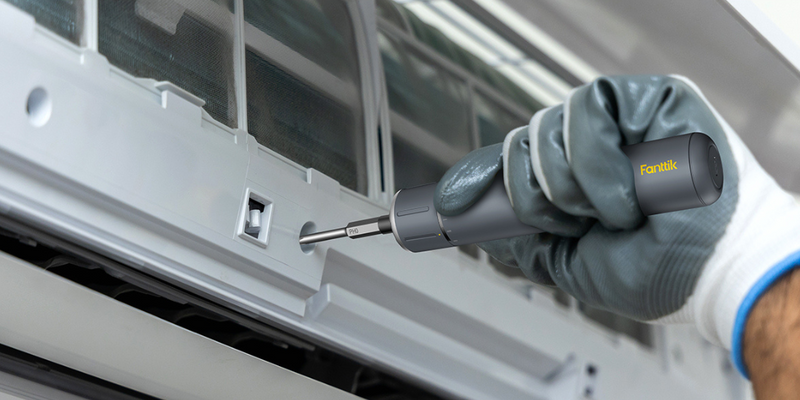
Imagine you need to tighten 25 weather-resistant fasteners on a rooftop tent or a camping stove. Using a manual screwdriver is silent but physically taxing and slow. Using a high-torque, brushless electric screwdriver significantly reduces the "noise window."
| Variable | Manual Method | Brushless Electric Method |
|---|---|---|
| Time per Fastener | 18 seconds | 4 seconds |
| Total Task Time | 7.5 minutes | ~1.7 minutes |
| Wrist Rotations | ~300 | ~12 (positioning only) |
| Noise Profile | Intermittent clattering | Steady, low-decibel hum |
By using a brushless tool, you save over 5 minutes of potential noise-generating activity. The reduced task time means you can complete repairs during a brief lull in campsite activity, minimizing your sonic footprint.
Scenario 2: Air Mattress Inflation
For the "Early Morning Minimalist," inflating a queen-size mattress (~200L) is a high-stakes task. A traditional brushed inflator often struggles as pressure increases, causing the motor to strain and the noise to intensify.
Our fluid dynamics modeling suggests that a brushless motor maintains a more consistent flow rate even as the mattress reaches its target pressure (typically 1.5 PSI). While a brushed motor's flow might drop by 50% under load, a brushless motor maintains roughly 90% of its free-air flow. This results in a shorter, more predictable noise event that is less likely to wake up a neighboring campsite.
Modeling Note: These calculations assume a queen-size mattress volume of approximately 202L and a target pressure of 1.5 PSI. The brushless model assumes a 32 LPM (liters per minute) free-air flow with a calibrated decay constant of 0.052 per PSI.
Trust and Compliance in a Cordless World
As we move toward a world of "modern self-reliance," the tools we choose must be backed by more than just aesthetic appeal. They must be engineered for reliability and transparency. This is what we call "Credibility Math"—the systematic engineering of trust through visible compliance and truthful claims.
When evaluating low-noise gear, it is essential to look for alignment with international safety and performance standards. For instance, electrical safety and ingress protection (IP) ratings, such as those defined by IEC 60529, often correlate with better build quality. A tool that is well-sealed against dust and water is often inherently quieter because the tight tolerances required for sealing also reduce mechanical "play" and vibration.
Furthermore, we must be wary of "unverifiable marketing hype." As noted in the FTC Endorsement Guides, claims regarding product performance must be grounded in measurable data. For the eco-conscious camper, this means seeking out brands that provide transparent technical specifications and clear documentation.
As highlighted in the industry report The 2026 Modern Essential Gear Industry Report: Engineering Trust in a Cordless World, the market has reached a phase where trust is the primary competitive advantage. By choosing gear that prioritizes low-noise engineering, we aren't just buying a tool; we are investing in the preservation of the outdoor experience.

The Human-Centered Benefit
Ultimately, the shift to low-noise, high-efficiency gear is about more than just decibels. It is about the quality of the experience. It is the difference between a frantic, noisy repair and a calm, methodical adjustment. It is the ability to maintain your vehicle or your campsite without breaking the spell of the wilderness.
For the person who values self-reliance and hands-on living, these tools are modern essentials. They allow us to be prepared for any situation while remaining respectful of the natural world. By understanding the engineering behind the silence, we can make more informed choices that align with our values and our love for the outdoors.

Method & Assumptions: How We Modeled This
To ensure transparency, we have provided the key assumptions and parameters used in our scenario modeling. These insights are intended as a decision-making aid for campers evaluating gear performance.
Assembly Time & Wrist Rotation Savings (Electric vs. Manual)
This model compares the efficiency of a precision electric screwdriver against manual effort for a standard campsite repair task.
| Parameter | Value | Unit | Rationale |
|---|---|---|---|
| Number of Screws | 25 | count | Typical campsite gear repair (tent, stove, lantern) |
| Manual Time | 18 | s/screw | Observed time in outdoor conditions with potential rust |
| Powered Time | 4 | s/screw | Benchmarked against high-performance brushless drivers |
| Manual Rotations | 12 | rot/screw | Increased for weather-resistant gear with threadlocker |
| Powered Rotations | 0.5 | rot/screw | Minimal wrist movement for positioning only |
Boundary Conditions: These estimates represent productivity gains and do not account for extreme fatigue or severely stripped fasteners.
Precision Inflation Time (Brushless vs. Traditional)
This model calculates the time required to inflate a standard camping air mattress using a high-flow brushless inflator.
| Parameter | Value | Unit | Rationale |
|---|---|---|---|
| Cavity Volume | ~24 | Liters | Estimated for a queen-size camping mattress |
| Target Pressure | 1.5 | PSI | Manufacturer recommendation for sleep comfort |
| Max Flow (Q_max) | 32 | LPM | Specification for premium brushless campsite inflators |
| Decay Constant (k) | 0.052 | 1/PSI | Calibrated for brushless performance under load |
| Efficiency Scale | 0.85 | ratio | Accounts for flexible material and internal baffles |
Boundary Conditions: Assumes isothermal conditions during filling and neglects minor valve stem restrictions.
This article is for informational purposes only. When performing gear maintenance or vehicle repairs, always consult the manufacturer's manual and follow local noise ordinances and campsite regulations. For safety-critical tasks, consider consulting a professional.
References
Continue reading
 Thermal Management Logic: Preventing Energy Loss in Winter
A guide to lithium-ion thermal management explains why tools lose power in cold weather and offers data-driven solutions...
Thermal Management Logic: Preventing Energy Loss in Winter
A guide to lithium-ion thermal management explains why tools lose power in cold weather and offers data-driven solutions...
 The Role of BMS in Reducing Electronic Waste for Car Owners
A guide explaining how Battery Management Systems extend the lifespan of car gear, reduce waste, and support sustainability...
The Role of BMS in Reducing Electronic Waste for Car Owners
A guide explaining how Battery Management Systems extend the lifespan of car gear, reduce waste, and support sustainability...

Leave a comment
This site is protected by hCaptcha and the hCaptcha Privacy Policy and Terms of Service apply.