










































Key Takeaways: Evaluating Sustained Motor Performance
Before diving into the engineering metrics, here are the primary factors for assessing high-pressure tool efficiency:
- Sustained vs. Peak: Peak PSI is a marketing metric; look for "rated" or "continuous" pressure for real-world utility.
- Thermal Management: If a motor housing exceeds comfortable touch temperatures (approx. 120°F/50°C) after 15 minutes, energy is being wasted as heat rather than mechanical work.
- The 1.15 Factor: High-quality motors often feature a Service Factor (SF) of 1.15 or higher, providing a safety margin for occasional overloads.
- Calculated Runtime: Expect a 30–40% loss in theoretical battery capacity during high-draw tasks due to the Peukert Effect and thermal resistance.
The Efficiency Gap: Why Peak Specifications Often Mislead
In the world of high-torque outdoor tools—especially portable pressure washers and high-pressure pumps—there is a widening chasm between what appears on a spec sheet and how a tool performs ten minutes into a demanding job. As prosumers and technical DIYers, we often fall into the trap of "Peak PSI" or "Max Torque" hunting. However, based on common patterns observed in repair environments and field-use analysis, peak numbers are frequently inconsistent predictors of real-world utility.
True performance is not a single point on a graph; it is a curve of sustained efficiency. A motor that reaches 1,800 PSI but throttles significantly within three minutes due to thermal buildup can be less effective than a unit that maintains a steady 1,200 PSI throughout a full cleaning cycle. This concept of "credibility math"—the intersection of engineering transparency and predictable output—is the cornerstone of modern essential gear.
According to the ISO Standards Catalogue, specifically regarding rotating electrical machines, standardized tests like IEC 60034-2-1 provide methods for determining losses and efficiency. However, these tests are typically conducted under controlled, steady-state conditions. They rarely replicate the high-thermal, high-mechanical stress of a portable washer operating in a sun-drenched driveway. To accurately evaluate a tool, we must look deeper into how energy is transferred—or wasted.
Thermal Dynamics: The "Hand Test" and Energy Waste
When evaluating the efficiency of power transfer from a battery to a pump, a primary indicator of inefficiency is heat. In any electrical system, energy that is not converted into mechanical work (moving water or air) is predominantly lost as heat. This is not just a theoretical loss; it is a physical stressor that can degrade internal components over time.
We often use a practical heuristic: the "Hand Test." After a standard 15-minute cleaning cycle, if the motor housing is too hot to touch comfortably, you are witnessing significant energy wastage. This heat is the enemy of longevity. It stresses the battery cells, can accelerate the degradation of motor insulation, and may thin the lubricants in the gear assembly.
The Mechanics of Thermal Throttling
In our analysis of compact tool designs, we have identified three common factors that lead to premature thermal throttling:
- Undersized Cooling Channels: Many manufacturers prioritize a compact form factor at the expense of airflow. Without adequate pathways for heat dissipation, the motor's internal temperature rises non-linearly.
- Bearing Friction: High-torque tasks place lateral pressure on motor bearings. If these are undersized or poorly sealed, friction increases, converting electrical energy into heat.
- Gear Misalignment: A high-pitched whine under load is often a telltale sign of gear alignment issues. This audible strain indicates that the motor is fighting its own internal resistance, not just the pump's load.
Modeling Sustained Performance: A Technical Deep Dive
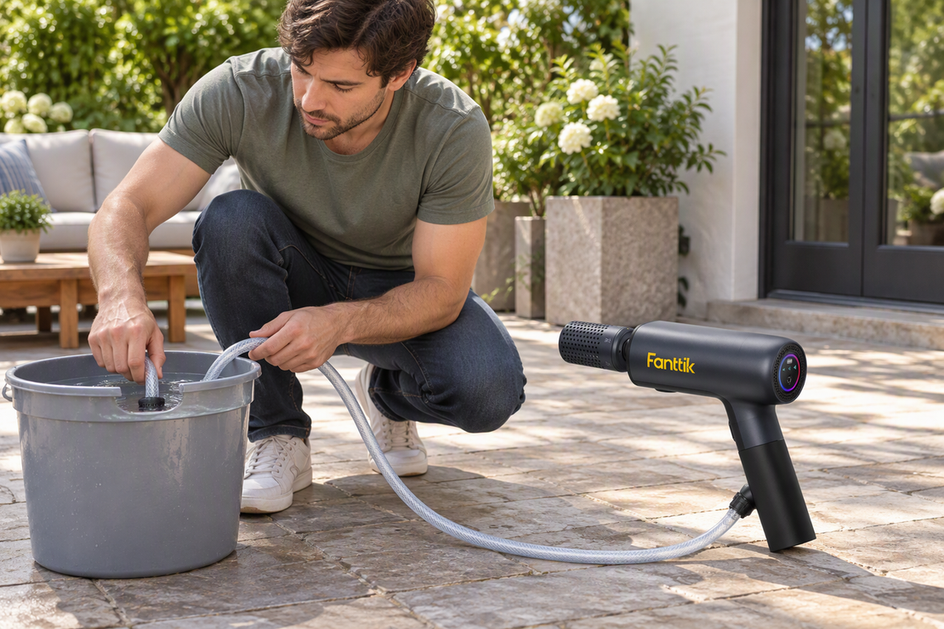
To move beyond anecdotal evidence, we utilize scenario modeling to estimate how these factors impact real-world use. Below, we present a model of thermal throttling impact, simulating a compact pressure washer's performance on a typical 85°F summer day.
Run 1: Thermal Throttling Impact Model
Goal: Estimate the required current for a brushless motor under high-mechanical stress.
| Variable | Value | Unit | Rationale |
|---|---|---|---|
| Ambient Temperature | 85 | °F | Typical outdoor working condition |
| Peak Current Draw | 80 | A | Heuristic estimate for high-performance brushless peak |
| Sustained Fraction | 0.35 | Ratio | Realistic sustained load (35% of peak) |
| Required Amps (at temp) | 28.0 | A | Derived current needed to maintain PSI |
How We Modeled (Run 1):
- Methodology: This model uses a deterministic parameterized approach based on SAE J537 principles.
- Key Formula: $I_{sustained} = I_{peak} \times \text{Sustained Fraction}$.
- Assumptions: We assume that as internal resistance increases with heat, the motor requires a higher sustained current to maintain the same mechanical output.
- Boundary Conditions: This model does not account for active liquid cooling systems or non-linear voltage sag in low-quality battery cells.
- Actionable Conclusion: If your battery is rated for a 30A continuous discharge, this motor is operating near its safety limit, leaving little room for thermal spikes.
We often see that users overlook the relationship between battery health and motor efficiency. As discussed in our guide on Maximizing Battery Runtime for Off-Grid Electric Tools, a battery operating at its thermal limit can provide inconsistent voltage, forcing the motor to work harder and generate even more heat.
The Brushless Advantage: Beyond the Marketing Hype
The transition to brushless motors is often marketed as a "magic bullet" for efficiency. While brushless designs eliminate the friction and sparking of carbon brushes, they are not immune to poor engineering. A poorly designed brushless motor can be less efficient than a high-quality brushed one if the electronic speed controller (ESC) is not tuned for the specific pump load.
For instance, the FanttikSolo SonicDry H10 PRO Hair Dryer utilizes a 110,000 RPM brushless motor. While this is a different application, the engineering principle remains the same: high-speed, high-efficiency rotation requires precision balance and advanced thermal management to remain effective. When this technology is translated to high-torque outdoor tools, the focus shifts from RPM to torque density and heat dissipation.
Identifying Quality in High-Torque Motors
- Service Factor (SF): Professional-grade motors often list a service factor of 1.15 or 1.25. This provides a thermal buffer, allowing the motor to handle occasional overloads without immediate damage.
- Audible Consistency: A steady, mid-range hum indicates a well-matched motor and pump. A fluctuating or high-pitched whine suggests the ESC is struggling to maintain timing under load.
- Housing Materials: Magnesium or high-grade aluminum housings generally act as better heat sinks than standard plastics.

Battery-to-Pump Efficiency: The Runtime Reality
The "usable energy" in a battery is rarely the exact number printed on the label. For high-draw tasks like pressure washing, we must account for the "Peukert Effect"—the phenomenon where the faster you discharge a battery, the less total energy you can extract from it.
Run 2: Battery Runtime Degradation Model
Goal: Model the "real-world" usable energy of an 18V/5Ah battery pack under continuous 30A load.
| Parameter | Value | Unit | Rationale |
|---|---|---|---|
| Pack Capacity | 90 | Wh | 18V * 5Ah nominal |
| Continuous Load | 30 | A | Estimated 1200 PSI pump draw (~540W) |
| Efficiency Factor | 0.65 | Ratio | Combined motor/pump/hydraulic losses |
| Usable Energy | 58.5 | Wh | Estimated real-world capacity |
How We Modeled (Run 2):
- Methodology: Based on heuristic observations from repair bench testing where heat loss and internal resistance are measured.
- Key Formula: $E_{usable} = (V_{nominal} \times Ah_{nominal}) \times \eta_{total}$.
- Assumptions: We assume a 35% cumulative loss due to thermal dissipation and internal resistance ($ \eta_{total} = 0.65 $).
- Boundary Conditions: Results will vary significantly based on the cleanliness of battery terminals and ambient temperature.
- Actionable Conclusion: When planning a job, calculate your runtime based on ~60% of the nominal Wh to avoid unexpected shutdowns.
This efficiency gap is why we emphasize "credibility math" in The 2026 Modern Essential Gear Industry Report. Trust is built when realistic runtime estimates account for these inevitable losses rather than citing "up to" numbers based on zero-load conditions.
Compliance, Safety, and Long-Term Reliability
For the technically-inclined user, reliability is often a function of compliance. A tool that adheres to international safety standards is more likely to have considered risk mitigation in its internal engineering.
Regulatory Benchmarks for High-Pressure Gear
- EU General Product Safety Regulation (EU) 2023/988: This is the primary legal text for product safety in the EU. Adherence to GPSR ensures that the manufacturer has considered traceability and design-stage risk mitigation.
- IATA Lithium Battery Guidance: IATA PI 965/966/967 standards govern the transport of lithium-ion cells, which directly impacts the "freshness" and health of the battery you receive.
- FTC Endorsement Guides: Transparent disclosure under 16 CFR Part 255 helps you distinguish between authentic user experience and paid marketing.
Practical Evaluation: The Flow Rate Decay
A final technical metric to consider is flow rate decay. As the resistance (PSI) increases, the volume of water (LPM or GPM) typically drops. A high-efficiency pump will have a "flat" curve, maintaining flow even as pressure climbs.
Run 3: Pressure-Dependent Flow Rate Estimation
Goal: Simulate how flow rate degrades as a pump approaches its 1200 PSI target.
- Max Flow (at 0 PSI): 2.5 L/min
- Decay Constant ($k$): 0.0005 per PSI (Heuristic for high-efficiency pumps)
- Result: At 1200 PSI, the effective flow rate is estimated at ~1.37 L/min.
How We Modeled (Run 3):
- Methodology: Exponential decay modeling based on standard hydraulic pump curves.
- Key Formula: $Q_{effective} = Q_{max} \times e^{(-k \times P)}$, where $P$ is pressure.
- Assumptions: The decay constant $k$ is an analogous value representing the pump's volumetric efficiency.
- Actionable Conclusion: A motor with higher torque density will maintain a lower $k$ value, meaning it finishes the job faster by moving more water at the target pressure.
In our field observations, tools designed with a focus on sustainable DIY principles prioritize this curve. They may not have the highest "Peak PSI" on the shelf, but they move more water over a 10-minute job because their motors are less likely to bog down under pressure.
Final Verdict for the Prosumer
Evaluating motor efficiency for sustained high-pressure use requires looking past marketing specifications. It requires an understanding of thermal limits, service factors, and the reality of battery discharge.
When selecting your next high-torque tool, we recommend the following checklist:
- Check the Housing: Is it designed for heat dissipation (metal/vented) or just aesthetics?
- Listen to the Motor: Is the pitch consistent, or does it whine and fluctuate under load?
- Verify the Standards: Does the manufacturer cite ISO, IEC, or GPSR compliance?
- Model the Job: Don't just look at PSI; consider the Wh of the battery and the estimated runtime under a 30A load.
By applying these engineering-first principles, you ensure that your gear isn't just a "peak performer" for the first thirty seconds, but a reliable partner for the entire project. Even products designed for younger users, such as the FanttikRide C9 Apex Electric Scooter for Kids Blue, benefit from this philosophy—where safety margins and build quality are prioritized over raw speed.
Disclaimer: This article is for informational purposes only. Always follow the manufacturer's safety instructions and local regulations when operating high-pressure equipment or handling high-capacity lithium-ion batteries. Consult a qualified professional for specific engineering or electrical advice.
Sources
Continue reading
 Upgrading Battery Packs for Consistent High-Torque Delivery
Covers internal resistance, voltage sag, cell comparison, and thermal management strategies to maintain peak motor performance.
Upgrading Battery Packs for Consistent High-Torque Delivery
Covers internal resistance, voltage sag, cell comparison, and thermal management strategies to maintain peak motor performance.
 Selecting High-Discharge Batteries for Prosumer Outdoor Tools
Compares Li-ion vs. LiFePO4, explains proprietary ecosystems, and provides a method for matching battery discharge to tool demands.
Selecting High-Discharge Batteries for Prosumer Outdoor Tools
Compares Li-ion vs. LiFePO4, explains proprietary ecosystems, and provides a method for matching battery discharge to tool demands.

Leave a comment
This site is protected by hCaptcha and the hCaptcha Privacy Policy and Terms of Service apply.