










































The Hidden Physics of Power: Why Amp-Hours Are Not Enough
When you are deep into a demanding outdoor project—perhaps clearing overgrowth with a high-torque trimmer or detailing a fleet of vehicles—the most frustrating failure isn't the tool breaking; it's the battery "stalling." Many prosumers and serious DIYers make the logical but incomplete assumption that a higher Amp-hour (Ah) rating automatically translates to more power. While Ah measures the "fuel tank" size (capacity), it tells you nothing about the "fuel line" diameter (discharge rate).
On our technical support bench, we frequently analyze "voltage sag" events where a high-capacity battery fails to drive a brushless motor under load. The tool triggers thermal protection or simply stops, despite the battery being 80% full. This happens because the battery cannot supply current as fast as the motor demands it. To move from a casual hobbyist to a high-performance prosumer, you must master the relationship between capacity, the C-rating, and continuous discharge current.
Understanding the "C-Rating" and Continuous Discharge
The C-rating is a multiplier that defines how fast a battery can be discharged relative to its maximum capacity. For example, a 1C rating on a 5.0Ah battery means it can safely provide 5 Amps for one hour. However, outdoor tools like chainsaws or high-pressure washers often require 30A to 40A of sustained current.
The Math of Performance
To determine if a battery is suitable for your tool, use the standard engineering heuristic: Continuous Discharge Current (Amps) = Capacity (Ah) × C-rating
If you have a 5.0Ah battery with a low 2C rating, it can only output 10A. Force that battery to power a tool drawing 30A, and you encounter dramatic voltage sag. The internal resistance of the cells creates heat, the voltage drops below the tool’s operating threshold, and the system shuts down. Conversely, a smaller 3.0Ah battery with a high 10C rating can deliver 30A consistently, outperforming the "larger" battery in high-torque applications.
Logic Summary: The 20-30% Headroom Rule Based on our analysis of high-torque motor behavior and thermal data, we recommend selecting a battery where the continuous discharge current exceeds the tool's peak amp draw by a 20-30% margin. This buffer reduces heat buildup and prevents the cells from operating at their absolute limit, which is a primary driver of premature cell degradation.
Internal Resistance and the Mechanism of Voltage Sag
The primary enemy of consistent power delivery is internal resistance (IR). As current flows out of the battery, some energy is lost as heat within the cells themselves. This is governed by Ohm’s Law: $V_{load} = V_{nominal} - (I \times R_{internal})$.
In high-discharge scenarios, a battery with high IR will see its voltage "collapse" under load. This is why professional-grade batteries, such as those discussed in the The 2026 Modern Essential Gear Industry Report, prioritize cell chemistry and interconnect materials that minimize resistance.
Modeling Battery Stress Under Load
To visualize how different batteries handle a high-torque load (like a brushless motor starting under resistance), consider the following scenario model based on standard 18650 cell specifications.
| Parameter | High-Capacity Cell (3500mAh) | High-Discharge Cell (2500mAh) | Unit | Rationale |
|---|---|---|---|---|
| Max Continuous Discharge | 10 | 30 | Amps | Source: Ultraxel 18650 Specs |
| Internal Resistance (Typical) | ~35 | ~15 | mΩ | Standard cell characterization |
| Voltage Drop at 20A Load | 0.70 | 0.30 | Volts | Calculated ($I \times R$) |
| Heat Generation at 20A | 14.0 | 6.0 | Watts | Calculated ($I^2 \times R$) |
| Thermal Runaway Risk | High | Low | Level | Based on heat dissipation rates |
Modeling Note: This is a deterministic scenario model, not a controlled lab study. It assumes an ambient temperature of 25°C and 18650 form-factor cells. Boundary conditions: results may vary if the Battery Management System (BMS) throttles current or if cooling airflow is restricted.
Chemistry Matters: Li-ion vs. LiFePO4
While the Lithium-ion battery is the industry standard for power density, prosumers are increasingly looking at Lithium Iron Phosphate (LiFePO4). For outdoor tools that face extreme temperatures and high-consequence workloads, the trade-offs are worth examining.
- Thermal Stability: LiFePO4 has a thermal runaway onset temperature of over 270°C, compared to approximately 150°C for traditional Li-ion. This makes them significantly safer during high-discharge cycles in summer heat.
- Cycle Life: A typical Li-ion pack provides 500–1,000 cycles. According to Wikipedia's data on Lithium Iron Phosphate, LiFePO4 can reach 2,000–4,000+ cycles, offering a much lower cost-per-use for "monetized prosumers" who use their tools daily.
- Performance Retention: LiFePO4 maintains a flatter discharge curve, meaning the tool's power doesn't drop off as noticeably as the battery empties.
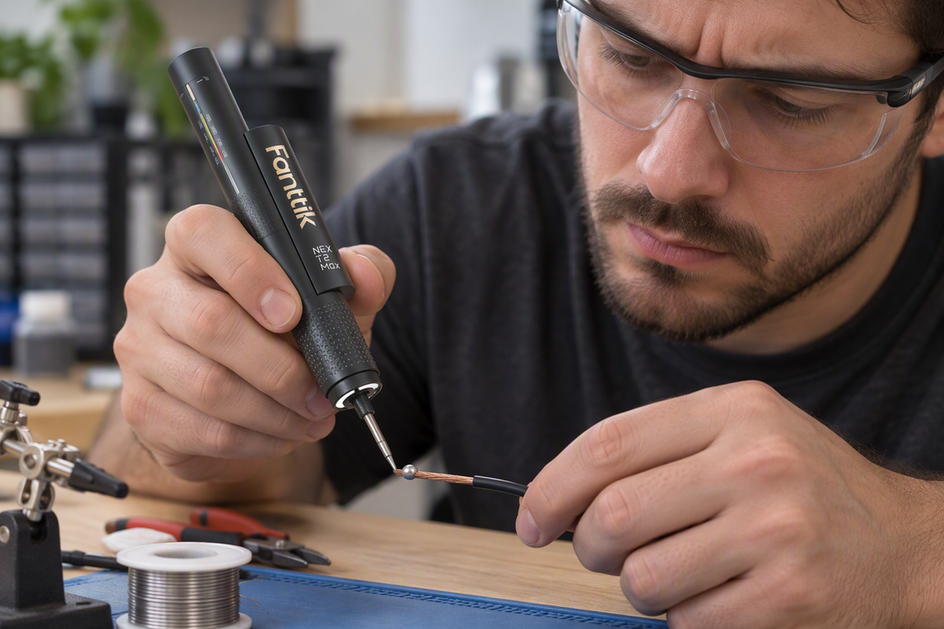
For precision tasks, the stability of the power source is paramount. Tools like the Fanttik K2 Nano 3.7V Precision Power Drill rely on consistent voltage to maintain torque during delicate DIY projects.

Matching the Battery to the Prosumer Type
The term "prosumer" is broad. According to Wikipedia's definition, it ranges from the hobbyist who wants professional results to the entrepreneur monetizing their gear. Your battery choice should reflect your specific "duty cycle."
- The DIY Prosumer (Intermittent High Torque): Needs high peak discharge for tools like chainsaws or impact wrenches that work in short, intense bursts.
- The Monetized Prosumer (Sustained High Current): Needs high continuous discharge and robust thermal management for tools like pressure washers or leaf blowers that run for 20+ minutes at a time.
For those focusing on workshop precision or automotive detailing, the Fanttik F2 PRO Cordless Rotary Tool Kit demonstrates how efficient motor design paired with the right battery can provide 25,000 RPM for sanding and cutting without the bulk of a traditional corded unit.
The Economic Trap of Proprietary Ecosystems
A common mistake is blindly committing to a single brand's battery platform for "interoperability." While convenient, this can lead to an economic trap. Proprietary battery packs often cost 2–3 times more than the actual cells inside.
Experienced prosumers often calculate the "Total Cost of Ownership" (TCO). If a proprietary battery lasts 500 cycles and costs $150, your "power cost" is $0.30 per cycle. A tool with a more open or commonly available interface might allow you to use higher-quality cells at a lower replacement cost. As noted in the The 2026 Modern Essential Gear Industry Report, transparency in battery replacement pathways is a key pillar of long-term brand trust.
Safety, Compliance, and Transport
High-discharge batteries are high-energy devices. When selecting gear, ensure it meets international safety standards. The EU General Product Safety Regulation (EU) 2023/988 mandates strict traceability and safety obligations for manufacturers.
Furthermore, if you travel for projects, you must be aware of IATA Lithium Battery Guidance. Most high-capacity power tool batteries exceed the 100Wh limit for carry-on luggage and require specific packing (PI 965/966/967) for shipping.
Pro-Tip: The 20% Floor
To extend the life of your high-discharge packs, never run them to 0%. Repeated high-discharge cycles below 20% state-of-charge (SOC) accelerate chemical degradation. A practical rule of thumb used on our repair bench is to swap the battery as soon as you notice a slight drop in tool RPM.
For maintenance tasks that require cleanup after a heavy project, using a dedicated tool like the Fanttik Slim V10 Apex Cordless Car Vacuum ensures you aren't wasting your high-torque tool batteries on low-draw tasks, preserving their "high-C" cycles for the work that actually requires them.
Scenario Analysis: Choosing Your Setup
To help you decide, let's look at two common prosumer scenarios.
Scenario A: The Weekend Landscaper (DIY Prosumer)
- Task: Clearing 0.5 acres of brush once a month.
- Requirement: High peak torque for thick branches.
- Recommendation: Prioritize high voltage (e.g., 40V or 60V systems) and high-C rated batteries. A 2.5Ah high-discharge pack is often better than a 5.0Ah "standard" pack because it's lighter and provides the necessary "punch" to prevent the blade from binding.
Scenario B: The Mobile Detailer (Monetized Prosumer)
- Task: Cleaning 5 cars a day using a cordless pressure washer and vacuum.
- Requirement: Long runtime and heat resistance.
- Recommendation: Prioritize capacity (Ah) but ensure the battery has a "Power" or "High Output" designation (indicating better thermal management). Consider LiFePO4 if the tool allows, to maximize the number of daily charge cycles. For interior work, the Fanttik Slim V10 Apex Cordless Car Vacuum is an ideal companion, offering 19,000pa suction without straining your primary power tool batteries.
Maintaining Peak Performance
Even the best battery will fail if the connection is poor. We recommend checking your tool terminals for oxidation regularly. As discussed in our guide on Cleaning Outdoor Appliance Terminals, a small amount of resistance at the connector can mimic the symptoms of a failing battery.
Additionally, managing heat is critical. If you are working in direct sunlight, your battery's internal temperature can skyrocket. Following Battery Cool-Down Periods between heavy uses can double the effective lifespan of your cells.
Final Technical Checklist for Battery Selection
Before your next purchase, run through this checklist to ensure your power source matches your ambition:
- Identify the Peak Amp Draw: Check the tool's manual or look for the "Max Watts" and divide by the voltage ($Amps = Watts / Volts$).
- Calculate the Battery's Limit: Multiply the Ah by the C-rating. If the C-rating isn't listed, look for "High Output" labels which typically indicate 10C or higher.
- Verify Safety Compliance: Ensure the pack has IEC Standards or UL certifications for electrical safety.
- Check for BMS Features: A quality Battery Management System (BMS) is essential. It prevents over-discharge and manages cell balancing. Learn more about how a BMS Extends Tool Life.
- Assess the Environment: If you work in sub-freezing or extreme heat, prioritize chemistries like LiFePO4 or packs with advanced Winter Care Features.
By looking beyond the simple Amp-hour sticker, you can build a tool kit that doesn't just last longer, but performs better under the most grueling conditions. Whether you are using the Fanttik C8 Nano Cordless Electric Scissors for precise cutting or a heavy-duty chainsaw for site clearing, the logic of high-discharge power remains the same: it's not just how much energy you have, but how fast you can use it.
Disclaimer: This article is for informational purposes only and does not constitute professional engineering or safety advice. Always refer to your tool manufacturer's specific battery requirements and local safety regulations. Lithium batteries carry risks of fire and injury if misused or damaged.
References
Continue reading
 Evaluating Motor Efficiency for Sustained High-Pressure Use
A technical guide for DIYers on assessing motor performance and thermal management for sustained high-pressure tool operation.
Evaluating Motor Efficiency for Sustained High-Pressure Use
A technical guide for DIYers on assessing motor performance and thermal management for sustained high-pressure tool operation.
 Preventing Motor Stall During Heavy-Duty Outdoor Projects
Covers BLDC motors, lithium-ion battery synergy, feathering triggers, burden tests, and maintenance for reliable tool performance.
Preventing Motor Stall During Heavy-Duty Outdoor Projects
Covers BLDC motors, lithium-ion battery synergy, feathering triggers, burden tests, and maintenance for reliable tool performance.
Leave a comment
This site is protected by hCaptcha and the hCaptcha Privacy Policy and Terms of Service apply.