










































The Engineering Reality of Vehicle Payload
For the serious overlander, the vehicle is more than a mode of transport; it is a self-contained ecosystem designed to sustain life and mechanical function in remote environments. However, a common point of failure in expedition planning is the misunderstanding of Gross Vehicle Weight Rating (GVWR). While many enthusiasts focus on horsepower or tire clearance, the most critical metric for long-term reliability and safety is the remaining payload after modifications and gear loading.
Exceeding a vehicle's GVWR does not simply result in a "heavy" ride. It leads to accelerated component fatigue, compromised braking distances, and increased rollover risk. To build a truly capable expedition vehicle, one must approach weight management with the precision of an engineer, factoring in not just the obvious additions like steel bumpers, but the cumulative weight of liquids, tools, and "always-packed" base gear.
Deconstructing the GVWR Equation: Curb Weight vs. Reality
The fundamental formula for vehicle capacity is seemingly simple: Payload = GVWR - Curb Weight. However, practitioners often encounter the "Payload Trap" because curb weight is a variable starting point.
Factory-listed curb weights often exclude optional equipment that comes standard on higher trim levels. For example, a base model's weight differs significantly from a premium trim equipped with a hardtop, winch-ready steel bumpers, and advanced safety suites. Based on common patterns from customer support and vehicle modification handling, these factory options can consume 200–300 lbs of payload before a single piece of camping gear is loaded.
The "Always-Packed" Baseline
Before calculating the gear for a specific trip, an overlander must account for the "base load"—the items that rarely leave the vehicle. This includes:
- Auxiliary Fuel and Water: Liquids are among the densest items carried. A full 40-gallon fuel tank adds over 240 lbs (based on a gasoline density of ~6 lbs/gal).
- Recovery Hardware: Winches, mounting plates, and heavy-duty sand tracks.
- Roof-Top Tents (RTT): A standard RTT with an annex can easily exceed 200 lbs, positioned at the highest point of the vehicle.
Logic Summary: Our analysis of payload management assumes that factory curb weight is a "best-case scenario" and that real-world builds start with a 10–15% payload deficit due to factory options and permanent modifications.

The Fluid Factor: Calculating the Weight of Sustenance
Weight management requires a strict accounting of consumables. Unlike static gear, fluids are "live loads" that deplete over time, changing the vehicle's handling characteristics.
| Parameter | Estimated Value | Unit | Rationale / Source |
|---|---|---|---|
| Gasoline Density | ~6.0 | lbs/gal | Standard petroleum heuristic |
| Diesel Density | ~7.1 | lbs/gal | Heavier molecular structure |
| Potable Water | 8.34 | lbs/gal | Physical constant |
| 20L Jerry Can (Full) | ~45 - 50 | lbs | Includes container weight |
| 40-Gallon Fuel Tank | ~240 | lbs | Total liquid weight only |
When a vehicle is fully loaded for a multi-week expedition, the weight of fuel and water alone can represent 20–30% of the total available payload. Experienced practitioners use a heuristic of keeping at least 10–15% of the GVWR in reserve to account for the dynamic stress of off-road terrain, where a fully loaded suspension is more prone to bottoming out and damaging bump stops or shock mounts.
Factoring in Portable Tool Weight and Consolidation
A comprehensive tool kit is non-negotiable for self-sufficiency, yet it is often the most overlooked weight category. Conventional wisdom suggests that a "full" kit is necessary, but reality shows that weights are highly variable and often unlisted on product packaging.
A standard overlanding tool kit, including a high-output portable compressor (~15–20 lbs), a 10-ton bottle jack (~30 lbs), a recovery strap set (~5–10 lbs), and a medium mechanics toolset (~40–50 lbs), can easily surpass 150 lbs. This weight is a significant portion of a vehicle's remaining payload after passengers and fuel are accounted for.
The Benefit of Compact Hardware
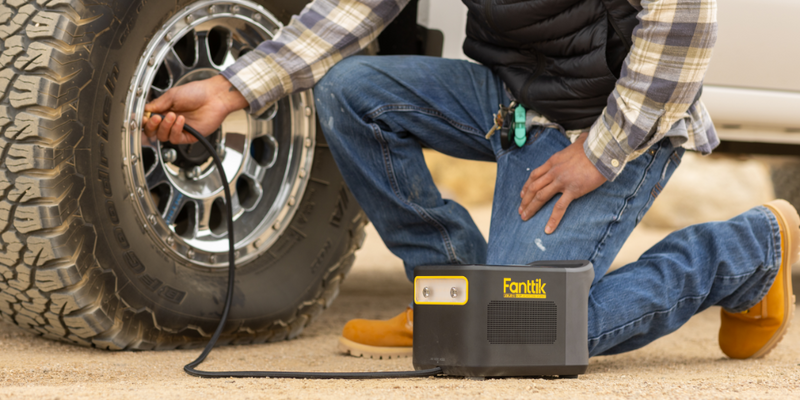
To maintain a safe GVWR, enthusiasts are increasingly moving toward gear consolidation. Selecting compact, multi-functional tools—such as digital portable tire inflators or modular power stations—allows for significant weight savings without sacrificing capability.
For instance, replacing a heavy, hard-mounted air system with a high-performance portable unit can save 10–15 lbs. While this may seem marginal, the cumulative effect of choosing "slim" or "lite" versions of essential gear (like folding chairs or handheld vacuums for cabin maintenance) can recover 50–100 lbs of payload. This recovered weight can then be reallocated to critical safety items or used to maintain the recommended 10% safety buffer.
Dynamic Stability and the Center of Mass
Weight distribution is as vital as total weight. Exceeding the GVWR is a mechanical risk, but poor weight distribution is a dynamic hazard. According to principles of Center of Mass, placing heavy loads high—such as spare tires or fuel cans on a roof rack—dramatically increases the vehicle's "tipping moment."
The Off-Camber Risk
In off-road scenarios, vehicles often operate on side-slopes (off-camber). A vehicle that is within its static GVWR but has a high center of gravity is significantly more likely to roll over than a slightly heavier vehicle with its weight stored low.
Expert Insight: Based on patterns observed in field recoveries, dynamic load shifting from loose tools creates a stability hazard long before the weight limit is breached. A 50 lb toolbox sliding laterally during a maneuver can create a tipping force equivalent to hundreds of pounds of static weight. It is essential to mount heavy recovery gear and tools low in the vehicle, utilizing factory cubbies or floor-mounted drawers, to improve handling and reduce body roll.
Practical Framework for Calculating Total Expedition Weight
To ensure your vehicle remains within legal and mechanical limits, follow this methodical calculation framework.
- Identify True Curb Weight: Do not rely solely on the door sticker. Weigh your vehicle at a certified CAT scale with a full tank of fuel and all permanent modifications (bumpers, winches, racks) but without passengers or removable gear.
- Calculate Occupant Load: Sum the weight of all passengers and pets.
- Inventory Removable Gear: Use a hanging scale to weigh your tool kits, camping gear, and kitchen setups.
- Apply the Liquid Multiplier: Calculate the weight of your water and auxiliary fuel using the density table provided above.
- Audit the Buffer: Subtract the sum of steps 2, 3, and 4 from your remaining payload. If the result is less than 10% of your GVWR, you should consider gear consolidation or removing non-essential items.
Modeling Scenario: The Mid-Size SUV Build
- Vehicle GVWR: 6,000 lbs
- Actual Curb Weight (Modded): 5,100 lbs
- Available Payload: 900 lbs
- Occupants (2 Adults + Gear): 400 lbs
- Tools & Recovery Gear: 150 lbs
- Water & Fuel (20G Total): ~140 lbs
- Remaining Buffer: 210 lbs (3.5% of GVWR)
In this scenario, the vehicle is legally under its limit but lacks a sufficient safety margin for aggressive off-road use. Consolidating the tool kit and opting for lightweight portable electronics could push that buffer back toward the 10% target.

Long-Term Reliability and Trust in Gear
Selecting gear for overlanding is an exercise in "credibility math." As noted in The 2026 Modern Essential Gear Industry Report, the market has shifted toward a "modern self-reliance" identity where trust is the primary advantage. For overlanders, this means choosing tools that offer documented reliability and safety margins.
Whether it is a tire inflator or a power station, the hardware must be engineered with explicit thermal margins and robust documentation. This transparency allows the user to make informed decisions about weight and performance. For example, understanding the exact state-of-charge limits for lithium batteries—as outlined in IATA Lithium Battery Guidance—is crucial for those transporting portable power over long distances or through varying climates.
Summary of Weight Management Best Practices
To maintain vehicle longevity and trail safety, adhere to these core principles:
- Weigh, Don't Guess: Use scales to verify the weight of your "full" kit.
- Store Low: Keep the heaviest items (tools, water, batteries) as close to the floor as possible.
- Consolidate: Prioritize multi-use, compact tools to save weight and space.
- Maintain a Buffer: Aim for a 10–15% payload reserve to handle dynamic stresses.
- Check Compliance: Ensure all portable gear meets relevant safety standards, such as IEC 60529 (IP Codes) for dust and water resistance, which is vital for tools stored in exterior compartments.
By treating GVWR as a hard boundary rather than a suggestion, you protect your vehicle’s suspension, drivetrain, and—most importantly—the safety of your passengers during remote expeditions.
Disclaimer: This article is for informational purposes only. Vehicle modifications and loading can significantly affect handling and safety. Always consult your vehicle's owner manual and a qualified automotive professional before making significant changes to your vehicle's weight or suspension. Calculated weights are estimates based on standard industry heuristics and may vary by specific product or fluid composition.
References
Continue reading
 Payload Audits: Removing Redundant Mass from Your Overlanding Kit
A methodical guide to auditing and removing redundant mass from your overlanding kit to restore vehicle safety margins...
Payload Audits: Removing Redundant Mass from Your Overlanding Kit
A methodical guide to auditing and removing redundant mass from your overlanding kit to restore vehicle safety margins...
 Weight-to-Power Ratios: Evaluating Expedition-Grade Jump Packs
Covers SCP metric, CCA importance, IATA/IEC standards, and payload optimization for selecting reliable emergency power in extreme conditions.
Weight-to-Power Ratios: Evaluating Expedition-Grade Jump Packs
Covers SCP metric, CCA importance, IATA/IEC standards, and payload optimization for selecting reliable emergency power in extreme conditions.

Leave a comment
This site is protected by hCaptcha and the hCaptcha Privacy Policy and Terms of Service apply.